




Sketch and label the Malpighian body.
Answer
 Verified
665.1k+ views
Hint: It is also known as the Renal corpuscle. It allows complete filtration of the blood resulting in the formation of urine.
Complete answer:
1. Bowman’s capsule and glomerulus are together called the Malpighian body. It is part of the structure of nephrons.
2. The glomerulus is a network of capillaries that receives blood from the afferent arteriole and gives it further to the efferent arteriole.
3. The endothelium and basement membrane of the glomerulus and the epithelium of Bowman’s Capsule.
4. The Bowman’s Capsule receives the filtrate from the glomerulus.
5. It is made up of a double layer called the parietal layer and the visceral membrane. The visceral membrane has special cells called the podocytes, that have spaces in between them through which the glomerular filtrate is filtered.
6. The blood comes into the glomerulus through which it is diffused into the Bowman's capsule.
7. Only the smaller solute molecules and water is allowed to pass through the membranes while the blood cells are retained within the glomerulus.
8. Hence, the Malpighian Body allows the filtration of blood so that the waste can be separated from the blood. The filtrate further moves to tubules where fine reabsorption and secretion take place.
Note:
1. Both the kidneys produce approximately 180 liters of filtrate every day.
2. The malpighian body is located in the cortex part of the kidney.
3. Surprisingly, the historic name of the splenic white pulp or the splenic lymphatic nodules is also Malpighian bodies.
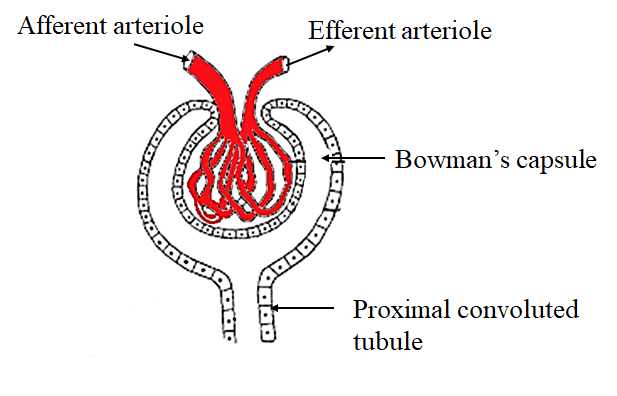
Complete answer:
1. Bowman’s capsule and glomerulus are together called the Malpighian body. It is part of the structure of nephrons.
2. The glomerulus is a network of capillaries that receives blood from the afferent arteriole and gives it further to the efferent arteriole.
3. The endothelium and basement membrane of the glomerulus and the epithelium of Bowman’s Capsule.
4. The Bowman’s Capsule receives the filtrate from the glomerulus.
5. It is made up of a double layer called the parietal layer and the visceral membrane. The visceral membrane has special cells called the podocytes, that have spaces in between them through which the glomerular filtrate is filtered.
6. The blood comes into the glomerulus through which it is diffused into the Bowman's capsule.
7. Only the smaller solute molecules and water is allowed to pass through the membranes while the blood cells are retained within the glomerulus.
8. Hence, the Malpighian Body allows the filtration of blood so that the waste can be separated from the blood. The filtrate further moves to tubules where fine reabsorption and secretion take place.
Note:
1. Both the kidneys produce approximately 180 liters of filtrate every day.
2. The malpighian body is located in the cortex part of the kidney.
3. Surprisingly, the historic name of the splenic white pulp or the splenic lymphatic nodules is also Malpighian bodies.
Recently Updated Pages
Which of the following graphs shows the variation of class 12 physics CBSE

Draw a labelled diagram of the human male reproductive class 12 biology CBSE
Describe the experiment to compare the emf of two cells class 12 physics CBSE
What is standard hydrogen electrode
What is conventional current and electric current class 12 physics CBSE
2Bromopentane is treated with an alcoholic KOH solution class 12 chemistry CBSE
Trending doubts
Draw a labelled sketch of the human eye class 12 physics CBSE
Which are the Top 10 Largest Countries of the World?
A member of Simon commission later became Prime Minister class 12 social science CBSE
Draw ray diagrams each showing i myopic eye and ii class 12 physics CBSE
Differentiate between homogeneous and heterogeneous class 12 chemistry CBSE
Which is the correct genotypic ratio of mendel dihybrid class 12 biology CBSE