




The process of taking in food from the environment is called
A. Ingestion
B. Digestion
C. Assimilation
D. Nutrition
Answer
 Verified
631.5k+ views
Hint: We take food from the environment by ingesting them.
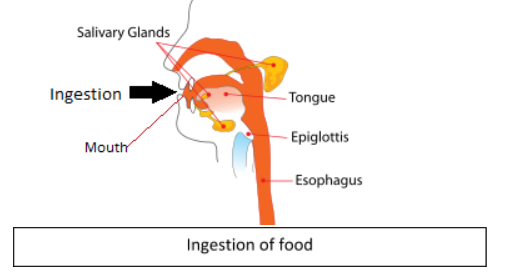
Complete answer:Ingestion is the consumption of a substance from the environment by an organism. In animals, it normally is done by taking in a substance using the mouth and then into the GI (gastrointestinal) tract. It is done through eating or drinking. In some prokaryotes or single-celled organisms, ingestion occurs by absorbing a substance through their cell membranes.
Ingestion is important because by this process nutritional items are taken into the body. The substances nourish the body and upon breakdown of the food, energy is produced.
Besides nutritional items, some other substances may also be ingested: these include medication (oral administration), drugs, and substances considered inedible, such as foreign bodies or pathogens. Ingestion is a common route taken by pathogenic organisms to enter the body. So, the oral area is protected by one of the immunological barriers- mucous barriers. Mucous in the mouth contains some immunoglobulin which protects the oral region.
There are few parts/organs which help in the ingestion process: tongue is a muscle which pushes the ingested food towards teeth. Teeth mechanically process it and shape the food into smaller rounded pieces to be swallowed. In humans and some other animals, ptyalin from the salivary glands is secreted immediately after ingestion. It helps digesting carbohydrates and in further processing of the food.
So, the correct answer is A. ingestion.
Note: After ingestion, the next step is digestion of the ingested items. Digested food particles are assimilated in our system to provide the required nutrition.
Complete answer:Ingestion is the consumption of a substance from the environment by an organism. In animals, it normally is done by taking in a substance using the mouth and then into the GI (gastrointestinal) tract. It is done through eating or drinking. In some prokaryotes or single-celled organisms, ingestion occurs by absorbing a substance through their cell membranes.
Ingestion is important because by this process nutritional items are taken into the body. The substances nourish the body and upon breakdown of the food, energy is produced.
Besides nutritional items, some other substances may also be ingested: these include medication (oral administration), drugs, and substances considered inedible, such as foreign bodies or pathogens. Ingestion is a common route taken by pathogenic organisms to enter the body. So, the oral area is protected by one of the immunological barriers- mucous barriers. Mucous in the mouth contains some immunoglobulin which protects the oral region.
There are few parts/organs which help in the ingestion process: tongue is a muscle which pushes the ingested food towards teeth. Teeth mechanically process it and shape the food into smaller rounded pieces to be swallowed. In humans and some other animals, ptyalin from the salivary glands is secreted immediately after ingestion. It helps digesting carbohydrates and in further processing of the food.
So, the correct answer is A. ingestion.
Note: After ingestion, the next step is digestion of the ingested items. Digested food particles are assimilated in our system to provide the required nutrition.
Recently Updated Pages
Master Class 11 English: Engaging Questions & Answers for Success

Master Class 11 Social Science: Engaging Questions & Answers for Success
Master Class 11 Maths: Engaging Questions & Answers for Success
Master Class 11 Biology: Engaging Questions & Answers for Success
Master Class 11 Physics: Engaging Questions & Answers for Success
Master Class 11 Chemistry: Engaging Questions & Answers for Success
Trending doubts
Explain the Treaty of Vienna of 1815 class 10 social science CBSE
What is the full form of POSCO class 10 social science CBSE
Define Potential, Developed, Stock and Reserved resources
The diagonals of a rhombus are 10cm and 24cm Find the class 10 maths CBSE
Fill the blanks with proper collective nouns 1 A of class 10 english CBSE
One number is chosen from numbers 1 to 200 Find the class 10 maths CBSE