




The functional group which is found in amino acid is
(A) $COOH$
(B) $N{H_3}$
(C) $C{H_3}$
(D) Both (A) and (B)
Answer
 Verified
593.1k+ views
Hint: Amino acids are the bifunctional organic compounds that have more than two groups present on the side chain with carbon as the central atom. The main elements other than carbon in the amino acids are Nitrogen, Oxygen, and Hydrogen.
Complete step by step solution:
Amino acids are the basic unit of protein. Proteins are formed when a long polymer chain of amino acids is formed.
Generally, an amino acid consists of an amine group and a carboxyl group, and other functional groups, depending on the structure of the acid.
The main functional group which is present in amino acids is \[COOH\;\;\] (carboxyl group) and $N{H_3}$ (amine group).
Every amino acid is formed in such a way that it has a central carbon with hydrogen and an R group. It varies for every amino acid.
A single (aliphatic) carbon binds all of these groups. The carbon which gets attached directly to the carboxyl group is given the alpha position, so all the amino acids in proteins are referred to as alpha-amino acids.
The General structure of amino acid is given as:
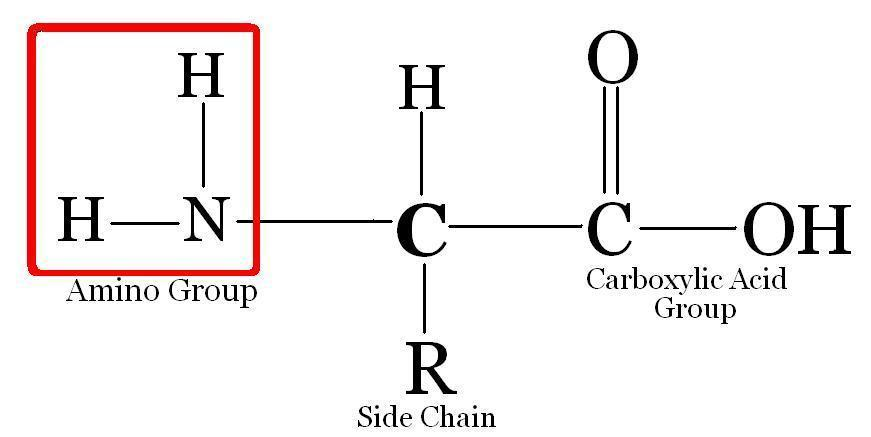
Hence, Option, ‘(D) Both (A) and (B)’ is the correct answer.
Note: An Amino acid can be identified with the presence of a carboxyl group and an amine group along with an R group. These are classified into acidic, basic, and neutral. It depends upon the number of \[COOH\;\;\] groups and $N{H_3}$ group present in the molecule i.e. if there are more carboxyl groups then the molecule is acidic and if there are more number of amine groups than the carboxyl group then it is basic. Amino acids are also classified as Essential and Non-Essential amino acids. The amino acids that can be produced in the human body are Non-Essential amino acids and those that cannot be produced in the human body are called essential amino acids. These amino acids are needed to be taken through food.
Complete step by step solution:
Amino acids are the basic unit of protein. Proteins are formed when a long polymer chain of amino acids is formed.
Generally, an amino acid consists of an amine group and a carboxyl group, and other functional groups, depending on the structure of the acid.
The main functional group which is present in amino acids is \[COOH\;\;\] (carboxyl group) and $N{H_3}$ (amine group).
Every amino acid is formed in such a way that it has a central carbon with hydrogen and an R group. It varies for every amino acid.
A single (aliphatic) carbon binds all of these groups. The carbon which gets attached directly to the carboxyl group is given the alpha position, so all the amino acids in proteins are referred to as alpha-amino acids.
The General structure of amino acid is given as:
Hence, Option, ‘(D) Both (A) and (B)’ is the correct answer.
Note: An Amino acid can be identified with the presence of a carboxyl group and an amine group along with an R group. These are classified into acidic, basic, and neutral. It depends upon the number of \[COOH\;\;\] groups and $N{H_3}$ group present in the molecule i.e. if there are more carboxyl groups then the molecule is acidic and if there are more number of amine groups than the carboxyl group then it is basic. Amino acids are also classified as Essential and Non-Essential amino acids. The amino acids that can be produced in the human body are Non-Essential amino acids and those that cannot be produced in the human body are called essential amino acids. These amino acids are needed to be taken through food.
Recently Updated Pages
Master Class 12 Economics: Engaging Questions & Answers for Success

Master Class 12 English: Engaging Questions & Answers for Success
Master Class 12 Social Science: Engaging Questions & Answers for Success
Master Class 12 Maths: Engaging Questions & Answers for Success
Master Class 12 Physics: Engaging Questions & Answers for Success
Master Class 11 Social Science: Engaging Questions & Answers for Success
Trending doubts
One Metric ton is equal to kg A 10000 B 1000 C 100 class 11 physics CBSE
Difference Between Prokaryotic Cells and Eukaryotic Cells
Find the value of the expression given below sin 30circ class 11 maths CBSE
Two of the body parts which do not appear in MRI are class 11 biology CBSE
Draw a diagram of nephron and explain its structur class 11 biology CBSE
10 examples of friction in our daily life