




The CSA of a right circular cylinder of height \[14{\text{ cm}}\] is \[{\text{88 c}}{{\text{m}}^2}\]. Find the radius of the base of the cylinder.
Answer
 Verified
597.6k+ views
Hint: Here we will use the formula of CSA (Curved surface area) of the cylinder for calculating the radius of the cylinder which equals to as below:
\[{\text{Curved surface area}} = 2\pi rh\]
Where \[r\] is known as the radius of the base of the cylinder, \[h\] is the height of the cylinder.
Complete step-by-step solution:
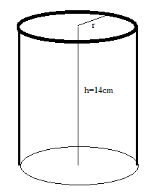
Step 1: From the below diagram we can see that the height of the cylinder is given which is \[14{\text{ cm}}\] and \[r\] is the radius of the base of the cylinder.
\[{\text{Curved surface area}} = 88{\text{ c}}{{\text{m}}^2}\]
Step 2: Now, by using the formula of the curved surface area of the cylinder and by substituting the values of \[h = 14{\text{ cm}}\]and \[\pi = \dfrac{{22}}{7}\] , and \[{\text{Curved surface area}} = 88{\text{ c}}{{\text{m}}^2}\], we get:
\[88{\text{ c}}{{\text{m}}^2} = 2 \times \dfrac{{22}}{7} \times r \times 14{\text{ cm}}\] ……………. (1)
By dividing \[14\] with \[7\] into the RHS side of the expression (1), we get:
\[ \Rightarrow 88{\text{ c}}{{\text{m}}^2} = 2 \times 22 \times r \times 2{\text{ cm}}\]
By bringing all the terms of the RHS side into the LHS side in the expression \[88 = 2 \times 22 \times r \times 2\] , we get:
\[ \Rightarrow \dfrac{{88{\text{ c}}{{\text{m}}^2}}}{{2 \times 22 \times 2{\text{ cm}}}} = r\]
By dividing into the LHS side we get:
\[ \Rightarrow 1{\text{ cm}} = r\]
\[\therefore \] The radius of the base of the cylinder is equal to \[1{\text{ cm}}\]
Note: Students need to remember some basic formulas for finding surface areas of the cylinder because there are two types of area, one is a Curved surface area and the second is the Total surface area. The formulas for finding both is given below:
\[{\text{Curved surface area}} = 2\pi rh\]
The total surface area of the cylinder\[ = 2\pi r\left( {r + h} \right)\], where \[r\] is known as the radius of the base of the cylinder, \[h\] is the height of the cylinder.
Similarly, the formula for finding the volume of the cylinder is as below:
\[{\text{Volume of the cylinder}} = \pi {r^2}h\]
\[{\text{Curved surface area}} = 2\pi rh\]
Where \[r\] is known as the radius of the base of the cylinder, \[h\] is the height of the cylinder.
Complete step-by-step solution:
Step 1: From the below diagram we can see that the height of the cylinder is given which is \[14{\text{ cm}}\] and \[r\] is the radius of the base of the cylinder.
\[{\text{Curved surface area}} = 88{\text{ c}}{{\text{m}}^2}\]
Step 2: Now, by using the formula of the curved surface area of the cylinder and by substituting the values of \[h = 14{\text{ cm}}\]and \[\pi = \dfrac{{22}}{7}\] , and \[{\text{Curved surface area}} = 88{\text{ c}}{{\text{m}}^2}\], we get:
\[88{\text{ c}}{{\text{m}}^2} = 2 \times \dfrac{{22}}{7} \times r \times 14{\text{ cm}}\] ……………. (1)
By dividing \[14\] with \[7\] into the RHS side of the expression (1), we get:
\[ \Rightarrow 88{\text{ c}}{{\text{m}}^2} = 2 \times 22 \times r \times 2{\text{ cm}}\]
By bringing all the terms of the RHS side into the LHS side in the expression \[88 = 2 \times 22 \times r \times 2\] , we get:
\[ \Rightarrow \dfrac{{88{\text{ c}}{{\text{m}}^2}}}{{2 \times 22 \times 2{\text{ cm}}}} = r\]
By dividing into the LHS side we get:
\[ \Rightarrow 1{\text{ cm}} = r\]
\[\therefore \] The radius of the base of the cylinder is equal to \[1{\text{ cm}}\]
Note: Students need to remember some basic formulas for finding surface areas of the cylinder because there are two types of area, one is a Curved surface area and the second is the Total surface area. The formulas for finding both is given below:
\[{\text{Curved surface area}} = 2\pi rh\]
The total surface area of the cylinder\[ = 2\pi r\left( {r + h} \right)\], where \[r\] is known as the radius of the base of the cylinder, \[h\] is the height of the cylinder.
Similarly, the formula for finding the volume of the cylinder is as below:
\[{\text{Volume of the cylinder}} = \pi {r^2}h\]
Recently Updated Pages
Master Class 11 English: Engaging Questions & Answers for Success

Master Class 11 Maths: Engaging Questions & Answers for Success
Class 11 Question and Answer - Your Ultimate Solutions Guide
Master Class 11 Biology: Engaging Questions & Answers for Success
Master Class 11 Physics: Engaging Questions & Answers for Success
Master Class 11 Accountancy: Engaging Questions & Answers for Success
Trending doubts
Explain the Treaty of Vienna of 1815 class 10 social science CBSE
Who Won 36 Oscar Awards? Record Holder Revealed
What is the median of the first 10 natural numbers class 10 maths CBSE
Why is it 530 pm in india when it is 1200 afternoon class 10 social science CBSE
Why is there a time difference of about 5 hours between class 10 social science CBSE
What is the full form of POSCO class 10 social science CBSE