




The cost of painting the total outside surface of a closed cylindrical oil tank at 60 paise per sq. dm is Rs. 237.60. The height of the tank is 6 times the radius of the base of the tank. Find its volume correct to two decimal places.
Answer
 Verified
658.2k+ views
Hint: First of all find the outer surface by dividing the total cost of the painting by cost per sq. dm. Then use the formula of the total surface area of the cylinder that is \[2\pi r\left( r+h \right)\] to find the radius and height of the tank. Use this radius and height to find the volume that is \[\pi {{r}^{2}}h\].
Complete step-by-step answer:
We are given that the cost of painting the total outside surface of the closed cylindrical oil tank at 60 paise per sq. dm is Rs. 237.60. Also, the height of the tank is 6 times the radius of the base of the tank. We have to find the volume of the cylinder.
Let us consider the cylindrical tank diagrammatically.
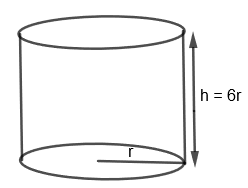
Let us consider the total outside surface area of the cylindrical tank as S \[\text{d}{{\text{m}}^{2}}\].
We are given that the cost of painting per sq dm = 60 paise
So, we get the cost of painting the total outside surface area of the cylinder (S) = 60 S paise
We know that 1 paise \[=\text{Rs}\text{.}\dfrac{1}{100}\]
So, we get, 60 S paise \[=\text{Rs}\text{.}\dfrac{60S}{100}\]
Also, we are given that the total cost of the painting = Rs. 237.60
So, we get,
\[\text{Rs}\text{.}\dfrac{60S}{100}=\text{Rs}.237.6\]
By multiplying \[\dfrac{100}{60}\] on both the sides, we get,
\[S=\left( \dfrac{100}{60} \right)\times \left( 237.6 \right)\]
\[S=396\text{ }d{{m}^{2}}\]
Now, we know that the surface area of the cylinder \[=2\pi r\left( r+h \right)\] where r and h are the radius and height of the cylinder respectively.
We are given that the height is 6 times the radius of the base of the tank. So, we get,
h = 6r
So, we get the total outer surface area of the tank \[=2\pi r\left( r+6r \right)\]
\[\begin{align}
& =2\pi r.7r \\
& =14\pi {{r}^{2}} \\
\end{align}\]
We have already found that the total outer surface area of the tank \[=396\text{ d}{{\text{m}}^{2}}\]. So, we get,
\[14\pi {{r}^{2}}=396\text{ d}{{\text{m}}^{2}}\]
Or, \[{{r}^{2}}=\dfrac{396}{14\pi }\]
By substituting \[\pi =\dfrac{22}{7}\], we get,
\[{{r}^{2}}=\dfrac{396\times 7}{14\times 22}\]
By simplifying the above equation, we get,
\[{{r}^{2}}=9\]
By taking square root on both the sides, we get,
\[r=\sqrt{9}=3\text{ dm}\]
So, we get, h = 6r = 6 x 3 = 18 dm.
Now, we know that the volume of the cylinder \[=\pi {{r}^{2}}h\]
So, we also get the volume of the cylindrical tank \[=\pi {{r}^{2}}h\]
By substituting r = 3 dm and h = 18 dm, we get,
The volume of the cylindrical tank \[=\left( \dfrac{22}{7} \right)\left( {{3}^{2}} \right)\left( 18 \right)\]
\[=\dfrac{22}{7}\times 9\times 18\]
\[=509.14\text{ d}{{\text{m}}^{3}}\]
Hence, we get the volume of the cylindrical tank as \[509.14\text{ d}{{\text{m}}^{3}}\].
Note: In this question, students often make mistakes in the conversion of units and sometimes even forget to convert one unit into another. So, these mistakes must be avoided and students should properly consider the units as well with magnitudes of each quantity. Also, students must remember the basic conversions like Re. 1 = 100 paise.
Complete step-by-step answer:
We are given that the cost of painting the total outside surface of the closed cylindrical oil tank at 60 paise per sq. dm is Rs. 237.60. Also, the height of the tank is 6 times the radius of the base of the tank. We have to find the volume of the cylinder.
Let us consider the cylindrical tank diagrammatically.
Let us consider the total outside surface area of the cylindrical tank as S \[\text{d}{{\text{m}}^{2}}\].
We are given that the cost of painting per sq dm = 60 paise
So, we get the cost of painting the total outside surface area of the cylinder (S) = 60 S paise
We know that 1 paise \[=\text{Rs}\text{.}\dfrac{1}{100}\]
So, we get, 60 S paise \[=\text{Rs}\text{.}\dfrac{60S}{100}\]
Also, we are given that the total cost of the painting = Rs. 237.60
So, we get,
\[\text{Rs}\text{.}\dfrac{60S}{100}=\text{Rs}.237.6\]
By multiplying \[\dfrac{100}{60}\] on both the sides, we get,
\[S=\left( \dfrac{100}{60} \right)\times \left( 237.6 \right)\]
\[S=396\text{ }d{{m}^{2}}\]
Now, we know that the surface area of the cylinder \[=2\pi r\left( r+h \right)\] where r and h are the radius and height of the cylinder respectively.
We are given that the height is 6 times the radius of the base of the tank. So, we get,
h = 6r
So, we get the total outer surface area of the tank \[=2\pi r\left( r+6r \right)\]
\[\begin{align}
& =2\pi r.7r \\
& =14\pi {{r}^{2}} \\
\end{align}\]
We have already found that the total outer surface area of the tank \[=396\text{ d}{{\text{m}}^{2}}\]. So, we get,
\[14\pi {{r}^{2}}=396\text{ d}{{\text{m}}^{2}}\]
Or, \[{{r}^{2}}=\dfrac{396}{14\pi }\]
By substituting \[\pi =\dfrac{22}{7}\], we get,
\[{{r}^{2}}=\dfrac{396\times 7}{14\times 22}\]
By simplifying the above equation, we get,
\[{{r}^{2}}=9\]
By taking square root on both the sides, we get,
\[r=\sqrt{9}=3\text{ dm}\]
So, we get, h = 6r = 6 x 3 = 18 dm.
Now, we know that the volume of the cylinder \[=\pi {{r}^{2}}h\]
So, we also get the volume of the cylindrical tank \[=\pi {{r}^{2}}h\]
By substituting r = 3 dm and h = 18 dm, we get,
The volume of the cylindrical tank \[=\left( \dfrac{22}{7} \right)\left( {{3}^{2}} \right)\left( 18 \right)\]
\[=\dfrac{22}{7}\times 9\times 18\]
\[=509.14\text{ d}{{\text{m}}^{3}}\]
Hence, we get the volume of the cylindrical tank as \[509.14\text{ d}{{\text{m}}^{3}}\].
Note: In this question, students often make mistakes in the conversion of units and sometimes even forget to convert one unit into another. So, these mistakes must be avoided and students should properly consider the units as well with magnitudes of each quantity. Also, students must remember the basic conversions like Re. 1 = 100 paise.
Recently Updated Pages
Master Class 11 English: Engaging Questions & Answers for Success

Master Class 11 Social Science: Engaging Questions & Answers for Success
Master Class 11 Maths: Engaging Questions & Answers for Success
Master Class 11 Biology: Engaging Questions & Answers for Success
Master Class 11 Physics: Engaging Questions & Answers for Success
Master Class 11 Chemistry: Engaging Questions & Answers for Success
Trending doubts
Explain the Treaty of Vienna of 1815 class 10 social science CBSE
What is the full form of POSCO class 10 social science CBSE
Define Potential, Developed, Stock and Reserved resources
The diagonals of a rhombus are 10cm and 24cm Find the class 10 maths CBSE
Fill the blanks with proper collective nouns 1 A of class 10 english CBSE
What planets have no moons Which one has only one moon class 10 physics CBSE