



The central angle of a semicircle is:
A. ${{90}^{\circ }}$
B. ${{270}^{\circ }}$
C. ${{180}^{\circ }}$
D. ${{360}^{\circ }}$
Answer
 Verified
536.4k+ views
Hint: For solving this question you should know about the figure and area of a semicircle. A complete circle contains two semicircles in it. And we can prove it by an example. And then we can also find that the central angle of a semicircle is exactly half of the centre of a circle. So, for this we will prove the half area.
Complete step by step answer:
According to our question it is asked of us to find the central angle of a semicircle. So, if we take a circle with a radius of 7m and we see the diagram for this, then:
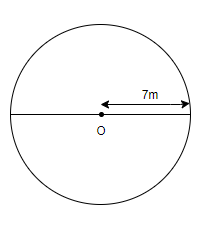
The circle’s centre is a point where the angle is ${{360}^{\circ }}$. But if we see a semicircle, then:
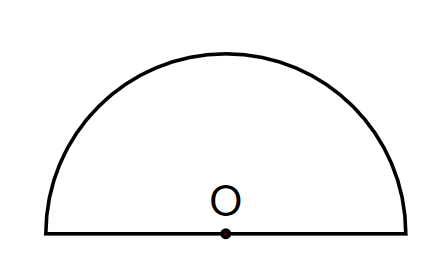
Here the centre is on a straight line and the angle on any point of a straight line is always ${{180}^{\circ }}$. So, the angle is ${{180}^{\circ }}$. And if we look for the areas of semicircle and circle, then:
It is given that the radius of the circle is 7m. So, we know that the area of a circle is calculated by $\pi {{r}^{2}}$.
Thus the area of a whole circle is:
$\begin{align}
& A=\pi {{\left( 7 \right)}^{2}} \\
& \Rightarrow A=49\pi \\
& \Rightarrow A=49\times \dfrac{22}{7} \\
& \Rightarrow A=154{{m}^{2}} \\
\end{align}$
So, the area of the whole circle is $154{{m}^{2}}$.
We know that, to calculate the area of a semicircle, it is half of the whole circle. So, we can calculate it by the formula $\dfrac{1}{2}\pi {{r}^{2}}$. The radius for the semicircle is 7m.
So, the area of the semicircle is:
$\begin{align}
& A'=\dfrac{1}{2}\pi {{r}^{2}} \\
& \Rightarrow A'=\dfrac{1}{2}\times \pi \times {{\left( 7 \right)}^{2}} \\
& \Rightarrow A'=77{{m}^{2}} \\
\end{align}$
So, the area of the semicircle is exactly half of the whole circle and it is $77{{m}^{2}}$.
So, the correct answer is “Option C”.
Note: The area of a semicircle is half the area of a circle of the same radius and a circle contains two semicircles in its area. We can directly do half of the complete area of the circle to calculate the area of a semicircle. And it is mandatory that the area will be of the same radius circle and semicircle of same radius.
Complete step by step answer:
According to our question it is asked of us to find the central angle of a semicircle. So, if we take a circle with a radius of 7m and we see the diagram for this, then:
The circle’s centre is a point where the angle is ${{360}^{\circ }}$. But if we see a semicircle, then:
Here the centre is on a straight line and the angle on any point of a straight line is always ${{180}^{\circ }}$. So, the angle is ${{180}^{\circ }}$. And if we look for the areas of semicircle and circle, then:
It is given that the radius of the circle is 7m. So, we know that the area of a circle is calculated by $\pi {{r}^{2}}$.
Thus the area of a whole circle is:
$\begin{align}
& A=\pi {{\left( 7 \right)}^{2}} \\
& \Rightarrow A=49\pi \\
& \Rightarrow A=49\times \dfrac{22}{7} \\
& \Rightarrow A=154{{m}^{2}} \\
\end{align}$
So, the area of the whole circle is $154{{m}^{2}}$.
We know that, to calculate the area of a semicircle, it is half of the whole circle. So, we can calculate it by the formula $\dfrac{1}{2}\pi {{r}^{2}}$. The radius for the semicircle is 7m.
So, the area of the semicircle is:
$\begin{align}
& A'=\dfrac{1}{2}\pi {{r}^{2}} \\
& \Rightarrow A'=\dfrac{1}{2}\times \pi \times {{\left( 7 \right)}^{2}} \\
& \Rightarrow A'=77{{m}^{2}} \\
\end{align}$
So, the area of the semicircle is exactly half of the whole circle and it is $77{{m}^{2}}$.
So, the correct answer is “Option C”.
Note: The area of a semicircle is half the area of a circle of the same radius and a circle contains two semicircles in its area. We can directly do half of the complete area of the circle to calculate the area of a semicircle. And it is mandatory that the area will be of the same radius circle and semicircle of same radius.
Recently Updated Pages
Three beakers labelled as A B and C each containing 25 mL of water were taken A small amount of NaOH anhydrous CuSO4 and NaCl were added to the beakers A B and C respectively It was observed that there was an increase in the temperature of the solutions contained in beakers A and B whereas in case of beaker C the temperature of the solution falls Which one of the following statements isarecorrect i In beakers A and B exothermic process has occurred ii In beakers A and B endothermic process has occurred iii In beaker C exothermic process has occurred iv In beaker C endothermic process has occurred

Master Class 9 Social Science: Engaging Questions & Answers for Success
Master Class 9 Science: Engaging Questions & Answers for Success
Master Class 9 Maths: Engaging Questions & Answers for Success
Master Class 9 General Knowledge: Engaging Questions & Answers for Success
Class 9 Question and Answer - Your Ultimate Solutions Guide
Three beakers labelled as A B and C each containing 25 mL of water were taken A small amount of NaOH anhydrous CuSO4 and NaCl were added to the beakers A B and C respectively It was observed that there was an increase in the temperature of the solutions contained in beakers A and B whereas in case of beaker C the temperature of the solution falls Which one of the following statements isarecorrect i In beakers A and B exothermic process has occurred ii In beakers A and B endothermic process has occurred iii In beaker C exothermic process has occurred iv In beaker C endothermic process has occurred
Master Class 9 Social Science: Engaging Questions & Answers for Success
Master Class 9 Science: Engaging Questions & Answers for Success
Trending doubts
Find the sum of series 1 + 2 + 3 + 4 + 5 + + 100 class 9 maths CBSE
What is the Full Form of ISI and RAW
Fill the blanks with the suitable prepositions 1 The class 9 english CBSE
Difference Between Plant Cell and Animal Cell
What is pollution? How many types of pollution? Define it
Which are the Top 10 Largest States of India?