




State true or false.
In any quadrilateral, if a pair of opposite sides is equal, then it is a parallelogram.
A. TRUE
B. FALSE
Answer
 Verified
592.8k+ views
Hint: We use the property of parallelogram that in a parallelogram opposite sides are equal and parallel to each other and check if the statement satisfies the property.
Complete step-by-step answer:
We know a parallelogram is a quadrilateral having four sides and four angles. The pair of opposite sides of a parallelogram are parallel and equal to each other, since we have four sides therefore we have two pairs of equal and parallel sides in a parallelogram. We can draw a parallelogram ABCD with sides \[AB,BC,CD,DA\] and angles \[\angle A,\angle B,\angle C,\angle D\]
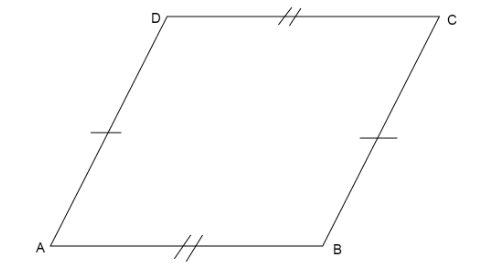
Now we can write the set of parallel lines in the parallelogram as \[AB\parallel CD,BC\parallel DA\].
Also, pairs of equal lines in parallelogram are\[AB = CD,{\text{BC = }}DA\]
If a quadrilateral has one pair of sides equal then it does not imply the quadrilateral is a parallelogram because we don’t know if the pair of sides given equal is parallel or not.
Also, we know nothing about the second pair of lines which could be not equal or not parallel in nature so the figure could be of any form be it a trapezium( which has only one pair of parallel lines).
Therefore, the statement given in the question is FALSE.
So, option B is correct.
Note: Students might make the mistake of assuming from the word parallelogram that one side must be parallel to the other side which is wrong because to be a parallelogram a quadrilateral has to have both pairs of opposite sides equal and parallel.
Keep in mind in this question we are not given any pair of lines parallel so don’t assume an equal set of lines as a parallel set of lines.
Complete step-by-step answer:
We know a parallelogram is a quadrilateral having four sides and four angles. The pair of opposite sides of a parallelogram are parallel and equal to each other, since we have four sides therefore we have two pairs of equal and parallel sides in a parallelogram. We can draw a parallelogram ABCD with sides \[AB,BC,CD,DA\] and angles \[\angle A,\angle B,\angle C,\angle D\]
Now we can write the set of parallel lines in the parallelogram as \[AB\parallel CD,BC\parallel DA\].
Also, pairs of equal lines in parallelogram are\[AB = CD,{\text{BC = }}DA\]
If a quadrilateral has one pair of sides equal then it does not imply the quadrilateral is a parallelogram because we don’t know if the pair of sides given equal is parallel or not.
Also, we know nothing about the second pair of lines which could be not equal or not parallel in nature so the figure could be of any form be it a trapezium( which has only one pair of parallel lines).
Therefore, the statement given in the question is FALSE.
So, option B is correct.
Note: Students might make the mistake of assuming from the word parallelogram that one side must be parallel to the other side which is wrong because to be a parallelogram a quadrilateral has to have both pairs of opposite sides equal and parallel.
Keep in mind in this question we are not given any pair of lines parallel so don’t assume an equal set of lines as a parallel set of lines.
Recently Updated Pages
Master Class 9 General Knowledge: Engaging Questions & Answers for Success

Master Class 9 Social Science: Engaging Questions & Answers for Success
Master Class 9 English: Engaging Questions & Answers for Success
Master Class 9 Maths: Engaging Questions & Answers for Success
Master Class 9 Science: Engaging Questions & Answers for Success
Class 9 Question and Answer - Your Ultimate Solutions Guide
Trending doubts
Difference Between Plant Cell and Animal Cell
Fill the blanks with the suitable prepositions 1 The class 9 english CBSE
Who is eligible for RTE class 9 social science CBSE
Which places in India experience sunrise first and class 9 social science CBSE
What is pollution? How many types of pollution? Define it
Name 10 Living and Non living things class 9 biology CBSE