



Show that (x-1) is the factor of $ ({x^3} - 7{x^2} + 14x - 8)$ . Hence, completely factorise the given expression.
Answer
 Verified
538.5k+ views
Hint: In this problem cubic expression is given. It is asked to find out if the given (x-1) is a factor of the equation or not. Basically, when (x-1) factorises the equation completely then the remainder will be zero. So using long division we can find other roots.
Factorization: Factors of a number are numbers that divide evenly into another number. Factorization writes a number as the product of smaller numbers.
Complete step by step solution:
Given, expression $ ({x^3} - 7{x^2} + 14x - 8)$ .
TO check whether (x-1) is a factor of the given equation or not we need to equate the factor to zero.
It means (x-1) =0
Here it gives x=1.
Putting x=1 in the given expression we get
$
= ({x^3} - 7{x^2} + 14x - 8) \\
\Rightarrow {(1)^3} - 7{(1)^2} + 14(1) - 8 \\
\Rightarrow 1 - 7 + 14 - 8 = 0 \\
$
This shows that (x-1) is the factor of $ ({x^3} - 7{x^2} + 14x - 8)$ .
Now by using long division method
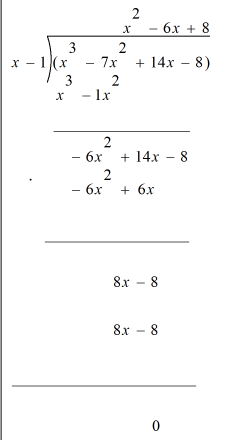
Now we have two factors $ (x - 1)\,and\,({x^2} - 6x + 8)$
To factorise completely, Let
$
f(x) = ({x^3} - 7{x^2} + 14x - 8) \\
\Rightarrow (x - 1)({x^2} - 6x + 8) \\
\Rightarrow (x - 1)({x^2} - 2x - 4x + 8) \\
$
By further simplifying we get
$
f(x) = (x - 1)[x(x - 2) - 4(x - 2)] \\
\Rightarrow (x - 1)(x - 2)(x - 4) \\
$
It is the complete factorisation of the given problem.
Note:
> Try to read the problem stepwise. Follow the procedure of long division step by step to get the solution. This is the prominent and errorless way to solve the problem.
> Retrace the solution to check if it is correct or not. We can equate all the terms to zero and put it in the given expression and get the idea of roots x = 1, 2, 4.
> We can also solve this question by using trial and error methods. we can assume some value for x at which the whole equation will be zero. then we can find all values of x and then form an equation by using them.
Factorization: Factors of a number are numbers that divide evenly into another number. Factorization writes a number as the product of smaller numbers.
Complete step by step solution:
Given, expression $ ({x^3} - 7{x^2} + 14x - 8)$ .
TO check whether (x-1) is a factor of the given equation or not we need to equate the factor to zero.
It means (x-1) =0
Here it gives x=1.
Putting x=1 in the given expression we get
$
= ({x^3} - 7{x^2} + 14x - 8) \\
\Rightarrow {(1)^3} - 7{(1)^2} + 14(1) - 8 \\
\Rightarrow 1 - 7 + 14 - 8 = 0 \\
$
This shows that (x-1) is the factor of $ ({x^3} - 7{x^2} + 14x - 8)$ .
Now by using long division method
Now we have two factors $ (x - 1)\,and\,({x^2} - 6x + 8)$
To factorise completely, Let
$
f(x) = ({x^3} - 7{x^2} + 14x - 8) \\
\Rightarrow (x - 1)({x^2} - 6x + 8) \\
\Rightarrow (x - 1)({x^2} - 2x - 4x + 8) \\
$
By further simplifying we get
$
f(x) = (x - 1)[x(x - 2) - 4(x - 2)] \\
\Rightarrow (x - 1)(x - 2)(x - 4) \\
$
It is the complete factorisation of the given problem.
Note:
> Try to read the problem stepwise. Follow the procedure of long division step by step to get the solution. This is the prominent and errorless way to solve the problem.
> Retrace the solution to check if it is correct or not. We can equate all the terms to zero and put it in the given expression and get the idea of roots x = 1, 2, 4.
> We can also solve this question by using trial and error methods. we can assume some value for x at which the whole equation will be zero. then we can find all values of x and then form an equation by using them.
Recently Updated Pages
Master Class 10 Computer Science: Engaging Questions & Answers for Success

Master Class 10 General Knowledge: Engaging Questions & Answers for Success
Master Class 10 English: Engaging Questions & Answers for Success
Master Class 10 Social Science: Engaging Questions & Answers for Success
Master Class 10 Maths: Engaging Questions & Answers for Success
Master Class 10 Science: Engaging Questions & Answers for Success
Trending doubts
Find the sum of series 1 + 2 + 3 + 4 + 5 + + 100 class 9 maths CBSE
Fill the blanks with the suitable prepositions 1 The class 9 english CBSE
Difference Between Plant Cell and Animal Cell
What is pollution? How many types of pollution? Define it
Name 10 Living and Non living things class 9 biology CBSE
Which are the Top 10 Largest States of India?