




Prove that the external bisector of an angle of triangle divides the opposite side externally in the ratio to the sides containing the angle.
Answer
 Verified
553.5k+ views
Hint: The given question is a named theorem called the angle bisector theorem. The angle bisector theorem is defined for internal angles and also external angles.
Here, we are asked to prove the external angle bisector theorem.
Let us consider $\Delta ABC$ where $AD$ is the external bisector. The angle bisector is nothing but a line or line segment which divides the angle into two equal parts.
Now, we need to prove that the external bisector of an angle of a triangle divides the opposite side externally in the ratio to the sides containing the angle.
Complete step-by-step solution:
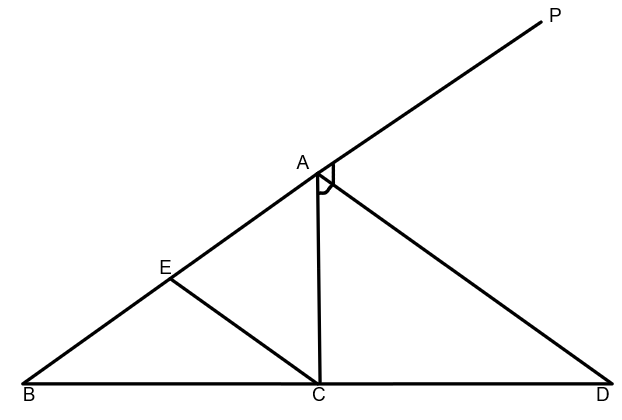
From the given information, let $AD$ be the external bisector of $\Delta BAC$ which intersects $BC$ produced at $D$ .
To verify:
$\dfrac{{BD}}{{DC}} = \dfrac{{AB}}{{AC}}$
Now, draw $CE\parallel DA$ meeting $AB$ at $E$ .
Since $CE\parallel DA$ and $AC$ is a transversal, we get $\angle ECA = \angle CAD$..\[\left( 1 \right)\]
Where, $\angle ECA$ and $\angle CAD$ are alternate angles again, $CE$ is parallel to $DA$ and $BP$ is a transversal, so
$\angle CEA = \angle DAP$…..\[\left( 2 \right)\]
Where, $\angle CEA$ and $\angle DAP$ are corresponding angles,
Since $AD$ is the bisector of $\angle CAP$ ,
$\angle CAD = \angle DAP$ … \[\left( 3 \right)\]
We know that, the sides opposite to equal angles are equal, by using this statement and also from\[\left( 1 \right)\],\[\left( 2 \right)\] and \[\left( 3 \right)\]
We have
$\angle CEA = \angle ECA$
Also, $EC\parallel AD$ in $\angle BDA$, so we have
$\dfrac{{BD}}{{DC}} = \dfrac{{BA}}{{AE}}$ (By Thales theorem)
And we know, $\angle CEA = \angle ECA \Rightarrow AE=AC$
Substituting $AE = AC$ in the above equation, we get
$\dfrac{{BD}}{{DC}} = \dfrac{{BA}}{{AC}}$ which is the required result.
Hence the theorem is proved.
Note: Thales theorem is introduced by Thales which is also called basic proportionality theorem; and this theorem proved that the ratio of any two corresponding sides is always same for any two equiangular triangles.
If an internal angle bisector theorem is asked to prove, follow the same procedure as we did for the external angle bisector theorem.
Here, we are asked to prove the external angle bisector theorem.
Let us consider $\Delta ABC$ where $AD$ is the external bisector. The angle bisector is nothing but a line or line segment which divides the angle into two equal parts.
Now, we need to prove that the external bisector of an angle of a triangle divides the opposite side externally in the ratio to the sides containing the angle.
Complete step-by-step solution:
From the given information, let $AD$ be the external bisector of $\Delta BAC$ which intersects $BC$ produced at $D$ .
To verify:
$\dfrac{{BD}}{{DC}} = \dfrac{{AB}}{{AC}}$
Now, draw $CE\parallel DA$ meeting $AB$ at $E$ .
Since $CE\parallel DA$ and $AC$ is a transversal, we get $\angle ECA = \angle CAD$..\[\left( 1 \right)\]
Where, $\angle ECA$ and $\angle CAD$ are alternate angles again, $CE$ is parallel to $DA$ and $BP$ is a transversal, so
$\angle CEA = \angle DAP$…..\[\left( 2 \right)\]
Where, $\angle CEA$ and $\angle DAP$ are corresponding angles,
Since $AD$ is the bisector of $\angle CAP$ ,
$\angle CAD = \angle DAP$ … \[\left( 3 \right)\]
We know that, the sides opposite to equal angles are equal, by using this statement and also from\[\left( 1 \right)\],\[\left( 2 \right)\] and \[\left( 3 \right)\]
We have
$\angle CEA = \angle ECA$
Also, $EC\parallel AD$ in $\angle BDA$, so we have
$\dfrac{{BD}}{{DC}} = \dfrac{{BA}}{{AE}}$ (By Thales theorem)
And we know, $\angle CEA = \angle ECA \Rightarrow AE=AC$
Substituting $AE = AC$ in the above equation, we get
$\dfrac{{BD}}{{DC}} = \dfrac{{BA}}{{AC}}$ which is the required result.
Hence the theorem is proved.
Note: Thales theorem is introduced by Thales which is also called basic proportionality theorem; and this theorem proved that the ratio of any two corresponding sides is always same for any two equiangular triangles.
If an internal angle bisector theorem is asked to prove, follow the same procedure as we did for the external angle bisector theorem.
Recently Updated Pages
Master Class 11 English: Engaging Questions & Answers for Success

Master Class 11 Social Science: Engaging Questions & Answers for Success
Master Class 11 Maths: Engaging Questions & Answers for Success
Master Class 11 Biology: Engaging Questions & Answers for Success
Master Class 11 Physics: Engaging Questions & Answers for Success
Master Class 11 Chemistry: Engaging Questions & Answers for Success
Trending doubts
Explain the Treaty of Vienna of 1815 class 10 social science CBSE
What is the full form of CNG A Complete Natural Gas class 10 social science CBSE
In cricket, what is a "Yorker" designed to do?
What is the full form of POSCO class 10 social science CBSE
Define Potential, Developed, Stock and Reserved resources
What were the majoritarian measures taken in Sri Lanka class 10 social science CBSE