




What can population pyramids tell us?
Answer
 Verified
560.1k+ views
Hint: Population pyramid is a graphical representation of a population in a particular area which includes details like age groups of both the male and female populations. The graph has a line drawn in the center to indicate the separation of female from male population. Demographers use population pyramids to study populations on different basis.
Complete answer:
Population pyramids tell us about the birth and death rate of the population and about the age and gender of people. It gives us information about the number of dependents. People aged below $15$ are young dependents whereas people aged above $65$ are senior dependents.
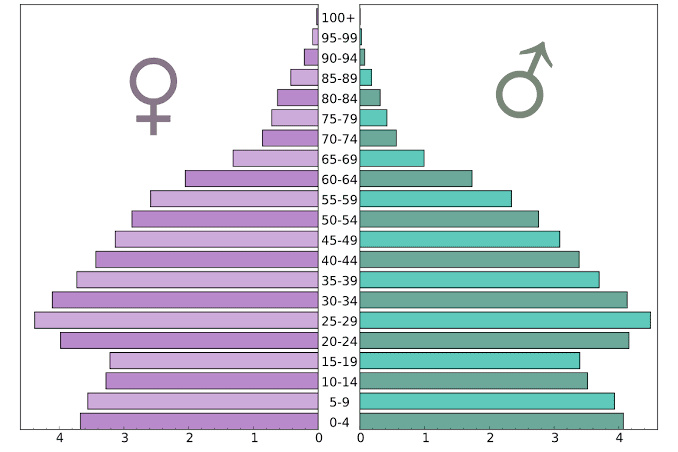
There are five stages in a population pyramid:
1. High fluctuation is the first stage in the population pyramid. They have bases which are wide and tops that are narrow. This shows that there are more young people than elderly ones.
2. The second stage is expanding early. At this stage, the birth rate is higher than the death rate.
3. Late expansion is the third stage in the population pyramid. The base starts to become narrow as the pyramid becomes stable.
4. The fourth stage in the pyramid is low fluctuating. At this stage, the death rate is higher than the birth rate.
5. In the final stage of the population pyramid, the population is dominated by the elderly people. This stage is known as natural decrease.
Note:
Population pyramids are also known as age-sex pyramids. It is of three types: expansive population pyramids, constrictive population pyramids and stationary population pyramids. The population pyramid speaks about death rate and birth rate. It also shows the development and stability of a country or a particular area.
Complete answer:
Population pyramids tell us about the birth and death rate of the population and about the age and gender of people. It gives us information about the number of dependents. People aged below $15$ are young dependents whereas people aged above $65$ are senior dependents.
There are five stages in a population pyramid:
1. High fluctuation is the first stage in the population pyramid. They have bases which are wide and tops that are narrow. This shows that there are more young people than elderly ones.
2. The second stage is expanding early. At this stage, the birth rate is higher than the death rate.
3. Late expansion is the third stage in the population pyramid. The base starts to become narrow as the pyramid becomes stable.
4. The fourth stage in the pyramid is low fluctuating. At this stage, the death rate is higher than the birth rate.
5. In the final stage of the population pyramid, the population is dominated by the elderly people. This stage is known as natural decrease.
Note:
Population pyramids are also known as age-sex pyramids. It is of three types: expansive population pyramids, constrictive population pyramids and stationary population pyramids. The population pyramid speaks about death rate and birth rate. It also shows the development and stability of a country or a particular area.
Recently Updated Pages
Which of the following graphs shows the variation of class 12 physics CBSE

Draw a labelled diagram of the human male reproductive class 12 biology CBSE
Describe the experiment to compare the emf of two cells class 12 physics CBSE
What is standard hydrogen electrode
What is conventional current and electric current class 12 physics CBSE
2Bromopentane is treated with an alcoholic KOH solution class 12 chemistry CBSE
Trending doubts
Draw a labelled sketch of the human eye class 12 physics CBSE
Which are the Top 10 Largest Countries of the World?
A member of Simon commission later became Prime Minister class 12 social science CBSE
Differentiate between homogeneous and heterogeneous class 12 chemistry CBSE
Draw ray diagrams each showing i myopic eye and ii class 12 physics CBSE
Which is the correct genotypic ratio of mendel dihybrid class 12 biology CBSE