




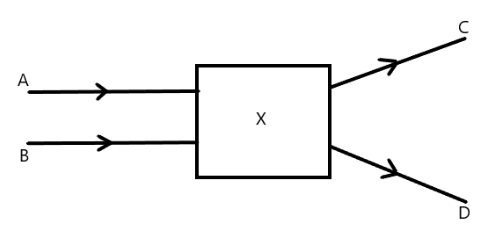
Light rays A and B fall on an optical component X and come out as C and D. The optical component is
A. Concave
B. Convex
C. Prism
D. None of these.
Answer
 Verified
573.6k+ views
Hint:The lens which generally diverges incident rays on them is known as a concave lens. The lens which converges incident rays of light is known as a convex lens. An arrangement that splits a single ray of light incident on them into several wavelengths is called prism. As you can see from the diagram given above, A and B are two incident rays falling on an unknown component X. Also you can see from the above diagram rays C and D getting diverged from the initial direction of incident rays. Using this information, we can find out the correct answer.
Complete step by step answer:
As the rays in the given diagram diverge and we know that the component which diverges incident rays falling on them from their initial direction is known as a concave lens, thus the given component in the above diagram is a concave lens.
Hence option A is the correct answer.
Note:A lens is a combination of two curved mirrors that diverts the incident light from its path, An incident ray undergoes refraction twice, once while entering the lens and then while leaving the lens. There are mainly two types of lenses – concave lens and convex lens. Both of them have different properties so they refract the light in different ways. The image of the object placed depends on the position of the object.
Complete step by step answer:
As the rays in the given diagram diverge and we know that the component which diverges incident rays falling on them from their initial direction is known as a concave lens, thus the given component in the above diagram is a concave lens.
Hence option A is the correct answer.
Note:A lens is a combination of two curved mirrors that diverts the incident light from its path, An incident ray undergoes refraction twice, once while entering the lens and then while leaving the lens. There are mainly two types of lenses – concave lens and convex lens. Both of them have different properties so they refract the light in different ways. The image of the object placed depends on the position of the object.
Recently Updated Pages
Basicity of sulphurous acid and sulphuric acid are

Master Class 10 English: Engaging Questions & Answers for Success
Master Class 10 Social Science: Engaging Questions & Answers for Success
Master Class 10 Computer Science: Engaging Questions & Answers for Success
Class 10 Question and Answer - Your Ultimate Solutions Guide
Master Class 10 General Knowledge: Engaging Questions & Answers for Success
Trending doubts
Who is known as the "Little Master" in Indian cricket history?
A boat goes 24 km upstream and 28 km downstream in class 10 maths CBSE
State and explain Ohms law class 10 physics CBSE
Distinguish between soap and detergent class 10 chemistry CBSE
a Why did Mendel choose pea plants for his experiments class 10 biology CBSE
Draw the diagram of the sectional view of the human class 10 biology CBSE