




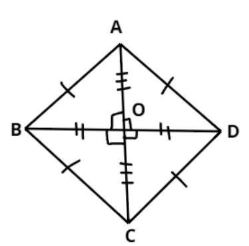
In the rhombus ABCD, show that $4{\left( {AB} \right)^2} = {\left( {AC} \right)^2} + {\left( {BD} \right)^2}$
Answer
 Verified
622.5k+ views
Hint – Take any one of the four triangles and apply PGT in it after using the few properties of the Rhombus, that is diagonals are perpendicular bisectors of each other and all sides are equal.
ABCD rhombus is shown above.
As we know in rhombus diagonals bisect each other and are perpendicular to each other.
$
\Rightarrow OB = OD,{\text{ & }}OA = OC..................\left( 1 \right) \\
\angle AOB = \angle AOD = \angle BOC = \angle DOC = {90^0} \\
$
And also we know that all the sides of the rhombus are equal.
$ \Rightarrow AB = BC = CD = DA$………………. (2)
So in triangle AOB apply Pythagoras Theorem
${\left( {{\text{Hypotenuse}}} \right)^2} = {\left( {{\text{Perpendicular}}} \right)^2} + {\left( {{\text{Base}}} \right)^2}$
$ \Rightarrow {\left( {AB} \right)^2} = {\left( {OA} \right)^2} + {\left( {OB} \right)^2}$…………. (3)
Now from figure $AC = OA + OC,{\text{ }}BD = BO + OD$
From equation (2)
$
AC = OA + OA,{\text{ }}BD = OB + OB \\
\Rightarrow OA = \dfrac{{AC}}{2},{\text{ }}OB = \dfrac{{BD}}{2} \\
$
Now from equation (3)
$
\Rightarrow {\left( {AB} \right)^2} = {\left( {\dfrac{{AC}}{2}} \right)^2} + {\left( {\dfrac{{BD}}{2}} \right)^2} \\
\Rightarrow {\left( {AB} \right)^2} = \dfrac{{{{\left( {AC} \right)}^2}}}{4} + \dfrac{{{{\left( {BD} \right)}^2}}}{4} \\
\Rightarrow 4{\left( {AB} \right)^2} = {\left( {AC} \right)^2} + {\left( {BD} \right)^2} \\
$
Hence Proved.
Note – In such types of questions the key concept we have to remember is that always recall the condition of Rhombus which is stated above in equation (1) and (2), then use the property of Pythagoras theorem which is also stated above and simplify according to properties of rhombus, we will get the required result.
ABCD rhombus is shown above.
As we know in rhombus diagonals bisect each other and are perpendicular to each other.
$
\Rightarrow OB = OD,{\text{ & }}OA = OC..................\left( 1 \right) \\
\angle AOB = \angle AOD = \angle BOC = \angle DOC = {90^0} \\
$
And also we know that all the sides of the rhombus are equal.
$ \Rightarrow AB = BC = CD = DA$………………. (2)
So in triangle AOB apply Pythagoras Theorem
${\left( {{\text{Hypotenuse}}} \right)^2} = {\left( {{\text{Perpendicular}}} \right)^2} + {\left( {{\text{Base}}} \right)^2}$
$ \Rightarrow {\left( {AB} \right)^2} = {\left( {OA} \right)^2} + {\left( {OB} \right)^2}$…………. (3)
Now from figure $AC = OA + OC,{\text{ }}BD = BO + OD$
From equation (2)
$
AC = OA + OA,{\text{ }}BD = OB + OB \\
\Rightarrow OA = \dfrac{{AC}}{2},{\text{ }}OB = \dfrac{{BD}}{2} \\
$
Now from equation (3)
$
\Rightarrow {\left( {AB} \right)^2} = {\left( {\dfrac{{AC}}{2}} \right)^2} + {\left( {\dfrac{{BD}}{2}} \right)^2} \\
\Rightarrow {\left( {AB} \right)^2} = \dfrac{{{{\left( {AC} \right)}^2}}}{4} + \dfrac{{{{\left( {BD} \right)}^2}}}{4} \\
\Rightarrow 4{\left( {AB} \right)^2} = {\left( {AC} \right)^2} + {\left( {BD} \right)^2} \\
$
Hence Proved.
Note – In such types of questions the key concept we have to remember is that always recall the condition of Rhombus which is stated above in equation (1) and (2), then use the property of Pythagoras theorem which is also stated above and simplify according to properties of rhombus, we will get the required result.
Recently Updated Pages
Master Class 10 Computer Science: Engaging Questions & Answers for Success

Master Class 10 General Knowledge: Engaging Questions & Answers for Success
Master Class 10 English: Engaging Questions & Answers for Success
Master Class 10 Social Science: Engaging Questions & Answers for Success
Master Class 10 Maths: Engaging Questions & Answers for Success
Master Class 10 Science: Engaging Questions & Answers for Success
Trending doubts
What is the median of the first 10 natural numbers class 10 maths CBSE
Which women's tennis player has 24 Grand Slam singles titles?
Who is the Brand Ambassador of Incredible India?
Why is there a time difference of about 5 hours between class 10 social science CBSE
Write a letter to the principal requesting him to grant class 10 english CBSE
A moving boat is observed from the top of a 150 m high class 10 maths CBSE