




In the refining of silver, the recovery of silver from silver nitrate solution involved displacement by copper metal. Write down the chemical reaction involved.
Answer
 Verified
650.7k+ views
Hint: It is given that the displacement reaction is taking place so, to write the reaction involved, we can use the fact that a highly reactive metal can displace less reactive metal ion in a displacement reaction. To identify which metal is more reactive, reactivity series can be used.
Complete answer:
The reactivity series is:
Potassium (K)
Sodium (Na)
Calcium (Ca)
Magnesium (Mg)
Aluminium (Al)
Zinc (Zn)
Iron (Fe)
Tin (Sn)
Lead (Pb)
Copper (Cu)
Silver (Ag)
Gold (Au)
Platinum (Pt)
As we move down the series, the reactivity decreases.
When we compare silver (Ag) and copper (Cu):
Cu is more reactive than Ag as it lies above it.
The reaction taking place in refining can be given as:
Reactants:
Silver nitrate $\left[ {AgN{O_3}} \right]$ reacts with Copper metal [Cu].
Products:
Silver metal [Ag] (refined) and Copper nitrate $\left[ {CuN{O_3}} \right]$ (ion exchange)
Reaction:
$AgN{O_3}_{(aq)} + C{u_{(s)}} \to A{g_{(s)}} + CuN{O_3}_{(aq)}$
Here, (aq) means aqueous (dissolved in water)
Balancing the reaction:
$2AgN{O_3}_{(aq)} + C{u_{(s)}} \to 2A{g_{(s)}} + Cu{\left( {N{O_3}} \right)_2}_{(aq)}$
In balancing we equate the number of molecules of an element present on the reactant side equal to the product side.
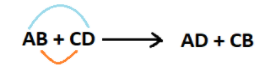
Here, in the reaction, Copper (Cu) is displacing Silver from its nitrate solution $\left( {AgN{O_3}} \right)$ as it is more reactive compared to silver. Copper itself forms a compound by reacting with nitrate $\left( {N{O_3}} \right)$ and refined silver metal is obtained as another product.
Nitrate with silver forms $AgN{O_3}$ but with copper forms $Cu{\left( {N{O_3}} \right)_2}$ because valency of both silver and nitrate is 1 but that of copper is 2 and during the formation of compound the valencies are exchanges, so that 2 of copper’s valency goes to nitrate and it becomes ${\left( {N{O_3}} \right)_2}$
It can be stated that when the metallic copper is dissolved in silver nitrate solution during the recovery of silver, copper nitrate is formed, whereas silver is precipitated as metallic silver.
Therefore, the required reaction for given way of refining of silver is $2AgN{O_3}_{(aq)} + C{u_{(s)}} \to 2A{g_{(s)}} + Cu{\left( {N{O_3}} \right)_2}_{(aq)}$
Note: Displacement of metal ions by highly reactive metal can be learnt and observed with the help of activity series. The metal placed above can easily displace the metal placed below in the series as reactivity decreases moving downwards.
Complete answer:
The reactivity series is:
Potassium (K)
Sodium (Na)
Calcium (Ca)
Magnesium (Mg)
Aluminium (Al)
Zinc (Zn)
Iron (Fe)
Tin (Sn)
Lead (Pb)
Copper (Cu)
Silver (Ag)
Gold (Au)
Platinum (Pt)
As we move down the series, the reactivity decreases.
When we compare silver (Ag) and copper (Cu):
Cu is more reactive than Ag as it lies above it.
The reaction taking place in refining can be given as:
Reactants:
Silver nitrate $\left[ {AgN{O_3}} \right]$ reacts with Copper metal [Cu].
Products:
Silver metal [Ag] (refined) and Copper nitrate $\left[ {CuN{O_3}} \right]$ (ion exchange)
Reaction:
$AgN{O_3}_{(aq)} + C{u_{(s)}} \to A{g_{(s)}} + CuN{O_3}_{(aq)}$
Here, (aq) means aqueous (dissolved in water)
Balancing the reaction:
$2AgN{O_3}_{(aq)} + C{u_{(s)}} \to 2A{g_{(s)}} + Cu{\left( {N{O_3}} \right)_2}_{(aq)}$
In balancing we equate the number of molecules of an element present on the reactant side equal to the product side.
Here, in the reaction, Copper (Cu) is displacing Silver from its nitrate solution $\left( {AgN{O_3}} \right)$ as it is more reactive compared to silver. Copper itself forms a compound by reacting with nitrate $\left( {N{O_3}} \right)$ and refined silver metal is obtained as another product.
Nitrate with silver forms $AgN{O_3}$ but with copper forms $Cu{\left( {N{O_3}} \right)_2}$ because valency of both silver and nitrate is 1 but that of copper is 2 and during the formation of compound the valencies are exchanges, so that 2 of copper’s valency goes to nitrate and it becomes ${\left( {N{O_3}} \right)_2}$
It can be stated that when the metallic copper is dissolved in silver nitrate solution during the recovery of silver, copper nitrate is formed, whereas silver is precipitated as metallic silver.
Therefore, the required reaction for given way of refining of silver is $2AgN{O_3}_{(aq)} + C{u_{(s)}} \to 2A{g_{(s)}} + Cu{\left( {N{O_3}} \right)_2}_{(aq)}$
Note: Displacement of metal ions by highly reactive metal can be learnt and observed with the help of activity series. The metal placed above can easily displace the metal placed below in the series as reactivity decreases moving downwards.
Recently Updated Pages
Write any three differences between metals and nonmetals class 10 social science CBSE

Amit standing on a horizontal plane finds a bird flying class 10 maths CBSE
Two circles of radii 5 cm and 3 cm intersect at two class 10 maths CBSE
Solve the following i John and Jivanti together have class 10 maths CBSE
What is the relation between orthocenter circumcentre class 10 maths CBSE
Two plane mirrors are inclined at 70circ A ray incident class 10 physics CBSE
Trending doubts
Which country is known as "The land of Fire and Ice"?
1 GB equals how many MB?
Which is the hottest planet in the Solar system A Earth class 10 social science CBSE
Name any four life processes in living things class 10 biology CBSE
Choose the feminine form of the given noun Fox AFoxess class 10 english CBSE
In which year voting age was reduced from 21 to 18?