




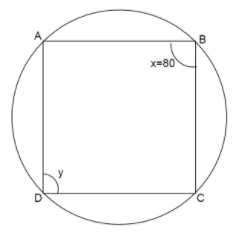
In the given figure, the points A, B, C, D are concyclic, when \[x = {80^ \circ }, z = y - {20^ \circ }\] then \[z = ?\]
A. \[{100^ \circ }\]
B. \[{80^ \circ }\]
C. \[{40^ \circ }\]
D. \[{140^ \circ }\]
Answer
 Verified
604.2k+ views
Hint: We use the property of concyclic points that they all lie on the circle and joining these points forms a quadrilateral. Using the property of the sum of opposite interior angles of a quadrilateral we calculate the value of y and substitute in to find the value of z.
Complete step-by-step answer:
We know points \[A,B,C,D\] are concyclic, which means they all lie on the circle.
Now joining the points on the circle we can form a quadrilateral \[ABCD\].
From the property of opposite angles in a quadrilateral we know that the sum of opposite pairs of angles in a quadrilateral is equal to \[{180^ \circ }\].
Now from the diagram we see that pairs of opposite angles are \[\angle ADC,\angle ABC\] and \[\angle BCD,\angle BAD\].
Now we will consider the set of opposite angles \[\angle ADC,\angle ABC\].
So, using the property we can write
\[ \Rightarrow \angle ADC + \angle ABC = {180^ \circ }\]
We know the value of \[\angle ADC = y,\angle ABC = {80^ \circ }\]
\[ \Rightarrow y + {80^ \circ } = {180^ \circ }\]
Shift all constant terms in degree to the right hand side of the equation.
\[
\Rightarrow y = {180^ \circ } - {80^ \circ } \\
\Rightarrow y = {100^ \circ } \\
\]
Therefore the value of \[\angle ADC = {100^ \circ }\]
Now we have to find the value of \[z\] from the equation \[z = y - {20^ \circ }\]
We will substitute the value of \[y = {100^ \circ }\] in the equation.
\[ \Rightarrow z = {100^ \circ } - {20^ \circ } = {80^ \circ }\]
Therefore, value of \[z = {80^ \circ }\]
So, the correct answer is “Option B”.
Note: Students many times make the mistake of writing the final answer as the value of y as in figure there is no mention of z, so they look at the variable and write its value, but keep in mind the question is asking for the value of z. Many students write their final answer without a degree sign, always writing the symbol along with the value.
Complete step-by-step answer:
We know points \[A,B,C,D\] are concyclic, which means they all lie on the circle.
Now joining the points on the circle we can form a quadrilateral \[ABCD\].
From the property of opposite angles in a quadrilateral we know that the sum of opposite pairs of angles in a quadrilateral is equal to \[{180^ \circ }\].
Now from the diagram we see that pairs of opposite angles are \[\angle ADC,\angle ABC\] and \[\angle BCD,\angle BAD\].
Now we will consider the set of opposite angles \[\angle ADC,\angle ABC\].
So, using the property we can write
\[ \Rightarrow \angle ADC + \angle ABC = {180^ \circ }\]
We know the value of \[\angle ADC = y,\angle ABC = {80^ \circ }\]
\[ \Rightarrow y + {80^ \circ } = {180^ \circ }\]
Shift all constant terms in degree to the right hand side of the equation.
\[
\Rightarrow y = {180^ \circ } - {80^ \circ } \\
\Rightarrow y = {100^ \circ } \\
\]
Therefore the value of \[\angle ADC = {100^ \circ }\]
Now we have to find the value of \[z\] from the equation \[z = y - {20^ \circ }\]
We will substitute the value of \[y = {100^ \circ }\] in the equation.
\[ \Rightarrow z = {100^ \circ } - {20^ \circ } = {80^ \circ }\]
Therefore, value of \[z = {80^ \circ }\]
So, the correct answer is “Option B”.
Note: Students many times make the mistake of writing the final answer as the value of y as in figure there is no mention of z, so they look at the variable and write its value, but keep in mind the question is asking for the value of z. Many students write their final answer without a degree sign, always writing the symbol along with the value.
Recently Updated Pages
Basicity of sulphurous acid and sulphuric acid are

Master Class 10 English: Engaging Questions & Answers for Success
Master Class 10 Social Science: Engaging Questions & Answers for Success
Master Class 10 Computer Science: Engaging Questions & Answers for Success
Class 10 Question and Answer - Your Ultimate Solutions Guide
Master Class 10 General Knowledge: Engaging Questions & Answers for Success
Trending doubts
Which country won the ICC Men's ODI World Cup in 2023?
In cricket, how many legal balls are there in a standard over?
Explain the Treaty of Vienna of 1815 class 10 social science CBSE
A boat goes 24 km upstream and 28 km downstream in class 10 maths CBSE
What does "powerplay" mean in limited-overs cricket?
What is the "Powerplay" in T20 cricket?