




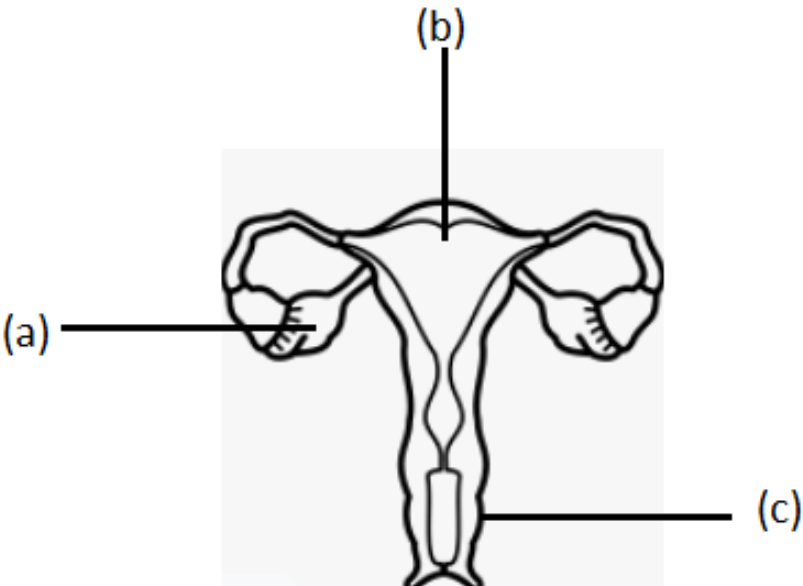
In the given figure given below, label the parts and mention their function:
Answer
 Verified
626.7k+ views
Hint: The reproductive system of an organism, also called the genital system, is the biological system comprising the anatomical organs engaged in sexual reproduction. Numerous non-living substances, for example, liquids, hormones, and pheromones are additionally significant assistants to the reproductive system. The diagram given in the question represents the female reproductive system of humans.
Complete answer:
The female reproductive system is has the inside and outside sex organs which altogether help in giving birth to an offspring. In humans, the female reproductive system is developed upon entering puberty to be able to produce gametes, and to carry a foetus to full term. The internal sex organs are the uterus, Fallopian tubes, ovaries and vagina.
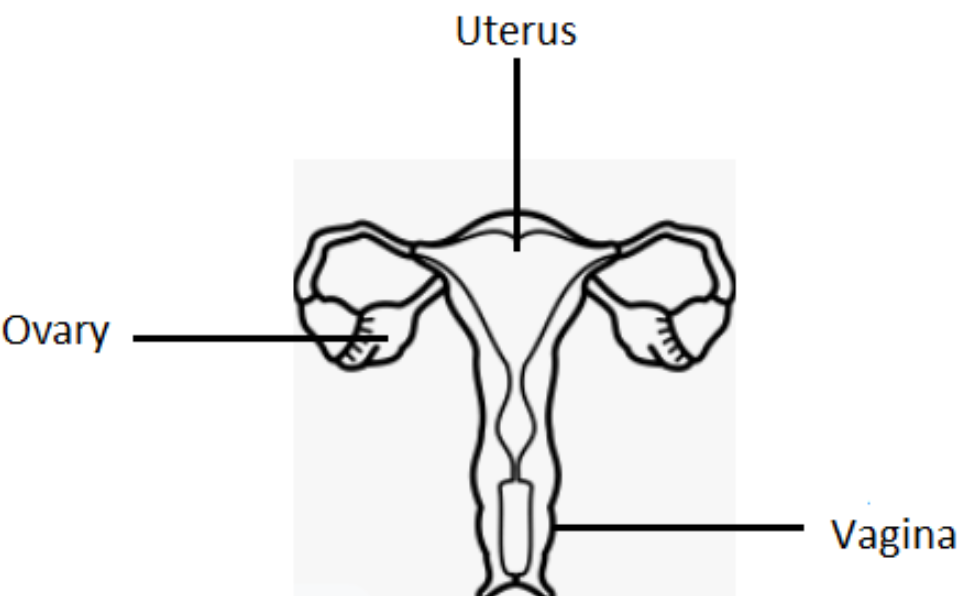
a. Ovary - The ovary is an organ found in the female genital framework that produces an ovum. When delivered, this moves down to the fallopian tube into the uterus, where it might be fertilized by a sperm. There is an ovary found on each side of the body. The ovaries additionally discharge hormones that assume a part in the menstrual cycle and Fertility.
b. Uterus - Fertilization takes place in the Fallopian tube and imprints the start of embryogenesis. The zygote will at that point divide over enough generations of cells to shape a blastocyst, which implants itself in the mass of the uterus.
c. Vagina – In mammals, the vagina is the elastic, muscular piece of the female genital tract. In humans, it reaches out from the vulva to the cervix. The external vaginal opening is covered by the hymen. At the profound end, the cervix swells into the vagina. The vagina allows sexual intercourse and birth. It additionally channels menstrual flow.
Note: Unlike most organ systems, the sexes of differential species have differences. These differences allow for a combination of genetic material between two individuals, which considers the chance of more prominent genetic fitness of the offspring. The human reproductive system is a complex and highly evolved system which works in coordination with the other parts of the body.
Complete answer:
The female reproductive system is has the inside and outside sex organs which altogether help in giving birth to an offspring. In humans, the female reproductive system is developed upon entering puberty to be able to produce gametes, and to carry a foetus to full term. The internal sex organs are the uterus, Fallopian tubes, ovaries and vagina.
a. Ovary - The ovary is an organ found in the female genital framework that produces an ovum. When delivered, this moves down to the fallopian tube into the uterus, where it might be fertilized by a sperm. There is an ovary found on each side of the body. The ovaries additionally discharge hormones that assume a part in the menstrual cycle and Fertility.
b. Uterus - Fertilization takes place in the Fallopian tube and imprints the start of embryogenesis. The zygote will at that point divide over enough generations of cells to shape a blastocyst, which implants itself in the mass of the uterus.
c. Vagina – In mammals, the vagina is the elastic, muscular piece of the female genital tract. In humans, it reaches out from the vulva to the cervix. The external vaginal opening is covered by the hymen. At the profound end, the cervix swells into the vagina. The vagina allows sexual intercourse and birth. It additionally channels menstrual flow.
Note: Unlike most organ systems, the sexes of differential species have differences. These differences allow for a combination of genetic material between two individuals, which considers the chance of more prominent genetic fitness of the offspring. The human reproductive system is a complex and highly evolved system which works in coordination with the other parts of the body.
Recently Updated Pages
Which of the following graphs shows the variation of class 12 physics CBSE

Draw a labelled diagram of the human male reproductive class 12 biology CBSE
Describe the experiment to compare the emf of two cells class 12 physics CBSE
What is standard hydrogen electrode
What is conventional current and electric current class 12 physics CBSE
2Bromopentane is treated with an alcoholic KOH solution class 12 chemistry CBSE
Trending doubts
A member of Simon commission later became Prime Minister class 12 social science CBSE
What is the Full Form of PVC, PET, HDPE, LDPE, PP and PS ?
Differentiate between internal fertilization and external class 12 biology CBSE
Differentiate between lanthanoids and actinoids class 12 chemistry CBSE
Sketch and label the Malpighian body class 12 biology CBSE
State the principle of an ac generator and explain class 12 physics CBSE