



In the following multiplication, each of the different letters denotes a different integer. Each letter stands for the same integer throughout. If ′A′ stands for 2 and ′C′ stands for 6, then what is the value of ′M′?
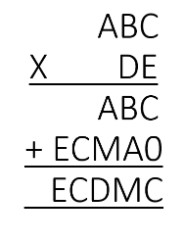
A.9
B.7
C.5
D.8
Answer
 Verified
602.4k+ views
Hint:One approach to the question is for you to make up some simple number sentences in the format “number +/–/x/÷ number = number” and then to look for a repeated digit that they could remove and replace with a alphabet.
You need to think about patterns (or strategies) that you may use, such as:
• odd + odd = even (for example: 9 + 5 = 14)
• odd – odd = even (for example: 9 – 5 = 4)
• even + even = even
• even + odd = odd
• even – odd = odd
• odd – even = odd
• odd x odd = odd
• even x even = even
• odd x even = even.
Complete step-by-step answer:
If ′A′ stands for 2 and ′C′ stands for 6
When ‘A’, ‘B’ and ‘C’ are multiplied by ‘E’ then the product doesn’t change. So, the value of ‘E’ = 1
So, now by replacing the value of ‘A’, ‘C’ and ‘E’
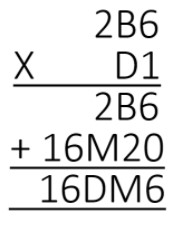
When ‘2B6’ is multiplied with ‘D’ then 2 comes in unit place.
Now, 2 appears as a unit digit when 6 is multiplied by either 2 or 7.
Value of ‘D’ cannot be 2 as 2 is already a value of ‘A’.
So value of ‘D’ =7
As we can see out of 10 integers we have already used 1, 2, 6, 7
So, now we are left with 0, 3, 4, 5, 8, 9
So, lets try to put the value of ‘B’ as 0
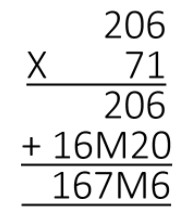
The calculation is not coming correct.
So, lets try to put the value of ‘B’ as 3
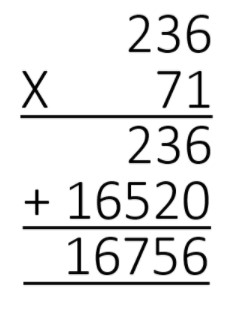
The calculation is coming correct.
So, the value of ‘M’ is 5
So, the correct answer is “Option C”.
Note:Most of these types of questions could be done using trial and improvement, but you will like to find it more efficient (and more satisfying) to first narrow the range of options as much as possible by studying the problem and seeing what you can deduce.We should be careful while choosing numbers as in question said that all letters represents different integers so none of them should not be repeated.
You need to think about patterns (or strategies) that you may use, such as:
• odd + odd = even (for example: 9 + 5 = 14)
• odd – odd = even (for example: 9 – 5 = 4)
• even + even = even
• even + odd = odd
• even – odd = odd
• odd – even = odd
• odd x odd = odd
• even x even = even
• odd x even = even.
Complete step-by-step answer:
If ′A′ stands for 2 and ′C′ stands for 6
When ‘A’, ‘B’ and ‘C’ are multiplied by ‘E’ then the product doesn’t change. So, the value of ‘E’ = 1
So, now by replacing the value of ‘A’, ‘C’ and ‘E’
When ‘2B6’ is multiplied with ‘D’ then 2 comes in unit place.
Now, 2 appears as a unit digit when 6 is multiplied by either 2 or 7.
Value of ‘D’ cannot be 2 as 2 is already a value of ‘A’.
So value of ‘D’ =7
As we can see out of 10 integers we have already used 1, 2, 6, 7
So, now we are left with 0, 3, 4, 5, 8, 9
So, lets try to put the value of ‘B’ as 0
The calculation is not coming correct.
So, lets try to put the value of ‘B’ as 3
The calculation is coming correct.
So, the value of ‘M’ is 5
So, the correct answer is “Option C”.
Note:Most of these types of questions could be done using trial and improvement, but you will like to find it more efficient (and more satisfying) to first narrow the range of options as much as possible by studying the problem and seeing what you can deduce.We should be careful while choosing numbers as in question said that all letters represents different integers so none of them should not be repeated.
Recently Updated Pages
Basicity of sulphurous acid and sulphuric acid are

Master Class 11 Business Studies: Engaging Questions & Answers for Success
Master Class 11 Computer Science: Engaging Questions & Answers for Success
Master Class 11 Economics: Engaging Questions & Answers for Success
Master Class 12 English: Engaging Questions & Answers for Success
Master Class 12 Social Science: Engaging Questions & Answers for Success
Trending doubts
Fill the blanks with the suitable prepositions 1 The class 9 english CBSE
Difference Between Plant Cell and Animal Cell
Find the sum of series 1 + 2 + 3 + 4 + 5 + + 100 class 9 maths CBSE
Distinguish between Conventional and nonconventional class 9 social science CBSE
Find the mode and median of the data 13 16 12 14 1-class-9-maths-CBSE
What is pollution? How many types of pollution? Define it