




In the diamond crystal, each carbon atom is linked with carbon atoms? The number of carbon atoms linked is:
A.2
B.4
C.3
D.1
Answer
 Verified
651k+ views
Hint: To answer this question, recall the concept of the crustal structure of the diamond lattice. Diamonds also can be produced synthetically during a high-pressure high-temperature process which approximately simulates the conditions within the Earth’s mantle.
Complete step by step answer:
The four main optical characteristics of diamonds are transparency, luster, dispersion of sunshine, and colour. In its pure carbon form, diamond is totally clear and transparent. Diamonds are the toughest substance known. This beautiful diamond didn’t start because it looks in its final form. Uncut diamonds have greasy lustre and aren't brilliant in the least. But equivalent stones when cut exhibit a high luster. The first object of cutting a diamond is to bring out the hearth and brilliance of the stone. It is the toughest natural substance with the very best thermal conductivity. it's utilized in major industrial applications like cutting and polishing tools. The diamond crystal consists of an atom during which each atom is linked with four other carbon atoms by strong covalent bonds. The four surrounding carbon atoms form the four vertices of a daily tetrahedron. Each atom has the toughest natural substance with the very best thermal conductivity. it's utilized in major industrial applications like cutting and polishing tools. The diamond crystal consists of an atom during which each atom is linked with four other carbon atoms by strong covalent bonds. The four surrounding carbon atoms form the four vertices of a daily tetrahedron. Each atom has \[s{p^3}\] hybridization. \[\sigma \] bond links a carbon atom with 4 other carbon atoms. The overall structure can be summarized by the figure below:
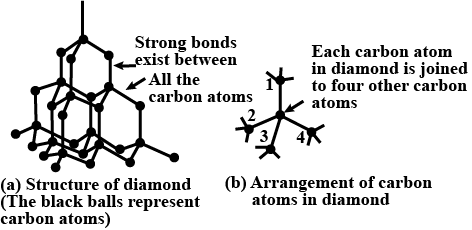
Hence, the right option is option B.
Note:
The diamond lattice (formed by the carbon atoms during a diamond crystal) consists of two interpenetrating face-centered cubic Bravais lattices, displaced along the body diagonal of the cubic cell by a length of one quarter the length of the diagonal.
Complete step by step answer:
The four main optical characteristics of diamonds are transparency, luster, dispersion of sunshine, and colour. In its pure carbon form, diamond is totally clear and transparent. Diamonds are the toughest substance known. This beautiful diamond didn’t start because it looks in its final form. Uncut diamonds have greasy lustre and aren't brilliant in the least. But equivalent stones when cut exhibit a high luster. The first object of cutting a diamond is to bring out the hearth and brilliance of the stone. It is the toughest natural substance with the very best thermal conductivity. it's utilized in major industrial applications like cutting and polishing tools. The diamond crystal consists of an atom during which each atom is linked with four other carbon atoms by strong covalent bonds. The four surrounding carbon atoms form the four vertices of a daily tetrahedron. Each atom has the toughest natural substance with the very best thermal conductivity. it's utilized in major industrial applications like cutting and polishing tools. The diamond crystal consists of an atom during which each atom is linked with four other carbon atoms by strong covalent bonds. The four surrounding carbon atoms form the four vertices of a daily tetrahedron. Each atom has \[s{p^3}\] hybridization. \[\sigma \] bond links a carbon atom with 4 other carbon atoms. The overall structure can be summarized by the figure below:
Hence, the right option is option B.
Note:
The diamond lattice (formed by the carbon atoms during a diamond crystal) consists of two interpenetrating face-centered cubic Bravais lattices, displaced along the body diagonal of the cubic cell by a length of one quarter the length of the diagonal.
Recently Updated Pages
Which of the following graphs shows the variation of class 12 physics CBSE

Draw a labelled diagram of the human male reproductive class 12 biology CBSE
Describe the experiment to compare the emf of two cells class 12 physics CBSE
What is standard hydrogen electrode
What is conventional current and electric current class 12 physics CBSE
2Bromopentane is treated with an alcoholic KOH solution class 12 chemistry CBSE
Trending doubts
Draw a labelled sketch of the human eye class 12 physics CBSE
Which are the Top 10 Largest Countries of the World?
A member of Simon commission later became Prime Minister class 12 social science CBSE
Differentiate between homogeneous and heterogeneous class 12 chemistry CBSE
Draw ray diagrams each showing i myopic eye and ii class 12 physics CBSE
Which is the correct genotypic ratio of mendel dihybrid class 12 biology CBSE