




In Fraunhofer diffraction, what kind of source of light is used and where is it situated?
Answer
 Verified
655.2k+ views
Hint: In Fraunhofer diffraction, monochromatic light is used as a source of light which is placed behind the slit in the setup. As monochromatic light is an EM wave which has a single wavelength due to this behavior it is easy to trace the diffraction pattern produced by it. Diffraction of light occurs due to the bending of light at the corners of the opening.
Complete answer:
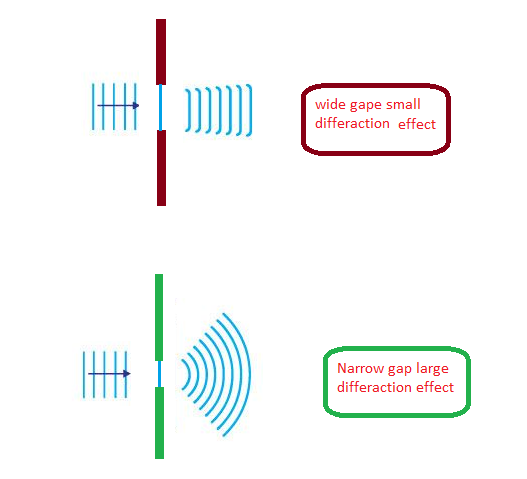
Diffraction is the phenomenon by which light bends while passing through the edge of a material or through a slit opening. The extent of bending depends upon the diameter of the slit. Both Interference and Diffraction are closely related to each other. This phenomenon can also take place when light is bent around particles that are on the same order of magnitude as the wavelength of the light. A good example of this is the diffraction we see is the blue colour of light
The diffractive effect seen in a set up depends on the length of the opening of the slit. Smaller the length of opening higher will be the diffraction effect.
Fraunhofer diffraction set up:
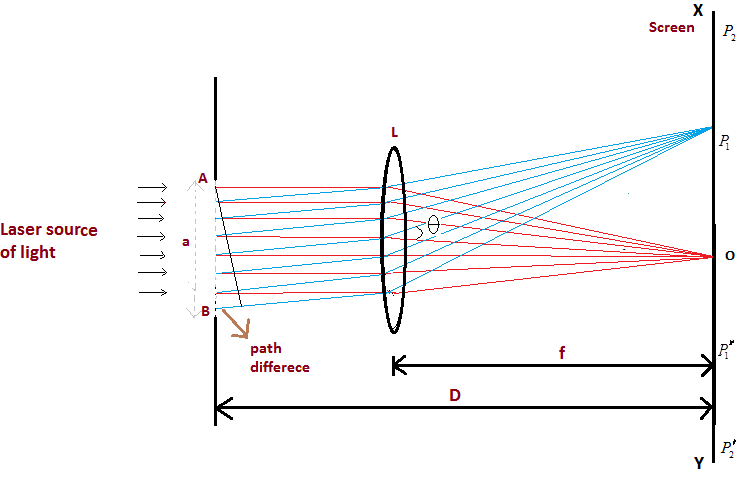
To see the diffraction property clearly a source of light must be chosen which gives a monochromatic light as an output. Thus in Fraunhofer diffraction setup a laser light is used as a source of electromagnetic waves.
When the monochromatic light passes from the slit the light gets diffracted. Then diffracted rays are converged on a screen with the help of a double convex lane.
There were two experiments set up by which diffraction patterns were studied. One was the single slit experiment and another was the double.
Note:
Diffraction is observed in our date to day life. It is not necessary that diffraction can be obtained using monochromatic light. Just for the study purpose in Fraunhofer diffraction a monochromatic beam of light is used.
Complete answer:
Diffraction is the phenomenon by which light bends while passing through the edge of a material or through a slit opening. The extent of bending depends upon the diameter of the slit. Both Interference and Diffraction are closely related to each other. This phenomenon can also take place when light is bent around particles that are on the same order of magnitude as the wavelength of the light. A good example of this is the diffraction we see is the blue colour of light
The diffractive effect seen in a set up depends on the length of the opening of the slit. Smaller the length of opening higher will be the diffraction effect.
Fraunhofer diffraction set up:
To see the diffraction property clearly a source of light must be chosen which gives a monochromatic light as an output. Thus in Fraunhofer diffraction setup a laser light is used as a source of electromagnetic waves.
When the monochromatic light passes from the slit the light gets diffracted. Then diffracted rays are converged on a screen with the help of a double convex lane.
There were two experiments set up by which diffraction patterns were studied. One was the single slit experiment and another was the double.
Note:
Diffraction is observed in our date to day life. It is not necessary that diffraction can be obtained using monochromatic light. Just for the study purpose in Fraunhofer diffraction a monochromatic beam of light is used.
Recently Updated Pages
Which of the following graphs shows the variation of class 12 physics CBSE

Draw a labelled diagram of the human male reproductive class 12 biology CBSE
Describe the experiment to compare the emf of two cells class 12 physics CBSE
What is standard hydrogen electrode
What is conventional current and electric current class 12 physics CBSE
2Bromopentane is treated with an alcoholic KOH solution class 12 chemistry CBSE
Trending doubts
Draw a labelled sketch of the human eye class 12 physics CBSE
Which are the Top 10 Largest Countries of the World?
A member of Simon commission later became Prime Minister class 12 social science CBSE
Differentiate between homogeneous and heterogeneous class 12 chemistry CBSE
Draw ray diagrams each showing i myopic eye and ii class 12 physics CBSE
Which is the correct genotypic ratio of mendel dihybrid class 12 biology CBSE