




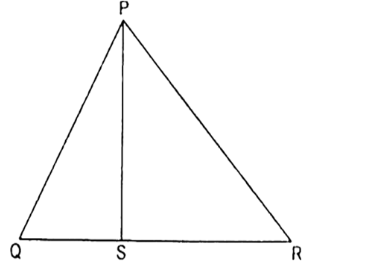
In figure, PS is the bisector of $\angle QPR$ of $\vartriangle PQR.$ Prove that $\dfrac{{QS}}{{SR}} = \dfrac{{PQ}}{{PR}}$
Answer
 Verified
632.7k+ views
Hint: We are going to use basic proportionality theorem, Alternate interior angles and corresponding angles to solve this problem.
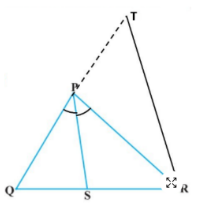
In $\vartriangle QRT,RT\parallel SP$ [By construction]
And PS intersects QT and QR at two distinct points P and Q.
Therefore, QT and QR will be divided in the same ratio.
$\dfrac{{QS}}{{SR}} = \dfrac{{PQ}}{{PT}}$ ..... (1) [Basic proportionality theorem]
Now $RS\parallel SP$ and PR is transversal.
Therefore, $\angle SPR = \angle PRT$.....(2) [Alternate interior angles]
And $\angle QPS = \angle PTR$..... (3) [Corresponding angles]
Also given that PS is the bisector of $\angle QPR.$
$ \Rightarrow \angle QPR = \angle SPR$
From equations (2) and (3) $\angle PTR = \angle PRT$
Therefore, PT = PR [Sides opposite to equal angles of a triangle are equal]
Putting PT= PR in equation (1)
$\dfrac{{QS}}{{SR}} = \dfrac{{PQ}}{{PR}}$
Hence proved.
Note: Basic proportionality theorem states that if a line is drawn parallel to one side of a triangle, intersecting the other two sides at distinct points, then the other two sides are divided in the same ratio.
In $\vartriangle QRT,RT\parallel SP$ [By construction]
And PS intersects QT and QR at two distinct points P and Q.
Therefore, QT and QR will be divided in the same ratio.
$\dfrac{{QS}}{{SR}} = \dfrac{{PQ}}{{PT}}$ ..... (1) [Basic proportionality theorem]
Now $RS\parallel SP$ and PR is transversal.
Therefore, $\angle SPR = \angle PRT$.....(2) [Alternate interior angles]
And $\angle QPS = \angle PTR$..... (3) [Corresponding angles]
Also given that PS is the bisector of $\angle QPR.$
$ \Rightarrow \angle QPR = \angle SPR$
From equations (2) and (3) $\angle PTR = \angle PRT$
Therefore, PT = PR [Sides opposite to equal angles of a triangle are equal]
Putting PT= PR in equation (1)
$\dfrac{{QS}}{{SR}} = \dfrac{{PQ}}{{PR}}$
Hence proved.
Note: Basic proportionality theorem states that if a line is drawn parallel to one side of a triangle, intersecting the other two sides at distinct points, then the other two sides are divided in the same ratio.
Recently Updated Pages
Basicity of sulphurous acid and sulphuric acid are

Master Class 10 English: Engaging Questions & Answers for Success
Master Class 10 Social Science: Engaging Questions & Answers for Success
Master Class 10 Computer Science: Engaging Questions & Answers for Success
Class 10 Question and Answer - Your Ultimate Solutions Guide
Master Class 10 General Knowledge: Engaging Questions & Answers for Success
Trending doubts
Which country won the ICC Men's ODI World Cup in 2023?
In cricket, how many legal balls are there in a standard over?
Explain the Treaty of Vienna of 1815 class 10 social science CBSE
A boat goes 24 km upstream and 28 km downstream in class 10 maths CBSE
What does "powerplay" mean in limited-overs cricket?
What is the "Powerplay" in T20 cricket?