




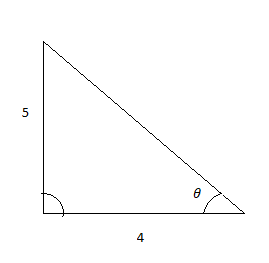
In figure, calculate the value of \[\theta \]
$A){\text{ }}36.9_{}^0$
$B){\text{ }}38.6_{}^0$
$C){\text{ }}41.4_{}^0$
$D){\text{ }}47.2_{}^0$
$E){\text{ }}51.3_{}^0$
Answer
 Verified
624.3k+ views
Hint: To solve this question we can apply the formula, of $\tan \theta $, and then we will get the required value of $\theta $ after doing inverse at last to get the required answer.
Formula used:
$\tan \theta = \dfrac{{Perpendicular}}{{Base}}$.
Complete step by step answer:
From the above diagram, we can see that the value of the perpendicular is $5$ and the value of the base is $4$.
Now by applying the formula $\tan \theta = \dfrac{{Perpendicular}}{{Base}}$ we get-
$\tan \theta = \dfrac{5}{4}$
$\Rightarrow \theta = {\tan ^{ - 1}}\left( {\dfrac{5}{4}} \right)$
$\Rightarrow \theta = 51.3_{}^0$
$\therefore$ The required value of $\theta $ is $51.3_{}^0$. Thus the correct option is $E$.
Note:
It is to be kept in mind that there are several formulas of $\tan \theta $ and most of the students make mistakes in applying the correct formula so try to remember all the formulas.
Another formula of $\tan \theta = \dfrac{{\sin \theta }}{{\cos \theta }}$or $\tan \theta = \sqrt {\sec _{}^2\theta - 1} $
There are three sides in a triangle and each side represents either perpendicular or base or hypotenuse. So when the values of perpendicular and hypotenuse are given, then we can find out the value of $\theta $ by using the formula$\sin \theta = \dfrac{{Perpendicular}}{{Hypotenuse}}$. Other formulas for finding out the values of $\theta $ is $\sin \theta = \sqrt {1 - \cos _{}^2\theta } $
When the values of base and hypotenuse are given then we can find out the value of $\theta $by using the formula of $\cos \theta $$ = \dfrac{{Base}}{{Hypotenuse}}$. Other formula for finding out the value of $\cos \theta $ is $\cos \theta = \sqrt {1 - \sin _{}^2\theta } $
When the values of perpendicular and base are given, then we can find out the value of $\theta $ by using the formula of $\tan \theta = \dfrac{{Perpendicular}}{{Base}}$.
If the values of perpendicular, base, and height or any two of them are given in the question, then to find out the angle we will apply the formula of $\sin \theta $, $\cos \theta $ or $\tan \theta $
Formula used:
$\tan \theta = \dfrac{{Perpendicular}}{{Base}}$.
Complete step by step answer:
From the above diagram, we can see that the value of the perpendicular is $5$ and the value of the base is $4$.
Now by applying the formula $\tan \theta = \dfrac{{Perpendicular}}{{Base}}$ we get-
$\tan \theta = \dfrac{5}{4}$
$\Rightarrow \theta = {\tan ^{ - 1}}\left( {\dfrac{5}{4}} \right)$
$\Rightarrow \theta = 51.3_{}^0$
$\therefore$ The required value of $\theta $ is $51.3_{}^0$. Thus the correct option is $E$.
Note:
It is to be kept in mind that there are several formulas of $\tan \theta $ and most of the students make mistakes in applying the correct formula so try to remember all the formulas.
Another formula of $\tan \theta = \dfrac{{\sin \theta }}{{\cos \theta }}$or $\tan \theta = \sqrt {\sec _{}^2\theta - 1} $
There are three sides in a triangle and each side represents either perpendicular or base or hypotenuse. So when the values of perpendicular and hypotenuse are given, then we can find out the value of $\theta $ by using the formula$\sin \theta = \dfrac{{Perpendicular}}{{Hypotenuse}}$. Other formulas for finding out the values of $\theta $ is $\sin \theta = \sqrt {1 - \cos _{}^2\theta } $
When the values of base and hypotenuse are given then we can find out the value of $\theta $by using the formula of $\cos \theta $$ = \dfrac{{Base}}{{Hypotenuse}}$. Other formula for finding out the value of $\cos \theta $ is $\cos \theta = \sqrt {1 - \sin _{}^2\theta } $
When the values of perpendicular and base are given, then we can find out the value of $\theta $ by using the formula of $\tan \theta = \dfrac{{Perpendicular}}{{Base}}$.
If the values of perpendicular, base, and height or any two of them are given in the question, then to find out the angle we will apply the formula of $\sin \theta $, $\cos \theta $ or $\tan \theta $
Recently Updated Pages
Master Class 11 English: Engaging Questions & Answers for Success

Master Class 11 Social Science: Engaging Questions & Answers for Success
Master Class 11 Maths: Engaging Questions & Answers for Success
Master Class 11 Biology: Engaging Questions & Answers for Success
Master Class 11 Physics: Engaging Questions & Answers for Success
Master Class 11 Chemistry: Engaging Questions & Answers for Success
Trending doubts
Explain the Treaty of Vienna of 1815 class 10 social science CBSE
What is the Total Duration of Football Match?
First Cotton Mill of India
In which year voting age was reduced from 21 to 18?
10 examples of evaporation in daily life with explanations
What planets have no moons Which one has only one moon class 10 physics CBSE