



In a triangle ABC, N is appointed on AC such that BN is perpendicular to AC. If $B{N^2} = AN \cdot NC$, prove that $\angle B = {90^0}$.
Answer
 Verified
623.1k+ views
Hint: - Use Pythagoras Theorem, $\left[ {{{\left( {{\text{Hypotenuse}}} \right)}^2} = {{\left( {{\text{Perpendicular}}} \right)}^2} + {{\left( {{\text{Base}}} \right)}^2}} \right]$
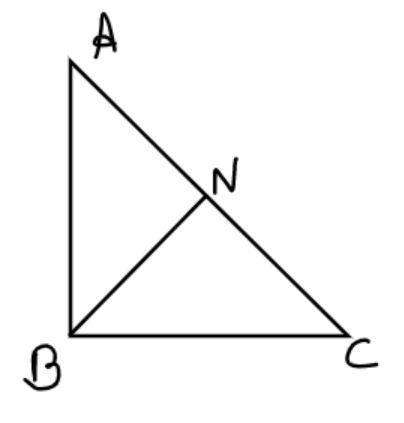
Given:
BN is perpendicular to AC
\[\therefore \angle BNC = \angle BNA = 90\]
And it is also given that $B{N^2} = AN \cdot NC............\left( 1 \right)$
Apply Pythagoras Theorem in $\Delta BNC$
$\therefore {\left( {BC} \right)^2} = {\left( {BN} \right)^2} + {\left( {NC} \right)^2}$
From equation 1
${\left( {BC} \right)^2} = \left( {AN \times NC} \right) + {\left( {NC} \right)^2}.................\left( 2 \right)$
Apply Pythagoras Theorem in $\Delta BNA$
$\therefore {\left( {BA} \right)^2} = {\left( {BN} \right)^2} + {\left( {NA} \right)^2}$
From equation 1
$\therefore {\left( {BA} \right)^2} = \left( {AN \times NC} \right) + {\left( {NA} \right)^2}.........\left( 3 \right)$
Add equations 2 and 3
$
{\left( {BC} \right)^2} + {\left( {BA} \right)^2} = \left( {AN \times NC} \right) + {\left( {NC} \right)^2} + \left( {AN \times NC} \right) + {\left( {NA} \right)^2} \\
\therefore {\left( {BC} \right)^2} + {\left( {BA} \right)^2} = {\left( {NC} \right)^2} + {\left( {NA} \right)^2} + 2\left( {AN \times NC} \right) \\
$
In above equation R.H.S is the formula of ${\left( {a + b} \right)^2} = {a^2} + {b^2} + 2ab$
$\therefore {\left( {BC} \right)^2} + {\left( {BA} \right)^2} = {\left( {AN + NC} \right)^2}$
From figure $AN + NC = AC$
$\therefore {\left( {BC} \right)^2} + {\left( {BA} \right)^2} = {\left( {AC} \right)^2}$
Which is the property of Pythagoras Theorem.
Where AC is hypotenuse, AB and BC are perpendicular to each other at B.
$\therefore \angle B = {90^0}$
Hence Proved.
Note: - whenever we face such types of problems first draw the pictorial representation of the given problem, then apply Pythagoras Theorem which is stated above, then according to given condition simplify the problem, then we will get the required answer.
Given:
BN is perpendicular to AC
\[\therefore \angle BNC = \angle BNA = 90\]
And it is also given that $B{N^2} = AN \cdot NC............\left( 1 \right)$
Apply Pythagoras Theorem in $\Delta BNC$
$\therefore {\left( {BC} \right)^2} = {\left( {BN} \right)^2} + {\left( {NC} \right)^2}$
From equation 1
${\left( {BC} \right)^2} = \left( {AN \times NC} \right) + {\left( {NC} \right)^2}.................\left( 2 \right)$
Apply Pythagoras Theorem in $\Delta BNA$
$\therefore {\left( {BA} \right)^2} = {\left( {BN} \right)^2} + {\left( {NA} \right)^2}$
From equation 1
$\therefore {\left( {BA} \right)^2} = \left( {AN \times NC} \right) + {\left( {NA} \right)^2}.........\left( 3 \right)$
Add equations 2 and 3
$
{\left( {BC} \right)^2} + {\left( {BA} \right)^2} = \left( {AN \times NC} \right) + {\left( {NC} \right)^2} + \left( {AN \times NC} \right) + {\left( {NA} \right)^2} \\
\therefore {\left( {BC} \right)^2} + {\left( {BA} \right)^2} = {\left( {NC} \right)^2} + {\left( {NA} \right)^2} + 2\left( {AN \times NC} \right) \\
$
In above equation R.H.S is the formula of ${\left( {a + b} \right)^2} = {a^2} + {b^2} + 2ab$
$\therefore {\left( {BC} \right)^2} + {\left( {BA} \right)^2} = {\left( {AN + NC} \right)^2}$
From figure $AN + NC = AC$
$\therefore {\left( {BC} \right)^2} + {\left( {BA} \right)^2} = {\left( {AC} \right)^2}$
Which is the property of Pythagoras Theorem.
Where AC is hypotenuse, AB and BC are perpendicular to each other at B.
$\therefore \angle B = {90^0}$
Hence Proved.
Note: - whenever we face such types of problems first draw the pictorial representation of the given problem, then apply Pythagoras Theorem which is stated above, then according to given condition simplify the problem, then we will get the required answer.

Recently Updated Pages
Master Class 8 Social Science: Engaging Questions & Answers for Success

Master Class 8 English: Engaging Questions & Answers for Success
Class 8 Question and Answer - Your Ultimate Solutions Guide
Master Class 8 Maths: Engaging Questions & Answers for Success
Master Class 8 Science: Engaging Questions & Answers for Success
Master Class 7 English: Engaging Questions & Answers for Success
Trending doubts
Difference Between Plant Cell and Animal Cell
Fill the blanks with the suitable prepositions 1 The class 9 english CBSE
Who is eligible for RTE class 9 social science CBSE
Which places in India experience sunrise first and class 9 social science CBSE
What is pollution? How many types of pollution? Define it
Name 10 Living and Non living things class 9 biology CBSE