




If two cubes each of side 12 cm are joined end to end then what will be the surface area of the resulting cuboid?
(a) 1728 $c{{m}^{2}}$
(b) 1440 $c{{m}^{2}}$
(c) 1445 $c{{m}^{2}}$
(d) 1450 $c{{m}^{2}}$
Answer
 Verified
652.2k+ views
Hint: We should try to think of this question in 3D as if two cubes are joined from end to end then one side of from each cube will be pressing along each other and hence, we will need to subtract the surface area of those two sides from the surface area of 2 cubes to get the resultant surface area.
Complete step-by-step solution:
If we suppose the length of the each side of the cube as $a\,cm$, then
Total surface area of 1 cube we will get as $6{{a}^{2}}\,c{{m}^{2}}$, hence we get
Total surface area of cube as,
\[\begin{align}
& =6\times {{(12)}^{2}}\,\,c{{m}^{2}} \\
& =6\times 144\,c{{m}^{2}} \\
& =864\,c{{m}^{2}} \\
\end{align}\]
Hence,
Total surface area of 2 cubes we get as,
\[\begin{align}
& =2\times 864\,c{{m}^{2}} \\
& =1728\,c{{m}^{2}} \\
\end{align}\]
Now when we combine both the cubes from end to end we will have to subtract the surface area of 2 faces of the cube as we can see in the below figure also to get the resultant surface area
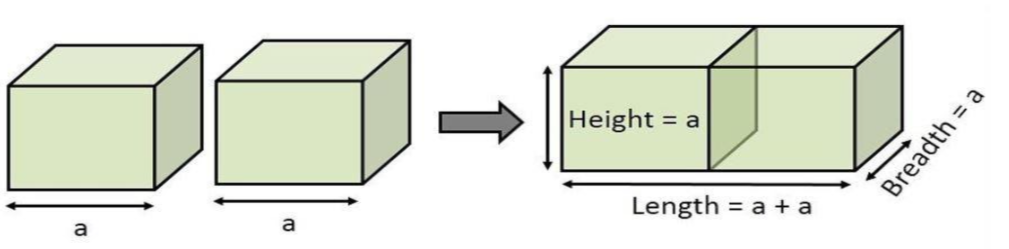
, so resultant surface area we get as,
\[\begin{align}
& =1728-(2\times 144)\,c{{m}^{2}} \\
& =1728-288\,c{{m}^{2}} \\
& =1440\,c{{m}^{2}} \\
\end{align}\]
Hence surface area of the resulting cuboid will be 1440 $c{{m}^{2}}$ which matches the option (b) hence option (b) is the correct answer.
Note: We can also solve this question by another method in which we can think of the resulting figure as a cuboid and then calculating the length of new length(l), breadth(b) and height(h) of the new cuboid. We will see that new length = a + a = 24 cm, breadth = a = 12 cm and height = a = 12 cm
We can also observe this from the presented diagram.
And we know that surface area of cuboid is given by = $2\times (l\times b+b\times h+h\times l)$
Hence we get resulting surface area of the cuboid as,
$\begin{align}
& =2\times (24\times 12+12\times 12+12\times 24) \\
& =2\times (288+144+288) \\
& =2\times (720) \\
& =1440\,c{{m}^{2}} \\
\end{align}$
Which is same as the answer found in the previous method.
Complete step-by-step solution:
If we suppose the length of the each side of the cube as $a\,cm$, then
Total surface area of 1 cube we will get as $6{{a}^{2}}\,c{{m}^{2}}$, hence we get
Total surface area of cube as,
\[\begin{align}
& =6\times {{(12)}^{2}}\,\,c{{m}^{2}} \\
& =6\times 144\,c{{m}^{2}} \\
& =864\,c{{m}^{2}} \\
\end{align}\]
Hence,
Total surface area of 2 cubes we get as,
\[\begin{align}
& =2\times 864\,c{{m}^{2}} \\
& =1728\,c{{m}^{2}} \\
\end{align}\]
Now when we combine both the cubes from end to end we will have to subtract the surface area of 2 faces of the cube as we can see in the below figure also to get the resultant surface area
, so resultant surface area we get as,
\[\begin{align}
& =1728-(2\times 144)\,c{{m}^{2}} \\
& =1728-288\,c{{m}^{2}} \\
& =1440\,c{{m}^{2}} \\
\end{align}\]
Hence surface area of the resulting cuboid will be 1440 $c{{m}^{2}}$ which matches the option (b) hence option (b) is the correct answer.
Note: We can also solve this question by another method in which we can think of the resulting figure as a cuboid and then calculating the length of new length(l), breadth(b) and height(h) of the new cuboid. We will see that new length = a + a = 24 cm, breadth = a = 12 cm and height = a = 12 cm
We can also observe this from the presented diagram.
And we know that surface area of cuboid is given by = $2\times (l\times b+b\times h+h\times l)$
Hence we get resulting surface area of the cuboid as,
$\begin{align}
& =2\times (24\times 12+12\times 12+12\times 24) \\
& =2\times (288+144+288) \\
& =2\times (720) \\
& =1440\,c{{m}^{2}} \\
\end{align}$
Which is same as the answer found in the previous method.
Recently Updated Pages
Differentiate between voluntary action and reflex class 10 biology CBSE

The uses of bleaching powder are A It is used bleaching class 10 chemistry CBSE
Fill in the blanks with abstract nouns of the words class 10 english CBSE
How many threedigit numbers are there class 10 maths CBSE
What is a reflex arc class 10 biology CBSE
Construct a square whose diagonal is 6cm Measure the class 10 maths CBSE
Trending doubts
Explain the Treaty of Vienna of 1815 class 10 social science CBSE
The slogan Jai Hind was given by A Lal Bahadur Shastri class 10 social science CBSE
10 examples of evaporation in daily life with explanations
What is the full form of POSCO class 10 social science CBSE
Identify the feminine form of noun nephew a shenephew class 10 english CBSE
Make a sketch of the human nerve cell What function class 10 biology CBSE