




If PAB is a secant to a circle of Centre O intersecting the circle of A and B and PT is tangent segment, then prove that-
${\text{PA}} \times {\text{PB = P}}{{\text{T}}^2}$
Answer
 Verified
637.5k+ views
Hint – In this question first make a circle then draw a tangent and a secant from an external point of the circle and also, draw a perpendicular line from the Centre of the circle to the secant, then apply Pythagoras theorem .
Complete step-by-step solution -
Given Data, PAB is a secant, Centre of circle O, PT is a tangent
We make a construction that is OM ⊥ AB, OA, OP, OT, Ob are joined.
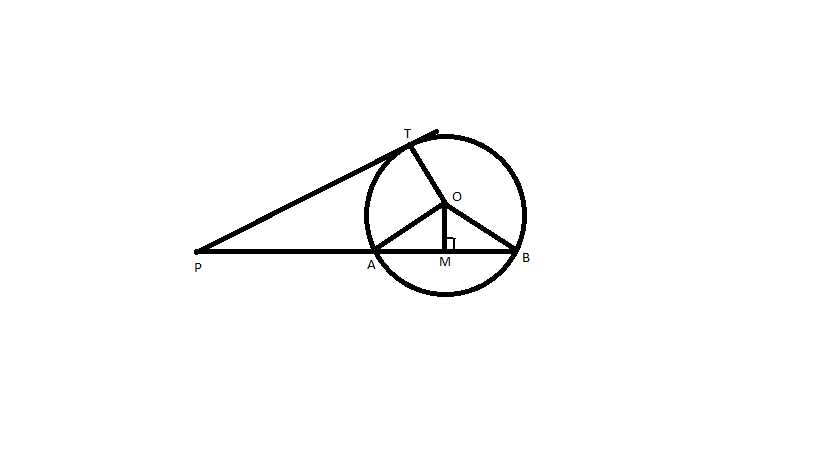
Here PAB is secant intersecting the circle with Centre O at A and B and a tangent PT at T.
Now PA = PM – AM
PB = PM + MB
As we know AM = BM (perpendicular drawn from the Centre of the circle to a chord is also a bisector of chord)
PA.PB = (PM – AM) × (PM + AM) = ${\text{P}}{{\text{M}}^2} - {\text{A}}{{\text{M}}^2}{\text{ }} \to {\text{ Equation 1}}$
Also from the diagram OM ⊥ AB
We can apply Pythagoras theorem in ∆OMP
${\text{P}}{{\text{M}}^2} = {\text{O}}{{\text{P}}^2} - {\text{O}}{{\text{M}}^2}$
We can apply Pythagoras theorem in ∆OMA
${\text{A}}{{\text{M}}^2} = {\text{O}}{{\text{A}}^2} - {\text{O}}{{\text{M}}^2}$
Put these values in Equation 1, we get
PA.PB = ${\text{P}}{{\text{M}}^2} - {\text{A}}{{\text{M}}^2}$
PA.PB = (${\text{O}}{{\text{P}}^2} - {\text{O}}{{\text{M}}^2}$) – (${\text{O}}{{\text{A}}^2} - {\text{O}}{{\text{M}}^2}$)
PA.PB = ${\text{O}}{{\text{P}}^2} - {\text{O}}{{\text{A}}^2}$
As OA = OT (radii)
PA.PB = ${\text{O}}{{\text{P}}^2} - {\text{O}}{{\text{T}}^2}{\text{ }} \to {\text{ Equation 2}}$
As radius is perpendicular to the tangent so this will form a right angled triangle, we can apply Pythagoras theorem in ∆OPT
We get ${\text{P}}{{\text{T}}^2}{\text{ = O}}{{\text{P}}^2} - {\text{O}}{{\text{T}}^2}$
By putting this in the Equation 2, we get
PA.PB = ${\text{P}}{{\text{T}}^2}$
Hence Proved.
Note – In order to solve this type of questions, draw an appropriate figure and construct any other additional elements using known geometrical properties. Pythagoras theorem can be used if we construct a right angled triangle. Properties of straight lines are very important in order to approach the answer or proof.
Complete step-by-step solution -
Given Data, PAB is a secant, Centre of circle O, PT is a tangent
We make a construction that is OM ⊥ AB, OA, OP, OT, Ob are joined.
Here PAB is secant intersecting the circle with Centre O at A and B and a tangent PT at T.
Now PA = PM – AM
PB = PM + MB
As we know AM = BM (perpendicular drawn from the Centre of the circle to a chord is also a bisector of chord)
PA.PB = (PM – AM) × (PM + AM) = ${\text{P}}{{\text{M}}^2} - {\text{A}}{{\text{M}}^2}{\text{ }} \to {\text{ Equation 1}}$
Also from the diagram OM ⊥ AB
We can apply Pythagoras theorem in ∆OMP
${\text{P}}{{\text{M}}^2} = {\text{O}}{{\text{P}}^2} - {\text{O}}{{\text{M}}^2}$
We can apply Pythagoras theorem in ∆OMA
${\text{A}}{{\text{M}}^2} = {\text{O}}{{\text{A}}^2} - {\text{O}}{{\text{M}}^2}$
Put these values in Equation 1, we get
PA.PB = ${\text{P}}{{\text{M}}^2} - {\text{A}}{{\text{M}}^2}$
PA.PB = (${\text{O}}{{\text{P}}^2} - {\text{O}}{{\text{M}}^2}$) – (${\text{O}}{{\text{A}}^2} - {\text{O}}{{\text{M}}^2}$)
PA.PB = ${\text{O}}{{\text{P}}^2} - {\text{O}}{{\text{A}}^2}$
As OA = OT (radii)
PA.PB = ${\text{O}}{{\text{P}}^2} - {\text{O}}{{\text{T}}^2}{\text{ }} \to {\text{ Equation 2}}$
As radius is perpendicular to the tangent so this will form a right angled triangle, we can apply Pythagoras theorem in ∆OPT
We get ${\text{P}}{{\text{T}}^2}{\text{ = O}}{{\text{P}}^2} - {\text{O}}{{\text{T}}^2}$
By putting this in the Equation 2, we get
PA.PB = ${\text{P}}{{\text{T}}^2}$
Hence Proved.
Note – In order to solve this type of questions, draw an appropriate figure and construct any other additional elements using known geometrical properties. Pythagoras theorem can be used if we construct a right angled triangle. Properties of straight lines are very important in order to approach the answer or proof.
Recently Updated Pages
Master Class 10 Social Science: Engaging Questions & Answers for Success

Master Class 10 Science: Engaging Questions & Answers for Success
Master Class 10 Maths: Engaging Questions & Answers for Success
Master Class 10 General Knowledge: Engaging Questions & Answers for Success
Master Class 10 Computer Science: Engaging Questions & Answers for Success
Class 10 Question and Answer - Your Ultimate Solutions Guide
Trending doubts
What is the full form of PNG A Petrol Natural Gas B class 10 chemistry CBSE
Explain the Treaty of Vienna of 1815 class 10 social science CBSE
In cricket, how many legal balls are there in a standard over?
Why is there a time difference of about 5 hours between class 10 social science CBSE
Who Won 36 Oscar Awards? Record Holder Revealed
What is the median of the first 10 natural numbers class 10 maths CBSE