



Formula to find the area of the quadrant of a circle is:
A.$\pi {{r}^{2}}$
B.$\dfrac{\pi {{r}^{2}}}{2}$
C.$\dfrac{\pi {{r}^{2}}}{4}$
D.$\dfrac{\pi {{r}^{2}}}{8}$
Answer
 Verified
648.9k+ views
Hint: The given problem is related to the area of a circle. The area of a sector of a circle, having radius $r$, which subtends an angle $\theta $ at the centre is given as $\left( \dfrac{\theta }{2\pi } \right)\times \pi {{r}^{2}}$ . The angle subtended by the quadrant of a circle at the centre is $\dfrac{\pi }{2}$ .
Complete step-by-step answer:
Before we proceed with the solution, we must understand the sector of a circle. The sector of a circle is defined as the region enclosed between two radii and the arc of the circle. If the angle between the radii is $\theta $ , then $\theta $ is called the central angle. The region corresponding to the smaller central angle is called the minor sector and the region corresponding to the larger central angle is called the major sector. If $\theta =\dfrac{\pi }{2}$ , then the sector is called a quadrant.
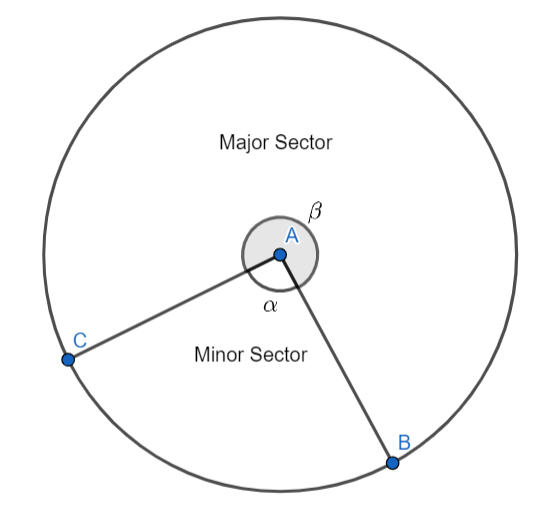
Consider the figure. In the figure $\alpha <\beta $ . So, the sector corresponding to angle $\alpha $ is the minor sector and the sector corresponding to angle $\beta $ is the major sector.
Now, the area of a sector of a circle, having radius $r$ , which subtends an angle $\theta $ at the centre is given as $\left( \dfrac{\theta }{2\pi } \right)\times \pi {{r}^{2}}$ . We know the angle subtended by the quadrant of a circle at the centre is $\dfrac{\pi }{2}$ . So, the area of the quadrant will be equal to $\dfrac{\dfrac{\pi }{2}}{2\pi }\times \pi {{r}^{2}}=\dfrac{\pi }{4\pi }\pi {{r}^{2}}=\dfrac{\pi {{r}^{2}}}{4}$ .
Hence, the area of the quadrant of a circle having radius $r$ is equal to \[\dfrac{\pi {{r}^{2}}}{4}\] .
Hence, option B. is the correct option.
Note: Most of the students get confused between sector and segment. Sector is the region between two radii and the circular arc, whereas segment is the region between a chord and its corresponding arc.
Complete step-by-step answer:
Before we proceed with the solution, we must understand the sector of a circle. The sector of a circle is defined as the region enclosed between two radii and the arc of the circle. If the angle between the radii is $\theta $ , then $\theta $ is called the central angle. The region corresponding to the smaller central angle is called the minor sector and the region corresponding to the larger central angle is called the major sector. If $\theta =\dfrac{\pi }{2}$ , then the sector is called a quadrant.
Consider the figure. In the figure $\alpha <\beta $ . So, the sector corresponding to angle $\alpha $ is the minor sector and the sector corresponding to angle $\beta $ is the major sector.
Now, the area of a sector of a circle, having radius $r$ , which subtends an angle $\theta $ at the centre is given as $\left( \dfrac{\theta }{2\pi } \right)\times \pi {{r}^{2}}$ . We know the angle subtended by the quadrant of a circle at the centre is $\dfrac{\pi }{2}$ . So, the area of the quadrant will be equal to $\dfrac{\dfrac{\pi }{2}}{2\pi }\times \pi {{r}^{2}}=\dfrac{\pi }{4\pi }\pi {{r}^{2}}=\dfrac{\pi {{r}^{2}}}{4}$ .
Hence, the area of the quadrant of a circle having radius $r$ is equal to \[\dfrac{\pi {{r}^{2}}}{4}\] .
Hence, option B. is the correct option.
Note: Most of the students get confused between sector and segment. Sector is the region between two radii and the circular arc, whereas segment is the region between a chord and its corresponding arc.
Recently Updated Pages
Master Class 11 Social Science: Engaging Questions & Answers for Success

Master Class 11 Chemistry: Engaging Questions & Answers for Success
Master Class 12 Business Studies: Engaging Questions & Answers for Success
Master Class 12 Chemistry: Engaging Questions & Answers for Success
Master Class 12 Biology: Engaging Questions & Answers for Success
Class 12 Question and Answer - Your Ultimate Solutions Guide
Trending doubts
What is the situation called when no party gets the class 9 social science CBSE
Find the sum of series 1 + 2 + 3 + 4 + 5 + + 100 class 9 maths CBSE
Fill the blanks with the suitable prepositions 1 The class 9 english CBSE
Difference Between Plant Cell and Animal Cell
What is pollution? How many types of pollution? Define it
Name 10 Living and Non living things class 9 biology CBSE