




Formation of the primary endosperm nucleus is called triple fusion. Give reason.
Answer
 Verified
591.6k+ views
Hint: Endosperm is a kind of food product manufactured by plants for the developing embryo present within the seed. It serves as a source of nutrition for the embryo until it's dormant stage.
Complete answer
The general process of fertilisation in plants includes fusion of nuclei of male and female gametes that later leads to the formation of the zygote. In angiosperms, the process of fertilization is not limited to the zygote formation thus, includes formation of endosperm also. This endosperm formation takes place at the same time of zygote formation.
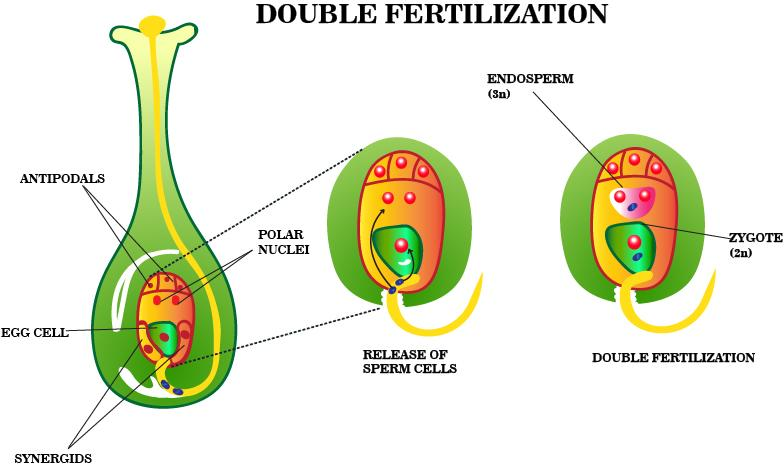
Anther, the male gamete splits into two haploid nuclei before entering into the ovule, the female reproductive part. Whereas, the ovule already has three haploid nuclei such that one is egg nuclei and the other two are polar nuclei. At the time of fertilization, one of the two male nuclei fuses with the egg nuclei to form the zygote while the other male nuclei fuses with the other two polar nuclei that leads to the formation of endosperm.
This fusion involves three haploid nuclei, thus, is called triple fusion. Therefore, we can say that the process of formation of primary endosperm is a triple fusion. However, as this whole process involves two fertilizations thus is called double fertilization. Later, the zygote develops to form a new plant individual when provided with favourable environmental conditions while endosperm nutrifies this embryo within the seed.
Note:
Every angiosperm has endosperm in its seeds. As, it takes a quite long time and specific environmental conditions for the embryo to germinate into a plant. Thus, in order to keep the dormant embryo nutrified while in its dormant stage, the tree provides its seeds with endosperm.
Complete answer
The general process of fertilisation in plants includes fusion of nuclei of male and female gametes that later leads to the formation of the zygote. In angiosperms, the process of fertilization is not limited to the zygote formation thus, includes formation of endosperm also. This endosperm formation takes place at the same time of zygote formation.
Anther, the male gamete splits into two haploid nuclei before entering into the ovule, the female reproductive part. Whereas, the ovule already has three haploid nuclei such that one is egg nuclei and the other two are polar nuclei. At the time of fertilization, one of the two male nuclei fuses with the egg nuclei to form the zygote while the other male nuclei fuses with the other two polar nuclei that leads to the formation of endosperm.
This fusion involves three haploid nuclei, thus, is called triple fusion. Therefore, we can say that the process of formation of primary endosperm is a triple fusion. However, as this whole process involves two fertilizations thus is called double fertilization. Later, the zygote develops to form a new plant individual when provided with favourable environmental conditions while endosperm nutrifies this embryo within the seed.
Note:
Every angiosperm has endosperm in its seeds. As, it takes a quite long time and specific environmental conditions for the embryo to germinate into a plant. Thus, in order to keep the dormant embryo nutrified while in its dormant stage, the tree provides its seeds with endosperm.
Recently Updated Pages
Which of the following graphs shows the variation of class 12 physics CBSE

Draw a labelled diagram of the human male reproductive class 12 biology CBSE
Describe the experiment to compare the emf of two cells class 12 physics CBSE
What is standard hydrogen electrode
What is conventional current and electric current class 12 physics CBSE
2Bromopentane is treated with an alcoholic KOH solution class 12 chemistry CBSE
Trending doubts
Draw a labelled sketch of the human eye class 12 physics CBSE
Which are the Top 10 Largest Countries of the World?
A member of Simon commission later became Prime Minister class 12 social science CBSE
Differentiate between homogeneous and heterogeneous class 12 chemistry CBSE
Draw ray diagrams each showing i myopic eye and ii class 12 physics CBSE
Which is the correct genotypic ratio of mendel dihybrid class 12 biology CBSE