




How do you find the point of intersection of diagonals?
Answer
 Verified
589.2k+ views
Hint: The diagonals of a quadrilateral are the line segments that connect opposite vertices. We will investigate the simplest case which is quadrilateral. The number of vertices in a quadrilateral are 4, and the number of diagonals are 2. To find the point of intersection of diagonals can be found using the coordinates of vertices of a quadrilateral.
Complete step-by-step solution:
We are not given a particular type of quadrilateral, let’s see the most general case with four vertices. Let the quadrilateral ABCD have coordinates of vertices as \[\left( {{x}_{1}},{{y}_{1}} \right),\left( {{x}_{2}},{{y}_{2}} \right),\left( {{x}_{3}},{{y}_{3}} \right)\And \left( {{x}_{4}},{{y}_{4}} \right)\] respectively.
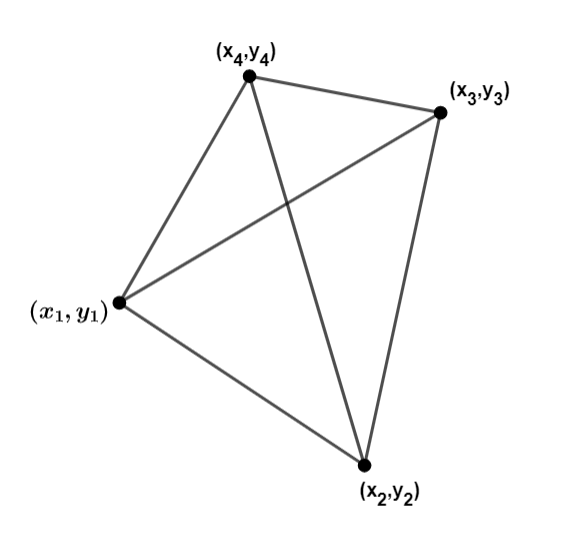
We can find the point of intersection of diagonals by writing their equation and solving both.
The equation for first diagonal is \[\dfrac{y-{{y}_{3}}}{x-{{x}_{3}}}=\dfrac{{{y}_{1}}-{{y}_{3}}}{{{x}_{3}}-{{x}_{3}}}\] , similarly the equation for the other diagonal is \[\dfrac{y-{{y}_{2}}}{x-{{x}_{2}}}=\dfrac{{{y}_{4}}-{{y}_{2}}}{{{x}_{4}}-{{x}_{2}}}\]. As the point of intersection lies on both diagonals, it must satisfy both equations. Solving the above two equations, we can find the point of intersection of diagonals.
Now, let’s look at some general cases of quadrilaterals such as square, rectangle, rhombus, parallelogram. For these quadrilaterals, the diagonals are bisectors of each other, so we can find the point of intersection by finding the midpoint of two opposite vertices.
Note: For different polygons, if the number of vertices that is the number of diagonals is more than two. We have to follow the same method, write an equation for any two diagonals, find their point of intersection, and then check if this point lies on another diagonal or not. Calculation mistakes while solving the equations should be avoided.
Complete step-by-step solution:
We are not given a particular type of quadrilateral, let’s see the most general case with four vertices. Let the quadrilateral ABCD have coordinates of vertices as \[\left( {{x}_{1}},{{y}_{1}} \right),\left( {{x}_{2}},{{y}_{2}} \right),\left( {{x}_{3}},{{y}_{3}} \right)\And \left( {{x}_{4}},{{y}_{4}} \right)\] respectively.
We can find the point of intersection of diagonals by writing their equation and solving both.
The equation for first diagonal is \[\dfrac{y-{{y}_{3}}}{x-{{x}_{3}}}=\dfrac{{{y}_{1}}-{{y}_{3}}}{{{x}_{3}}-{{x}_{3}}}\] , similarly the equation for the other diagonal is \[\dfrac{y-{{y}_{2}}}{x-{{x}_{2}}}=\dfrac{{{y}_{4}}-{{y}_{2}}}{{{x}_{4}}-{{x}_{2}}}\]. As the point of intersection lies on both diagonals, it must satisfy both equations. Solving the above two equations, we can find the point of intersection of diagonals.
Now, let’s look at some general cases of quadrilaterals such as square, rectangle, rhombus, parallelogram. For these quadrilaterals, the diagonals are bisectors of each other, so we can find the point of intersection by finding the midpoint of two opposite vertices.
Note: For different polygons, if the number of vertices that is the number of diagonals is more than two. We have to follow the same method, write an equation for any two diagonals, find their point of intersection, and then check if this point lies on another diagonal or not. Calculation mistakes while solving the equations should be avoided.
Recently Updated Pages
Basicity of sulphurous acid and sulphuric acid are

Master Class 12 Economics: Engaging Questions & Answers for Success
Master Class 12 Biology: Engaging Questions & Answers for Success
Master Class 11 English: Engaging Questions & Answers for Success
Master Class 11 Physics: Engaging Questions & Answers for Success
Master Class 11 Computer Science: Engaging Questions & Answers for Success
Trending doubts
Difference Between Plant Cell and Animal Cell
Fill the blanks with the suitable prepositions 1 The class 9 english CBSE
What is pollution? How many types of pollution? Define it
What is the full form of pH?
What is the Full Form of ICSE, CBSE and SSC
Name 10 Living and Non living things class 9 biology CBSE