




Find the area of trapezium \[ABCD\] as given in the figure in which \[ADCE\] is a rectangle.
Answer
 Verified
661.2k+ views
Hint: A trapezium is a quadrilateral which is defined as a shape with four sides and one set of parallels side.
The line segment connecting the midpoints of the non-parallel sides of a trapezoid is called the mid-segment.
If we drew a line segment, between the two non-parallels sides. From the mid-point of both sides, the trapezium will be divided into two unequal parts.
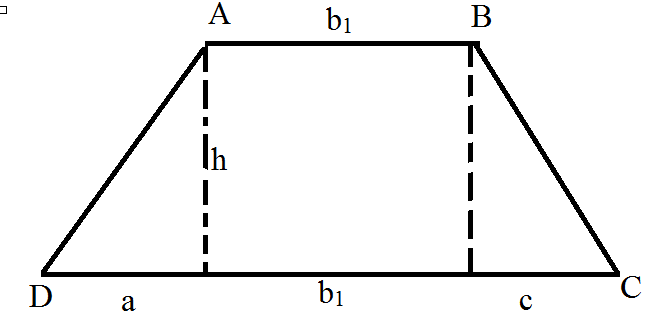
Area\[ = \dfrac{k}{2}(AB + CD)\]
We know that
Area of trapezoid \[ = \]area of triangle (1)\[ + \] area of rectangle \[ + \]area of triangle (2)
That means
\[A = \dfrac{{ah}}{2} + bh + \dfrac{{ch}}{2}\]
\[A = \dfrac{{ah + 2{b_1}h + cb}}{2}\]
Simplifying the equation, rearranging the term and factoring result to
\[A = \dfrac{h}{2}\left[ {{b_1}\_(a + {b_1}\_c)} \right].........(1)\]
We assume the longer base of the trapezium be \[{b_2}\] then
\[{b_2} = a + {b_1} + c...........(2)\]
Substituting (2) in equation (1)
\[A = \dfrac{h}{2}\left( {{b_1} + {b_2}} \right)\]
Therefore, the arc of trapezium with b bases \[{b_1} + {b_2}\] and altitude h is
\[A = \dfrac{h}{2}\left( {{b_1} + {b_2}} \right)\]
Therefore
Complete step by step answer:
Given image= where ADCE is a rectangle
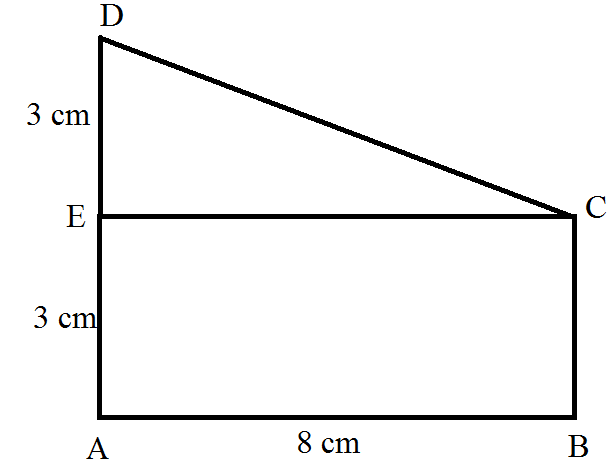
Given
\[BE = 3cm\] \[AB = 3 + 3 = 6cm\]
\[EA = 3cm\] \[CD = 3cm\]
\[AD = 8cm\] \[AD = 8cm\]
Area of trapezium \[ABCD = \dfrac{1}{2} \times \] parallel sides \[ \times \]height
\[ = \dfrac{1}{2} \times (AB + CD) \times AD\]
\[ = \dfrac{1}{2} \times (6 + 3) \times 8\] {BY putting the value of AB, CD and Ad in the formula}
\[ = \dfrac{1}{2} \times 9 \times 8 = 36c{m^2}\]
Hence,
The area of the trapezium
\[ABCD = 36c{m^2}\]
Note: Properties of trapezium
The sum of all the four angles of the trapezium is equal to \[{360^0}\]
It has two parallels and two non-parallels sides
The diagonals of regular trapezium bisect each other
The length of the mid-segment is equal to half the sum of the parallel’s bases, in trapezium
Two Paris of adjacent angles of trapezium formed between the parallel’s sides and one of the non-parallels side, add up to 180 degrees.
The line segment connecting the midpoints of the non-parallel sides of a trapezoid is called the mid-segment.
If we drew a line segment, between the two non-parallels sides. From the mid-point of both sides, the trapezium will be divided into two unequal parts.
Area\[ = \dfrac{k}{2}(AB + CD)\]
We know that
Area of trapezoid \[ = \]area of triangle (1)\[ + \] area of rectangle \[ + \]area of triangle (2)
That means
\[A = \dfrac{{ah}}{2} + bh + \dfrac{{ch}}{2}\]
\[A = \dfrac{{ah + 2{b_1}h + cb}}{2}\]
Simplifying the equation, rearranging the term and factoring result to
\[A = \dfrac{h}{2}\left[ {{b_1}\_(a + {b_1}\_c)} \right].........(1)\]
We assume the longer base of the trapezium be \[{b_2}\] then
\[{b_2} = a + {b_1} + c...........(2)\]
Substituting (2) in equation (1)
\[A = \dfrac{h}{2}\left( {{b_1} + {b_2}} \right)\]
Therefore, the arc of trapezium with b bases \[{b_1} + {b_2}\] and altitude h is
\[A = \dfrac{h}{2}\left( {{b_1} + {b_2}} \right)\]
Therefore
Complete step by step answer:
Given image= where ADCE is a rectangle
Given
\[BE = 3cm\] \[AB = 3 + 3 = 6cm\]
\[EA = 3cm\] \[CD = 3cm\]
\[AD = 8cm\] \[AD = 8cm\]
Area of trapezium \[ABCD = \dfrac{1}{2} \times \] parallel sides \[ \times \]height
\[ = \dfrac{1}{2} \times (AB + CD) \times AD\]
\[ = \dfrac{1}{2} \times (6 + 3) \times 8\] {BY putting the value of AB, CD and Ad in the formula}
\[ = \dfrac{1}{2} \times 9 \times 8 = 36c{m^2}\]
Hence,
The area of the trapezium
\[ABCD = 36c{m^2}\]
Note: Properties of trapezium
The sum of all the four angles of the trapezium is equal to \[{360^0}\]
It has two parallels and two non-parallels sides
The diagonals of regular trapezium bisect each other
The length of the mid-segment is equal to half the sum of the parallel’s bases, in trapezium
Two Paris of adjacent angles of trapezium formed between the parallel’s sides and one of the non-parallels side, add up to 180 degrees.
Recently Updated Pages
Write any three differences between metals and nonmetals class 10 social science CBSE

Amit standing on a horizontal plane finds a bird flying class 10 maths CBSE
Two circles of radii 5 cm and 3 cm intersect at two class 10 maths CBSE
Solve the following i John and Jivanti together have class 10 maths CBSE
What is the relation between orthocenter circumcentre class 10 maths CBSE
Two plane mirrors are inclined at 70circ A ray incident class 10 physics CBSE
Trending doubts
Explain the Treaty of Vienna of 1815 class 10 social science CBSE
1 GB equals how many MB?
10 examples of evaporation in daily life with explanations
What is the full form of POSCO class 10 social science CBSE
Which is the hottest planet in the Solar system A Earth class 10 social science CBSE
Name any four life processes in living things class 10 biology CBSE