



Do the sides, \[15,17\] and \[8\] form a right triangle? If so, which side is the hypotenuse?
A. \[15\]
B. \[17\]
C. \[8\]
D. \[10\]
Answer
 Verified
592.2k+ views
Hint: We are asked whether the triangle formed by the given sides form a right angled triangle. First recall the Pythagoras theorem and its condition for which a triangle can be called a right angled triangle. Check whether the sides given satisfy those conditions.
Complete step-by-step answer:
Given, the sides are \[15,17\] and \[8\]
Let the given sides be of a triangle ABC where
\[{\text{AB}} = 15\]
\[{\text{AC}} = 17\]
\[{\text{BC}} = 8\]
For a triangle to be right angled triangle, it must satisfy Pythagoras theorem which says
\[{\text{hypotenus}}{{\text{e}}^2} = {\text{bas}}{{\text{e}}^2} + {\text{perpendicula}}{{\text{r}}^2}\]
And hypotenuse is always the longest side.
Let us draw the triangle ABC
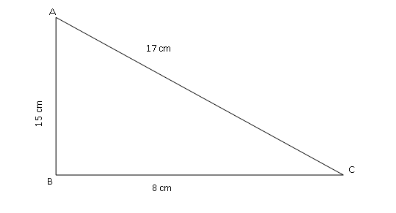
Here the longest side is \[{\text{AC}} = 17\] , so for ABC to be a right angled triangle we must have
\[{\text{A}}{{\text{C}}^2} = {\text{A}}{{\text{B}}^2} + {\text{B}}{{\text{C}}^2}\]
Let us calculate L.H.S and R.H.S separately,
L.H.S \[ = {\text{A}}{{\text{C}}^2} = {17^2} = 289\]
R.H.S \[ = {\text{A}}{{\text{B}}^2} + {\text{B}}{{\text{C}}^2}\]
\[
= {15^2} + {8^2} \\
= 225 + 64 \\
= 289
\]
We observe that L.H.S \[ = \] R.H.S
Therefore, triangle ABC or the given triangle is a right angled triangle and its hypotenuse is \[17\] .
So, the correct answer is “Option B”.
Note: Always remember the condition given by Pythagoras theorem as it is used in most of the problems. Hypotenuse is always the longest side and it is to the opposite of the right angle of the triangle. Pythagora's theorem is also used in our day to day life such as for calculating steepness of hill or mountain, height of a building, length of a ladder, used in construction and architecture works and used to find the shortest distance between two given points and also for many other purposes.
Complete step-by-step answer:
Given, the sides are \[15,17\] and \[8\]
Let the given sides be of a triangle ABC where
\[{\text{AB}} = 15\]
\[{\text{AC}} = 17\]
\[{\text{BC}} = 8\]
For a triangle to be right angled triangle, it must satisfy Pythagoras theorem which says
\[{\text{hypotenus}}{{\text{e}}^2} = {\text{bas}}{{\text{e}}^2} + {\text{perpendicula}}{{\text{r}}^2}\]
And hypotenuse is always the longest side.
Let us draw the triangle ABC
Here the longest side is \[{\text{AC}} = 17\] , so for ABC to be a right angled triangle we must have
\[{\text{A}}{{\text{C}}^2} = {\text{A}}{{\text{B}}^2} + {\text{B}}{{\text{C}}^2}\]
Let us calculate L.H.S and R.H.S separately,
L.H.S \[ = {\text{A}}{{\text{C}}^2} = {17^2} = 289\]
R.H.S \[ = {\text{A}}{{\text{B}}^2} + {\text{B}}{{\text{C}}^2}\]
\[
= {15^2} + {8^2} \\
= 225 + 64 \\
= 289
\]
We observe that L.H.S \[ = \] R.H.S
Therefore, triangle ABC or the given triangle is a right angled triangle and its hypotenuse is \[17\] .
So, the correct answer is “Option B”.
Note: Always remember the condition given by Pythagoras theorem as it is used in most of the problems. Hypotenuse is always the longest side and it is to the opposite of the right angle of the triangle. Pythagora's theorem is also used in our day to day life such as for calculating steepness of hill or mountain, height of a building, length of a ladder, used in construction and architecture works and used to find the shortest distance between two given points and also for many other purposes.

Recently Updated Pages
Master Class 12 Business Studies: Engaging Questions & Answers for Success

Master Class 12 Biology: Engaging Questions & Answers for Success
Master Class 12 Chemistry: Engaging Questions & Answers for Success
Class 12 Question and Answer - Your Ultimate Solutions Guide
Master Class 11 Social Science: Engaging Questions & Answers for Success
Master Class 11 English: Engaging Questions & Answers for Success
Trending doubts
What is the Full Form of ICSE / ISC ?
Fill the blanks with the suitable prepositions 1 The class 9 english CBSE
Difference Between Plant Cell and Animal Cell
How many hours before the closure of election must class 9 social science CBSE
What is pollution? How many types of pollution? Define it
Name 10 Living and Non living things class 9 biology CBSE