



Curved surface area of a cone with a base radius of 20cm is 500 $\pi c{m^2}$. Find the height of the cone.
Answer
 Verified
609.3k+ views
Hint: In order to solve this problem we need to draw the diagram of cone assuming height, the radius of the base, and slant height as variable and then use the formula of CSA to get the slant height of the cone and then use the Pythagoras theorem, to get the height of the cone since the CSA is already provided. Doing this will solve your problem and will give you the right answer.
Complete step-by-step solution:
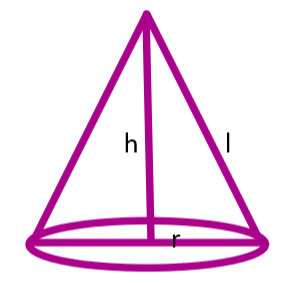
Let h be the height, r be the radius and l be the slant height of the cone.
The radius of the cone is given as 20cm.
Here, we will apply the formula of the curved surface area of cone $\pi rl$ to get the slant height l.
Here it is given that the curved surface area of the cone is, 500$\pi c{m^2}$
The base radius r is given as 20cm.
We know that the curved surface area of cone $\pi rl$.
So, we do after putting the value of radius and equating the formula to the surface area we get,
$ \Rightarrow 500\pi c{m^2} = \pi \times 20cm \times l$
We get the value of slant height $l = 25cm$
And now for calculating height, we apply the Pythagoras theorem.
That is ${l^2} = {h^2} + {r^2}$
So, we can say ${h^2} = {l^2} - {r^2}$
On putting the values and calculating we get the value of height as,
$ {h^2} = 625 - 400 \\
\Rightarrow {h^2} = 225 \\
\Rightarrow h = 15cm $
Hence, the height of the cone is 15cm.
Note: Whenever such a type of question is given, first apply the formula that results in the question to find out the unknown term. And then apply the formula for that term which is asked in the question. We always need to remember that if any of the terms like area, perimeter, or volume is given then we need to use that term to calculate any other variable. Doing this will solve your problem and will give you the right answer.
Complete step-by-step solution:
Let h be the height, r be the radius and l be the slant height of the cone.
The radius of the cone is given as 20cm.
Here, we will apply the formula of the curved surface area of cone $\pi rl$ to get the slant height l.
Here it is given that the curved surface area of the cone is, 500$\pi c{m^2}$
The base radius r is given as 20cm.
We know that the curved surface area of cone $\pi rl$.
So, we do after putting the value of radius and equating the formula to the surface area we get,
$ \Rightarrow 500\pi c{m^2} = \pi \times 20cm \times l$
We get the value of slant height $l = 25cm$
And now for calculating height, we apply the Pythagoras theorem.
That is ${l^2} = {h^2} + {r^2}$
So, we can say ${h^2} = {l^2} - {r^2}$
On putting the values and calculating we get the value of height as,
$ {h^2} = 625 - 400 \\
\Rightarrow {h^2} = 225 \\
\Rightarrow h = 15cm $
Hence, the height of the cone is 15cm.
Note: Whenever such a type of question is given, first apply the formula that results in the question to find out the unknown term. And then apply the formula for that term which is asked in the question. We always need to remember that if any of the terms like area, perimeter, or volume is given then we need to use that term to calculate any other variable. Doing this will solve your problem and will give you the right answer.
Recently Updated Pages
Master Class 12 Business Studies: Engaging Questions & Answers for Success

Master Class 12 Biology: Engaging Questions & Answers for Success
Master Class 12 Chemistry: Engaging Questions & Answers for Success
Class 12 Question and Answer - Your Ultimate Solutions Guide
Master Class 11 Social Science: Engaging Questions & Answers for Success
Master Class 11 English: Engaging Questions & Answers for Success
Trending doubts
What is the Full Form of ICSE / ISC ?
Fill the blanks with the suitable prepositions 1 The class 9 english CBSE
Difference Between Plant Cell and Animal Cell
How many hours before the closure of election must class 9 social science CBSE
What is pollution? How many types of pollution? Define it
Name 10 Living and Non living things class 9 biology CBSE