




How do you convert primary alcohol to aldehyde?
Answer
 Verified
622.5k+ views
Hint: A primary alcohol is an alcohol in which the hydroxyl group $\left( OH \right)$is bonded to a primary carbon atom. The primary alcohol is converted to aldehyde by the oxidation reaction using mild oxidizing reagent.
Complete step-by-step answer:Firstly, let us see oxidation reaction.
Oxidation reaction is defined as the loss of electrons where the reactant loses its electrons to form a new product. Oxidizing agent is used to carry out the oxidation reaction.
The oxidation reaction of primary alcohol to alcohol is a type of elimination reaction as the saturated compound having $C-O$ single bond is converted to compound with carbon-oxygen double bond.
We can convert a primary alcohol to aldehyde by oxidation of alcohol with mild oxidizing agent. Few mild oxidizing reagents used for the conversion of primary alcohol to aldehyde are as follows:
1. Collins reagent: $Cr{{O}_{3}}.2{{C}_{5}}{{H}_{5}}N\,$
2. PCC: pyridinium chlorochromate. $Cr{{O}_{3}}.{{C}_{5}}{{H}_{5}}N.HCl$
3. PDC: pyridinium dichromate ${{\left( {{C}_{5}}{{H}_{5}}NH \right)}_{2}}^{2+}C{{r}_{2}}{{O}_{7}}^{2-}$
The reaction for the conversion of Primary alcohol to aldehyde is as follows,
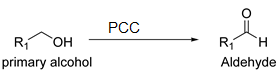
Where ${{R}_{1}}$ is an alkyl group.
For example: $C{{H}_{3}}C{{H}_{2}}OH\xrightarrow{PCC}C{{H}_{3}}CHO$
It should be noted that the oxidizing agent used for the above conversion should be mild. If strong oxidizing agents such as jones reagent are used, then they convert alcohols directly to the carboxylic acid. It means in the presence of strong oxidizing agent aldehyde will be further oxidized and carboxylic acids will be the final product.
So, to stop the reaction at aldehyde we should always use mild oxidizing agents.
Note:During the reaction of primary alcohols to aldehyde make sure that the water is not present as if it is present it will add to the aldehyde to form a hydrate which will require another molecule of PCC to prepare the aldehyde.
Complete step-by-step answer:Firstly, let us see oxidation reaction.
Oxidation reaction is defined as the loss of electrons where the reactant loses its electrons to form a new product. Oxidizing agent is used to carry out the oxidation reaction.
The oxidation reaction of primary alcohol to alcohol is a type of elimination reaction as the saturated compound having $C-O$ single bond is converted to compound with carbon-oxygen double bond.
We can convert a primary alcohol to aldehyde by oxidation of alcohol with mild oxidizing agent. Few mild oxidizing reagents used for the conversion of primary alcohol to aldehyde are as follows:
1. Collins reagent: $Cr{{O}_{3}}.2{{C}_{5}}{{H}_{5}}N\,$
2. PCC: pyridinium chlorochromate. $Cr{{O}_{3}}.{{C}_{5}}{{H}_{5}}N.HCl$
3. PDC: pyridinium dichromate ${{\left( {{C}_{5}}{{H}_{5}}NH \right)}_{2}}^{2+}C{{r}_{2}}{{O}_{7}}^{2-}$
The reaction for the conversion of Primary alcohol to aldehyde is as follows,
Where ${{R}_{1}}$ is an alkyl group.
For example: $C{{H}_{3}}C{{H}_{2}}OH\xrightarrow{PCC}C{{H}_{3}}CHO$
It should be noted that the oxidizing agent used for the above conversion should be mild. If strong oxidizing agents such as jones reagent are used, then they convert alcohols directly to the carboxylic acid. It means in the presence of strong oxidizing agent aldehyde will be further oxidized and carboxylic acids will be the final product.
So, to stop the reaction at aldehyde we should always use mild oxidizing agents.
Note:During the reaction of primary alcohols to aldehyde make sure that the water is not present as if it is present it will add to the aldehyde to form a hydrate which will require another molecule of PCC to prepare the aldehyde.
Recently Updated Pages
Which of the following graphs shows the variation of class 12 physics CBSE

Draw a labelled diagram of the human male reproductive class 12 biology CBSE
Describe the experiment to compare the emf of two cells class 12 physics CBSE
What is standard hydrogen electrode
What is conventional current and electric current class 12 physics CBSE
2Bromopentane is treated with an alcoholic KOH solution class 12 chemistry CBSE
Trending doubts
Draw a labelled sketch of the human eye class 12 physics CBSE
Which are the Top 10 Largest Countries of the World?
A member of Simon commission later became Prime Minister class 12 social science CBSE
Differentiate between homogeneous and heterogeneous class 12 chemistry CBSE
Draw ray diagrams each showing i myopic eye and ii class 12 physics CBSE
Which is the correct genotypic ratio of mendel dihybrid class 12 biology CBSE