




Construct a parallelogram ABCD such that $AC=6cm,BD=4.6cm$ and angle between them $45{}^\circ $ .
Answer
 Verified
626.4k+ views
Hint: For construction of a parallelogram we need a protractor, rules, pencil compass. Given lines are diagonals, we need to observe that end points of these lines are the opposite vertices of a parallelogram. By basic knowledge of geometry, we can say that diagonals of parallelograms always bisect each other. So, find the mis-point and draw another line segment passing through the midpoint of the first line segment. By joining the ends of these both line segments we get our required parallelogram ABCD.
Complete step-by-step answer:
Aim: To draw a parallelogram ABCD with lengths of line segments AC, BD as 6 cm, 4.6 cm respectively and angle between them as 45 degrees.
Given $AC=6cm,BD=4.6cm$
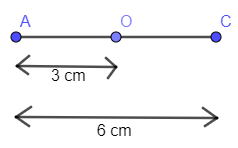
First take a ruler and draw a line segment of length 6 cm. Now, mark the end points of this line segment as A, C.
Now, mark a point O at a distance of 3 cm from A to line.
Now, the figure should like as shown below:
Now, take a protractor and mark the direction of . Take a compass and draw an arc from O with radius 2.3 cm.
As we know O is mid-point of AC we took AO as 3 cm.
As we also know O is taken midpoint of BD taken, we draw a line of 2.3 cm with ${45}^{\circ}$ with AC.
Now mark the intersection of line and arc as B.
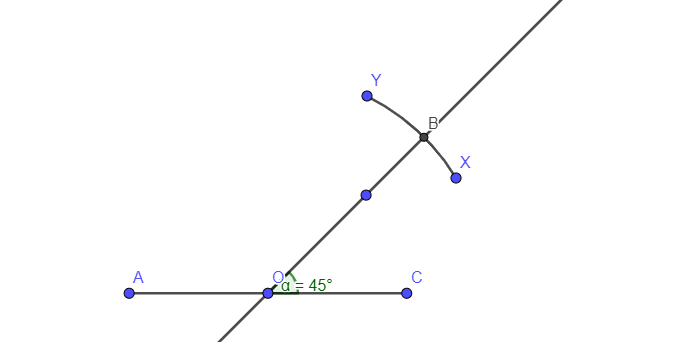
Do the similar way opposite side to get D.
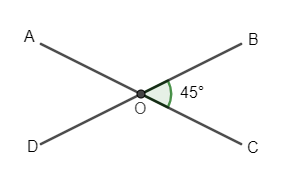
Now repeat the same on the other side of AC and find a point at 2.3 cm with ${45}^{\circ}$ .
Then join the both points B, D and mark the line as BD.
Now the figure will look as follows: -
Now by joining the point AB, BC, CD, DA we get our required parallelogram.
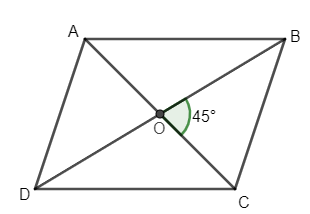
Hence, we constructed our required parallelogram.
Note: The compass may give error of nearly 0.1 cm due to sight error near the ruler whose precision is 0.1 cm. Kindly ignoring that we surely get out required parallelogram ABCD.
Complete step-by-step answer:
Aim: To draw a parallelogram ABCD with lengths of line segments AC, BD as 6 cm, 4.6 cm respectively and angle between them as 45 degrees.
Given $AC=6cm,BD=4.6cm$
First take a ruler and draw a line segment of length 6 cm. Now, mark the end points of this line segment as A, C.
Now, mark a point O at a distance of 3 cm from A to line.
Now, the figure should like as shown below:
Now, take a protractor and mark the direction of . Take a compass and draw an arc from O with radius 2.3 cm.
As we know O is mid-point of AC we took AO as 3 cm.
As we also know O is taken midpoint of BD taken, we draw a line of 2.3 cm with ${45}^{\circ}$ with AC.
Now mark the intersection of line and arc as B.
Do the similar way opposite side to get D.
Now repeat the same on the other side of AC and find a point at 2.3 cm with ${45}^{\circ}$ .
Then join the both points B, D and mark the line as BD.
Now the figure will look as follows: -
Now by joining the point AB, BC, CD, DA we get our required parallelogram.
Hence, we constructed our required parallelogram.
Note: The compass may give error of nearly 0.1 cm due to sight error near the ruler whose precision is 0.1 cm. Kindly ignoring that we surely get out required parallelogram ABCD.
Recently Updated Pages
Master Class 10 Social Science: Engaging Questions & Answers for Success

Master Class 10 Science: Engaging Questions & Answers for Success
Master Class 10 Maths: Engaging Questions & Answers for Success
Master Class 10 General Knowledge: Engaging Questions & Answers for Success
Master Class 10 Computer Science: Engaging Questions & Answers for Success
Class 10 Question and Answer - Your Ultimate Solutions Guide
Trending doubts
What is the full form of PNG A Petrol Natural Gas B class 10 chemistry CBSE
Explain the Treaty of Vienna of 1815 class 10 social science CBSE
In cricket, how many legal balls are there in a standard over?
Why is there a time difference of about 5 hours between class 10 social science CBSE
Who Won 36 Oscar Awards? Record Holder Revealed
What is the median of the first 10 natural numbers class 10 maths CBSE