




As observed from the top of a lighthouse, 100 m above the sea level, the angle of depression of a ship, sailing directly towards it, changes from 30° to 45°. Determine the distance travelled by the ship during the period of observation.
Answer
 Verified
564.3k+ views
Hint: Solve by representing the text with a diagram, then use trigonometric formulas to find the relation between the given variables. Then calculate the distance travelled by the ship during the period of observation.
Complete step-by-step answer:
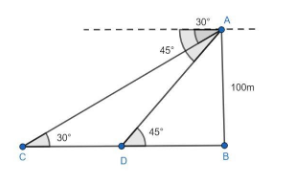
In the given figure, AB is the lighthouse and is 100 m in height. The angle of depression of the ship at C is 30° and the angle of depression of the ship at D is 45°.
We know that alternate angles between two parallel lines are equal. Hence, the angle ACB is equal to 30° and the angle ADB is equal to 45°.
We can use the tangent of the angle to find the distance of travel during the period of observation.
In triangle ABC, the tangent of the angle C is the ratio of side AB to side BC.
\[\tan C = \dfrac{{AB}}{{BC}}\]
Angle C is 30° and AB is 100m, then, we can find the value of the side BC.
\[\tan 30^\circ = \dfrac{{100}}{{BC}}\]
We know that the value of \[\tan 30^\circ \] is \[\dfrac{1}{{\sqrt 3 }}\], then, we have:
\[\dfrac{1}{{\sqrt 3 }} = \dfrac{{100}}{{BC}}\]
Cross multiplying, we have:
\[BC = 100\sqrt 3 m..........(1)\]
Now, in triangle ABD, the tangent of the angle D is the ratio of side AB to side BD.
\[\tan D = \dfrac{{AB}}{{BD}}\]
Angle D is 45° and AB is 100m, then, we can find the value of the side BD.
\[\tan 45^\circ = \dfrac{{100}}{{BD}}\]
We know that the value of \[\tan 45^\circ \] is 1, then, we have:
\[1 = \dfrac{{100}}{{BD}}\]
Cross multiplying, we have:
\[BD = 100m..........(2)\]
From equations (1) and (2), we can find the value of CD.
\[CD = BC - BD\]
\[CD = 100\sqrt 3 - 100\]
\[CD = 100(\sqrt 3 - 1)m\]
Hence, the answer is \[100(\sqrt 3 - 1)m\].
Note: You may think that the angle of depression is the angle made by the observer’s line of sight with the vertical line but it is wrong. It is the angle made between the line of sight and the horizontal line.
Complete step-by-step answer:
In the given figure, AB is the lighthouse and is 100 m in height. The angle of depression of the ship at C is 30° and the angle of depression of the ship at D is 45°.
We know that alternate angles between two parallel lines are equal. Hence, the angle ACB is equal to 30° and the angle ADB is equal to 45°.
We can use the tangent of the angle to find the distance of travel during the period of observation.
In triangle ABC, the tangent of the angle C is the ratio of side AB to side BC.
\[\tan C = \dfrac{{AB}}{{BC}}\]
Angle C is 30° and AB is 100m, then, we can find the value of the side BC.
\[\tan 30^\circ = \dfrac{{100}}{{BC}}\]
We know that the value of \[\tan 30^\circ \] is \[\dfrac{1}{{\sqrt 3 }}\], then, we have:
\[\dfrac{1}{{\sqrt 3 }} = \dfrac{{100}}{{BC}}\]
Cross multiplying, we have:
\[BC = 100\sqrt 3 m..........(1)\]
Now, in triangle ABD, the tangent of the angle D is the ratio of side AB to side BD.
\[\tan D = \dfrac{{AB}}{{BD}}\]
Angle D is 45° and AB is 100m, then, we can find the value of the side BD.
\[\tan 45^\circ = \dfrac{{100}}{{BD}}\]
We know that the value of \[\tan 45^\circ \] is 1, then, we have:
\[1 = \dfrac{{100}}{{BD}}\]
Cross multiplying, we have:
\[BD = 100m..........(2)\]
From equations (1) and (2), we can find the value of CD.
\[CD = BC - BD\]
\[CD = 100\sqrt 3 - 100\]
\[CD = 100(\sqrt 3 - 1)m\]
Hence, the answer is \[100(\sqrt 3 - 1)m\].
Note: You may think that the angle of depression is the angle made by the observer’s line of sight with the vertical line but it is wrong. It is the angle made between the line of sight and the horizontal line.
Recently Updated Pages
Master Class 11 English: Engaging Questions & Answers for Success

Master Class 11 Social Science: Engaging Questions & Answers for Success
Master Class 11 Maths: Engaging Questions & Answers for Success
Master Class 11 Biology: Engaging Questions & Answers for Success
Master Class 11 Physics: Engaging Questions & Answers for Success
Master Class 11 Chemistry: Engaging Questions & Answers for Success
Trending doubts
Explain the Treaty of Vienna of 1815 class 10 social science CBSE
First Cotton Mill of India
In which year voting age was reduced from 21 to 18?
10 examples of evaporation in daily life with explanations
What planets have no moons Which one has only one moon class 10 physics CBSE
What is the full form of POSCO class 10 social science CBSE