




How many are the examples of rhizomes
Ginger, turmeric, canna, waterlily, banana, colocasia, alocasia, colchicum, saffron.
(a) Two
(b) Four
(c) Five
(d) Eight
Answer
 Verified
633.9k+ views
Hint: plants that contain underground modified stems that store food which is developed from the auxiliary and grows horizontally and gives rise to a new plant.
Complete answer:
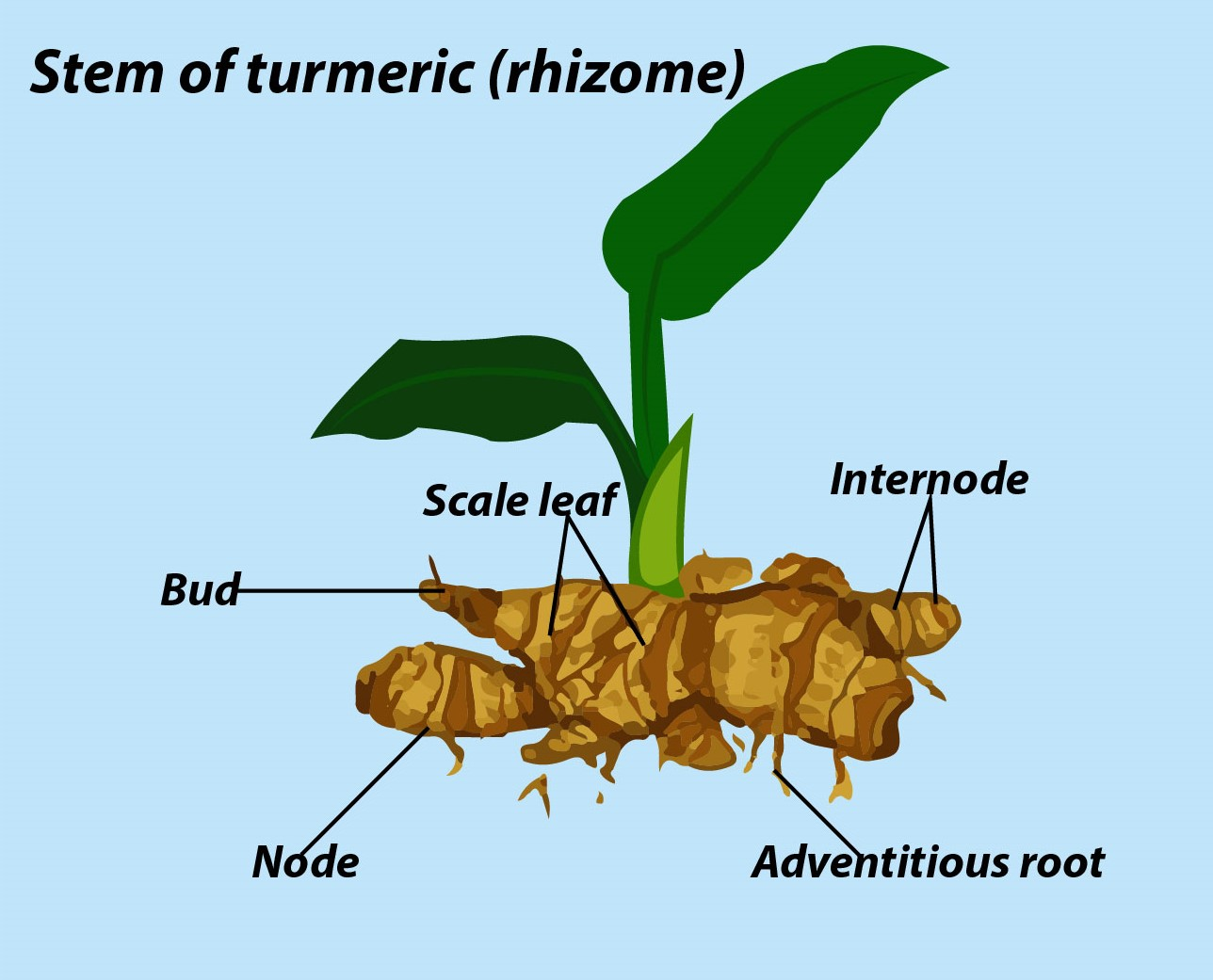
The main function of the stem is to spread out branches that bear leaves, flowers, and fruits. It also helps in the conduction of water and minerals and photosynthates. But in some plants, the stem is modified to perform other functions like storage of food, vegetative propagation, giving mechanical support, and protection. Some of the underground stem modifications are stem tuber, rhizome, corm, and bulb. The stems that develop from axillary buds and grow horizontally give rise to a new plant is called a rhizome. Ginger, turmeric, canna, and banana are examples of rhizomes.
Additional Information: - In order to survive in unfavorable conditions, vegetative parts like roots, stems, and leaves in plants undergo some modifications.
- Roots in plants are modified to prop roots, stilt roots, pneumatic roots, velamen roots, haustorial roots, nodular roots, photosynthetic roots.
- Underground stems are modified into stem tuber, rhizome, corm, and bulb, aerial stems are modified into stem tendrils, thorns, phylloclades, cladophylls, and bulbils.
- Ginger, turmeric, canna, and banana are examples of rhizomes; water lily is an example of thorns; colocasia, alocasia, and saffron are examples of corm
So, the correct answer is ‘four’
Note: -Not only roots and stem of the plant undergo modification but leaves also get modified to tendrils, spines, phyllodes, insectivorous leaves, and leaves that help in vegetative propagation.
-In colchicum, leaves are modified to tendrils.
-Other examples of stem modification are amorphophallus for corm, onions for bulbs, and

Complete answer:
The main function of the stem is to spread out branches that bear leaves, flowers, and fruits. It also helps in the conduction of water and minerals and photosynthates. But in some plants, the stem is modified to perform other functions like storage of food, vegetative propagation, giving mechanical support, and protection. Some of the underground stem modifications are stem tuber, rhizome, corm, and bulb. The stems that develop from axillary buds and grow horizontally give rise to a new plant is called a rhizome. Ginger, turmeric, canna, and banana are examples of rhizomes.
Additional Information: - In order to survive in unfavorable conditions, vegetative parts like roots, stems, and leaves in plants undergo some modifications.
- Roots in plants are modified to prop roots, stilt roots, pneumatic roots, velamen roots, haustorial roots, nodular roots, photosynthetic roots.
- Underground stems are modified into stem tuber, rhizome, corm, and bulb, aerial stems are modified into stem tendrils, thorns, phylloclades, cladophylls, and bulbils.
- Ginger, turmeric, canna, and banana are examples of rhizomes; water lily is an example of thorns; colocasia, alocasia, and saffron are examples of corm
So, the correct answer is ‘four’
Note: -Not only roots and stem of the plant undergo modification but leaves also get modified to tendrils, spines, phyllodes, insectivorous leaves, and leaves that help in vegetative propagation.
-In colchicum, leaves are modified to tendrils.
-Other examples of stem modification are amorphophallus for corm, onions for bulbs, and
Recently Updated Pages
Which of the following graphs shows the variation of class 12 physics CBSE

Draw a labelled diagram of the human male reproductive class 12 biology CBSE
Describe the experiment to compare the emf of two cells class 12 physics CBSE
What is standard hydrogen electrode
What is conventional current and electric current class 12 physics CBSE
2Bromopentane is treated with an alcoholic KOH solution class 12 chemistry CBSE
Trending doubts
Which are the Top 10 Largest Countries of the World?
Differentiate between internal fertilization and external class 12 biology CBSE
What is the Full Form of 1.DPT 2.DDT 3.BCG
Differentiate between lanthanoids and actinoids class 12 chemistry CBSE
Sketch and label the Malpighian body class 12 biology CBSE
Why is the cell called the structural and functional class 12 biology CBSE