




What are chromatin and Chromosomes made from?
Answer
 Verified
588.6k+ views
Hint: Chromatin and Chromosomes are the structures present in the nucleus of the living cells. They play vital roles in cell division and transferring of genetic material from one generation to another.
Complete answer:
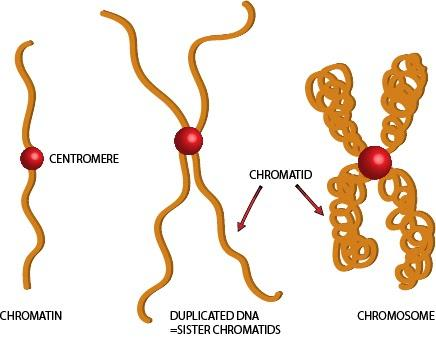
Chromatin fibres are nothing but complex protein compounds and DNA molecules carrying the genetic coding of an organism. This entire unit contained in a chromatin fibre is termed as Genome. They are found to exhibit many functions both in and after cell division. However, one of those is that they prevent tangling or mingling of DNA strands within themselves. Chromatins are present in the form of fibres. They are the actual carriers of the genetic material in a cell. Such an state is possede by the genetic material either prior to cell division or after a successful cell division. Amongst the six phases of mitotic cell division it is found in the interphase (the first or dormant phase) and telophase (the last phase).
Chromosomes are X-shaped structures that are evolved forms of chromatin fibres that aim at implementing cell division and genetic transfer effectively. Every cell has a definite number of chromosomes depending upon the species. These chromosomes carry DNA strands (made up of Deoxyribonucleic acid), the actual carrier of genetic coding and a binding protein called histone. This state of genetic material can be spotted in the rest three phases of mitotic division, that is, Prophase, Metaphase or Anaphase.
Note:
Chromatin state of genetic material before cell division is to keep the nucleus in a compact and dense state that also maintains its shape whereas at the time of cell division, these fibres turn themselves into called chromosomes that participate in cell division and transfer of genetic material.
Complete answer:
Chromatin fibres are nothing but complex protein compounds and DNA molecules carrying the genetic coding of an organism. This entire unit contained in a chromatin fibre is termed as Genome. They are found to exhibit many functions both in and after cell division. However, one of those is that they prevent tangling or mingling of DNA strands within themselves. Chromatins are present in the form of fibres. They are the actual carriers of the genetic material in a cell. Such an state is possede by the genetic material either prior to cell division or after a successful cell division. Amongst the six phases of mitotic cell division it is found in the interphase (the first or dormant phase) and telophase (the last phase).
Chromosomes are X-shaped structures that are evolved forms of chromatin fibres that aim at implementing cell division and genetic transfer effectively. Every cell has a definite number of chromosomes depending upon the species. These chromosomes carry DNA strands (made up of Deoxyribonucleic acid), the actual carrier of genetic coding and a binding protein called histone. This state of genetic material can be spotted in the rest three phases of mitotic division, that is, Prophase, Metaphase or Anaphase.
Note:
Chromatin state of genetic material before cell division is to keep the nucleus in a compact and dense state that also maintains its shape whereas at the time of cell division, these fibres turn themselves into called chromosomes that participate in cell division and transfer of genetic material.
Recently Updated Pages
Which of the following graphs shows the variation of class 12 physics CBSE

Draw a labelled diagram of the human male reproductive class 12 biology CBSE
Describe the experiment to compare the emf of two cells class 12 physics CBSE
What is standard hydrogen electrode
What is conventional current and electric current class 12 physics CBSE
2Bromopentane is treated with an alcoholic KOH solution class 12 chemistry CBSE
Trending doubts
Draw a labelled sketch of the human eye class 12 physics CBSE
Which are the Top 10 Largest Countries of the World?
A member of Simon commission later became Prime Minister class 12 social science CBSE
Differentiate between homogeneous and heterogeneous class 12 chemistry CBSE
Draw ray diagrams each showing i myopic eye and ii class 12 physics CBSE
Which is the correct genotypic ratio of mendel dihybrid class 12 biology CBSE