




An oil drum is in the shape of a cylinder having the following dimensions: Diameter \[ = 2.0m\], height \[ = 7m\]. The painter charges \[{\text{Rs}}{\text{. 3 per }}{{\text{m}}^{\text{2}}}\] to paint the drum. Find the total charge to be paid to the painter for \[10\] drums.
Answer
 Verified
610.5k+ views
Hint: we have to find the total paid the cost to the painter for painting in the drum. The drum is in cylinder shape and its diameter \[ = 2.0m\], height \[ = 7m\]. First, we need to find the surface area of the drum. Then calculate the cost by multiplying the given cost with the surface area of the drum.
Formula Used:
The total surface area of the cylinder is equal to the sum of all areas of the faces of the cylinder. The total surface area is equal to the total (sum) of the curved surface area and a circular area of the cylinder.
The curved surface area of cylinder = $2\pi rh$
The circular Surface area of cylinder = \[2\pi {r^2}\]
So, Total Surface area of cylinder = $2\pi rh + 2\pi {r^2}$
Taking $2\pi r$ common, we will get $ = 2\pi r(r + h)$
So, the total surface area of the cylinder includes the curved surface area and the circular area of the cylinder. It will help you to solve such types of problems if you do not remember the formula of the total surface area of the cylinder.
Total Surface area of cylinder = $2\pi r(r + h)$
Complete step by step answer:
It is given that,
Diameter \[{\text{ = 2m}}\]
Height \[{\text{ = 7m}}\]
The drum is in the shape of a cylinder. So, we will use the formula that we use for a cylinder.
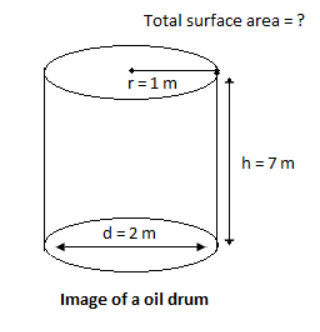
Initially, we will find out the total surface area of the drum.
So, the formula for calculating the total surface area of a cylinder = $2\pi r(r + h)$
As the only diameter is given we will calculate the radius first. So,
\[{\text{radius = }}\dfrac{{{\text{diameter}}}}{{\text{2}}}\]
So, radius \[{\text{ = }}\dfrac{{\text{2}}}{{\text{2}}}{\text{ = 1}}\]
Radius ${\text{ = 1m}}$
Now, taking $\pi = \dfrac{{22}}{7}$
Now, putting the value of radius (r), height (h) and π in the above formula: $2\pi r(r + h)$
Substituting the corresponding values, we get
$\Rightarrow 2 \times \dfrac{{22}}{7} \times 1(7 + 1)$
$\Rightarrow \dfrac{{44}}{7} \times 8 = \dfrac{{352}}{7}{m^2}$
On solving it further, we will get
$\Rightarrow$ The total surface area of drum = $\dfrac{{352}}{7}{m^2}$
As, mentioned in the question that painter charges \[{\text{Rs}}{\text{. 3 per }}{{\text{m}}^{\text{2}}}\] for the drum
We will calculate the cost of the painter to be paid for $\dfrac{{352}}{7}{m^2}$
So, for \[1{\text{ }}{m^2}\] the cost of the painter is \[ = 3\]
For $\dfrac{{352}}{7}{m^2}$ the area of drum, the cost of painter will be = $3 \times \dfrac{{352}}{7} = Rs\dfrac{{1056}}{7}$
So, cost to be paid for one drum = $Rs\dfrac{{1056}}{7}$
We have to calculate the cost for \[10\] drums = $Rs\dfrac{{1056}}{7} \times 10$
On solving we will get, $Rs\dfrac{{10560}}{7}$.
After simplification of the above fraction, we will get the cost to be paid for \[10\] drums \[ = 1508.57\](approx)
$\therefore$ The total charge to be paid to the painter for \[10\] drums is Rs.1508.57
Note:
In this question, we have to focus on the calculations of finding the total surface area of the cylinder. Because here we are using some logic for finding the total surface area of the cylinder. So we have to care about those calculations.
Formula Used:
The total surface area of the cylinder is equal to the sum of all areas of the faces of the cylinder. The total surface area is equal to the total (sum) of the curved surface area and a circular area of the cylinder.
The curved surface area of cylinder = $2\pi rh$
The circular Surface area of cylinder = \[2\pi {r^2}\]
So, Total Surface area of cylinder = $2\pi rh + 2\pi {r^2}$
Taking $2\pi r$ common, we will get $ = 2\pi r(r + h)$
So, the total surface area of the cylinder includes the curved surface area and the circular area of the cylinder. It will help you to solve such types of problems if you do not remember the formula of the total surface area of the cylinder.
Total Surface area of cylinder = $2\pi r(r + h)$
Complete step by step answer:
It is given that,
Diameter \[{\text{ = 2m}}\]
Height \[{\text{ = 7m}}\]
The drum is in the shape of a cylinder. So, we will use the formula that we use for a cylinder.
Initially, we will find out the total surface area of the drum.
So, the formula for calculating the total surface area of a cylinder = $2\pi r(r + h)$
As the only diameter is given we will calculate the radius first. So,
\[{\text{radius = }}\dfrac{{{\text{diameter}}}}{{\text{2}}}\]
So, radius \[{\text{ = }}\dfrac{{\text{2}}}{{\text{2}}}{\text{ = 1}}\]
Radius ${\text{ = 1m}}$
Now, taking $\pi = \dfrac{{22}}{7}$
Now, putting the value of radius (r), height (h) and π in the above formula: $2\pi r(r + h)$
Substituting the corresponding values, we get
$\Rightarrow 2 \times \dfrac{{22}}{7} \times 1(7 + 1)$
$\Rightarrow \dfrac{{44}}{7} \times 8 = \dfrac{{352}}{7}{m^2}$
On solving it further, we will get
$\Rightarrow$ The total surface area of drum = $\dfrac{{352}}{7}{m^2}$
As, mentioned in the question that painter charges \[{\text{Rs}}{\text{. 3 per }}{{\text{m}}^{\text{2}}}\] for the drum
We will calculate the cost of the painter to be paid for $\dfrac{{352}}{7}{m^2}$
So, for \[1{\text{ }}{m^2}\] the cost of the painter is \[ = 3\]
For $\dfrac{{352}}{7}{m^2}$ the area of drum, the cost of painter will be = $3 \times \dfrac{{352}}{7} = Rs\dfrac{{1056}}{7}$
So, cost to be paid for one drum = $Rs\dfrac{{1056}}{7}$
We have to calculate the cost for \[10\] drums = $Rs\dfrac{{1056}}{7} \times 10$
On solving we will get, $Rs\dfrac{{10560}}{7}$.
After simplification of the above fraction, we will get the cost to be paid for \[10\] drums \[ = 1508.57\](approx)
$\therefore$ The total charge to be paid to the painter for \[10\] drums is Rs.1508.57
Note:
In this question, we have to focus on the calculations of finding the total surface area of the cylinder. Because here we are using some logic for finding the total surface area of the cylinder. So we have to care about those calculations.
Recently Updated Pages
Master Class 12 Business Studies: Engaging Questions & Answers for Success

Master Class 12 Biology: Engaging Questions & Answers for Success
Master Class 12 Chemistry: Engaging Questions & Answers for Success
Class 12 Question and Answer - Your Ultimate Solutions Guide
Master Class 11 Social Science: Engaging Questions & Answers for Success
Master Class 11 English: Engaging Questions & Answers for Success
Trending doubts
What is the full form of NDA a National Democratic class 10 social science CBSE
Bharatiya Janata Party was founded in the year A 1979 class 10 social science CBSE
What is meant by the term constituency A Place where class 10 social science CBSE
The highest temperature in Karnataka is recorded in class 10 social science CBSE
What is the "grid" in Formula 1 racing?
Why is there a time difference of about 5 hours between class 10 social science CBSE