




Aftab tells his daughter, “Seven years ago, I was seven times as old as you were then. Also, three years from now, I shall be three times as old as you will be.” (Isn’t this interesting) Represent this situation algebraically and graphically.
Answer
 Verified
654.6k+ views
Hint- Here, we will be proceeding by assuming the present ages of Aftab and his daughter as two different variables and then forming two equations in two variables according to the problem statement.
Let us suppose that the present age of Aftab be $x$ years and the present age of Aftab’s daughter be $y$ years.
According to problem statement seven years ago, Aftab was seven times older than Aftab’s daughter i.e., $x - 7 = 7\left( {y - 7} \right) \Rightarrow x - 7 = 7y - 49 \Rightarrow x - 7y = - 42{\text{ }} \to (1)$
Also three years later, Aftab will be three times as old as Aftab’s daughter at that time i.e., $x + 3 = 3\left( {y + 3} \right) \Rightarrow x + 3 = 3y + 9 \Rightarrow x - 3y = 6{\text{ }} \to {\text{(2)}}$
As we know that the general equation of any straight line having slope $m$ and y-intercept as $c$ is given by $y = mx + c$
Equation (1) can be written as $ \Rightarrow x - 7y = - 42 \Rightarrow 7y = x + 42 \Rightarrow y = \dfrac{x}{7} + 6{\text{ }} \to {\text{(3)}}$
and equation (2) can be written as $ \Rightarrow x - 3y = 6 \Rightarrow 3y = x - 6 \Rightarrow y = \dfrac{x}{3} - 2{\text{ }} \to {\text{(4)}}$
Both the equations (1) and (2) represent equations in two variables.
Clearly, we can see that equation (3) represents the equation of a straight line having slope $\dfrac{1}{7}$ and y-intercept as 6.
Equation (4) also represents the equation of a straight line having slope $\dfrac{1}{3}$ and y-intercept as $\left( { - 2} \right)$.
For a point where these two straight lines cut each other or for the solution of these two straight lines.
Subtracting equation (1) from equation (2), we get
$ \Rightarrow x - 3y - x + 7y = 6 + 42 \Rightarrow 4y = 48 \Rightarrow y = 12$
Put the above value of $y$ in equation (1), we get
$ \Rightarrow x - 7\left( {12} \right) = - 42 \Rightarrow x = - 42 + 84 \Rightarrow x = 42$
Hence, the present age of Aftab is 42 years and the present age of his daughter is 12 years.
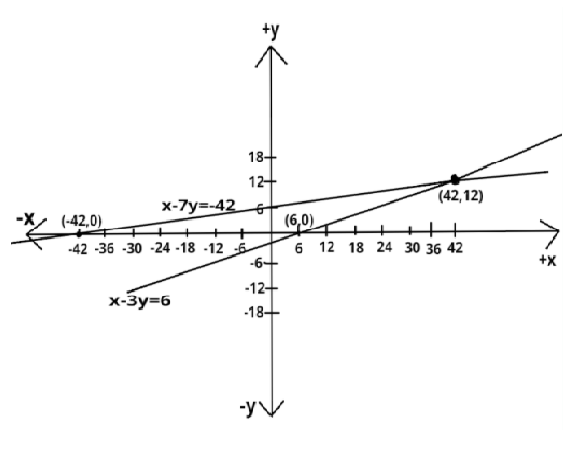
Therefore, the straight lines given by equations (3) and (4) or by equations (1) and (2) meet at a point having coordinates $\left[ {42,12} \right]$.
The above solution represents the situation algebraically.
In order to obtain the graphical solution to the given situation, we will put y=0 in equations (1) and (2) and this will give us a passing point apart from the other passing point i.e., $\left[ {42,12} \right]$
Equation (1) becomes
$ \Rightarrow x - \left( {7 \times 0} \right) = - 42 \Rightarrow x = - 42$
Hence, the straight line represented by equation (1) passes through two points which are (-42,0) and (42,12)
Equation (2) becomes
$ \Rightarrow x - \left( {3 \times 0} \right) = 6 \Rightarrow x = 6$
Hence, the straight line represented by equation (2) passes through two points which are (6,0) and (42,12)
The graphical solution to this problem is shown in the figure.
Note- In these types of problems, we represent the problem statement in terms of two equations with two variables and then compare these equations with the general form of straight lines. Here, we find the point of intersection of these two straight lines. Both of these straight lines pass through this point because these two meet at this particular point.
Let us suppose that the present age of Aftab be $x$ years and the present age of Aftab’s daughter be $y$ years.
According to problem statement seven years ago, Aftab was seven times older than Aftab’s daughter i.e., $x - 7 = 7\left( {y - 7} \right) \Rightarrow x - 7 = 7y - 49 \Rightarrow x - 7y = - 42{\text{ }} \to (1)$
Also three years later, Aftab will be three times as old as Aftab’s daughter at that time i.e., $x + 3 = 3\left( {y + 3} \right) \Rightarrow x + 3 = 3y + 9 \Rightarrow x - 3y = 6{\text{ }} \to {\text{(2)}}$
As we know that the general equation of any straight line having slope $m$ and y-intercept as $c$ is given by $y = mx + c$
Equation (1) can be written as $ \Rightarrow x - 7y = - 42 \Rightarrow 7y = x + 42 \Rightarrow y = \dfrac{x}{7} + 6{\text{ }} \to {\text{(3)}}$
and equation (2) can be written as $ \Rightarrow x - 3y = 6 \Rightarrow 3y = x - 6 \Rightarrow y = \dfrac{x}{3} - 2{\text{ }} \to {\text{(4)}}$
Both the equations (1) and (2) represent equations in two variables.
Clearly, we can see that equation (3) represents the equation of a straight line having slope $\dfrac{1}{7}$ and y-intercept as 6.
Equation (4) also represents the equation of a straight line having slope $\dfrac{1}{3}$ and y-intercept as $\left( { - 2} \right)$.
For a point where these two straight lines cut each other or for the solution of these two straight lines.
Subtracting equation (1) from equation (2), we get
$ \Rightarrow x - 3y - x + 7y = 6 + 42 \Rightarrow 4y = 48 \Rightarrow y = 12$
Put the above value of $y$ in equation (1), we get
$ \Rightarrow x - 7\left( {12} \right) = - 42 \Rightarrow x = - 42 + 84 \Rightarrow x = 42$
Hence, the present age of Aftab is 42 years and the present age of his daughter is 12 years.
Therefore, the straight lines given by equations (3) and (4) or by equations (1) and (2) meet at a point having coordinates $\left[ {42,12} \right]$.
The above solution represents the situation algebraically.
In order to obtain the graphical solution to the given situation, we will put y=0 in equations (1) and (2) and this will give us a passing point apart from the other passing point i.e., $\left[ {42,12} \right]$
Equation (1) becomes
$ \Rightarrow x - \left( {7 \times 0} \right) = - 42 \Rightarrow x = - 42$
Hence, the straight line represented by equation (1) passes through two points which are (-42,0) and (42,12)
Equation (2) becomes
$ \Rightarrow x - \left( {3 \times 0} \right) = 6 \Rightarrow x = 6$
Hence, the straight line represented by equation (2) passes through two points which are (6,0) and (42,12)
The graphical solution to this problem is shown in the figure.
Note- In these types of problems, we represent the problem statement in terms of two equations with two variables and then compare these equations with the general form of straight lines. Here, we find the point of intersection of these two straight lines. Both of these straight lines pass through this point because these two meet at this particular point.
Recently Updated Pages
Master Class 12 Economics: Engaging Questions & Answers for Success

Master Class 12 English: Engaging Questions & Answers for Success
Master Class 12 Social Science: Engaging Questions & Answers for Success
Master Class 12 Maths: Engaging Questions & Answers for Success
Master Class 12 Physics: Engaging Questions & Answers for Success
Master Class 10 English: Engaging Questions & Answers for Success
Trending doubts
Explain the Treaty of Vienna of 1815 class 10 social science CBSE
Why is it 530 pm in india when it is 1200 afternoon class 10 social science CBSE
What is the full form of POSCO class 10 social science CBSE
Define Potential, Developed, Stock and Reserved resources
The speaker of the Lok Sabha is elected by the APresident class 10 social science CBSE
Complete the sentence with the most appropriate word class 10 english CBSE