




ABCD is a cyclic quadrilateral BA and CD produced, met at E. Prove that \[\vartriangle EBC\] and \[\vartriangle EBC\] are equiangular.
Answer
 Verified
635.4k+ views
Hint: Draw a cyclic quadrilateral ABCD, name the angles as A, B, C, D according to the respective vertices with BA and CD produced, meeting at E. Then, according to the properties of cyclic quadrilaterals, $\angle A + \angle C = {180^ \circ },\angle B + \angle D = {180^ \circ }$ prove that the \[\vartriangle EBC\] and \[\vartriangle EBC\] are equiangular.
Complete step-by-step answer:
As given in the question that ABCD is a cyclic quadrilateral, so construct a cyclic quadrilateral ABCD and produce BA and CD which meets at E. So, the figure is shown below-
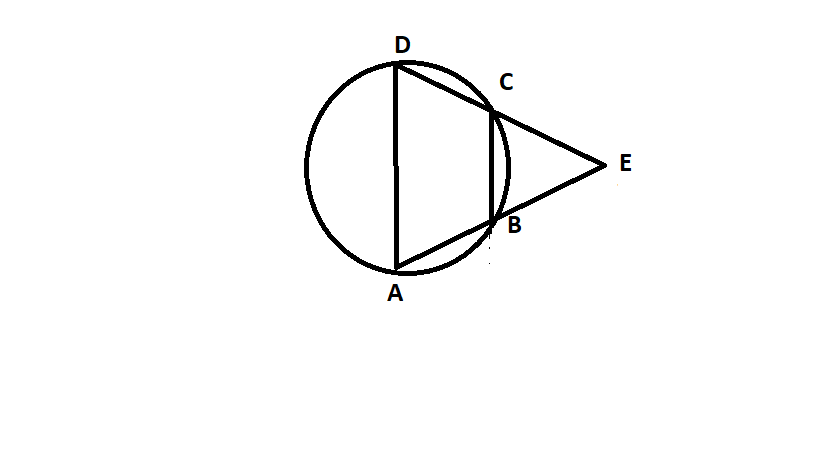
Now, in triangle EBC,
$\angle EBC + \angle B = {180^ \circ } \to (1)$ {Angles on a straight line}
Also, as we know that in a cyclic quadrilateral, $\angle A + \angle C = {180^ \circ },\angle B + \angle D = {180^ \circ }$.
Now using, $\angle D + \angle B = {180^ \circ } \to (2)$
Now, on subtracting equation (2) from equation (1), we get-
$
\angle EBC + \angle B - \angle B - \angle D = {180^ \circ } - {180^ \circ } \\
\Rightarrow \angle EBC = \angle D \to (3) \\
$
Similarly, by the angles on a straight-line property, we can say-
$\angle ECB + \angle C = {180^ \circ } \to (4)$
Also, we know- $\angle A + \angle C = {180^ \circ } \to (5)$
Similarly, we can say by subtracting equation (5) from equation (4), we get-
$
\angle ECB + \angle C - \angle C - \angle A = {180^ \circ } - {180^ \circ } \\
\Rightarrow \angle ECB = \angle A \to (6) \\
$
Therefore, in triangle EDA, we have-
$\angle EAD = \angle A$
$\angle EDA = \angle D$ and $\angle DEA = \angle DEA$ (common angle).
This implies the \[\vartriangle EBC\] and \[\vartriangle EBC\] are equiangular.
Note: Whenever such types of questions appear, then make a rough sketch of the figure, then by using the properties of the cyclic quadrilateral, as mentioned in the solution, prove that the \[\vartriangle EBC\] and \[\vartriangle EBC\] are equiangular.
Complete step-by-step answer:
As given in the question that ABCD is a cyclic quadrilateral, so construct a cyclic quadrilateral ABCD and produce BA and CD which meets at E. So, the figure is shown below-
Now, in triangle EBC,
$\angle EBC + \angle B = {180^ \circ } \to (1)$ {Angles on a straight line}
Also, as we know that in a cyclic quadrilateral, $\angle A + \angle C = {180^ \circ },\angle B + \angle D = {180^ \circ }$.
Now using, $\angle D + \angle B = {180^ \circ } \to (2)$
Now, on subtracting equation (2) from equation (1), we get-
$
\angle EBC + \angle B - \angle B - \angle D = {180^ \circ } - {180^ \circ } \\
\Rightarrow \angle EBC = \angle D \to (3) \\
$
Similarly, by the angles on a straight-line property, we can say-
$\angle ECB + \angle C = {180^ \circ } \to (4)$
Also, we know- $\angle A + \angle C = {180^ \circ } \to (5)$
Similarly, we can say by subtracting equation (5) from equation (4), we get-
$
\angle ECB + \angle C - \angle C - \angle A = {180^ \circ } - {180^ \circ } \\
\Rightarrow \angle ECB = \angle A \to (6) \\
$
Therefore, in triangle EDA, we have-
$\angle EAD = \angle A$
$\angle EDA = \angle D$ and $\angle DEA = \angle DEA$ (common angle).
This implies the \[\vartriangle EBC\] and \[\vartriangle EBC\] are equiangular.
Note: Whenever such types of questions appear, then make a rough sketch of the figure, then by using the properties of the cyclic quadrilateral, as mentioned in the solution, prove that the \[\vartriangle EBC\] and \[\vartriangle EBC\] are equiangular.
Recently Updated Pages
Three beakers labelled as A B and C each containing 25 mL of water were taken A small amount of NaOH anhydrous CuSO4 and NaCl were added to the beakers A B and C respectively It was observed that there was an increase in the temperature of the solutions contained in beakers A and B whereas in case of beaker C the temperature of the solution falls Which one of the following statements isarecorrect i In beakers A and B exothermic process has occurred ii In beakers A and B endothermic process has occurred iii In beaker C exothermic process has occurred iv In beaker C endothermic process has occurred

Master Class 10 Social Science: Engaging Questions & Answers for Success
Master Class 10 Science: Engaging Questions & Answers for Success
Master Class 10 Maths: Engaging Questions & Answers for Success
Master Class 10 General Knowledge: Engaging Questions & Answers for Success
Master Class 10 Computer Science: Engaging Questions & Answers for Success
Three beakers labelled as A B and C each containing 25 mL of water were taken A small amount of NaOH anhydrous CuSO4 and NaCl were added to the beakers A B and C respectively It was observed that there was an increase in the temperature of the solutions contained in beakers A and B whereas in case of beaker C the temperature of the solution falls Which one of the following statements isarecorrect i In beakers A and B exothermic process has occurred ii In beakers A and B endothermic process has occurred iii In beaker C exothermic process has occurred iv In beaker C endothermic process has occurred
Master Class 10 Social Science: Engaging Questions & Answers for Success
Master Class 10 Science: Engaging Questions & Answers for Success
Trending doubts
In cricket, what is the term for a bowler taking five wickets in an innings?
Who Won 36 Oscar Awards? Record Holder Revealed
What is deficiency disease class 10 biology CBSE
Select the word that is correctly spelled a Twelveth class 10 english CBSE
Bharatiya Janata Party was founded in the year A 1979 class 10 social science CBSE
Write an application to the principal requesting five class 10 english CBSE