




A tower stands vertically on the ground. From a point on the ground which is 25 m away from the foot of the tower , the angle of elevation of the top of the tower is found to be $$45^{0}$$. Then the height (in meters) of the tower is:
A. $$25\sqrt{2}$$
B. $$25\sqrt{3}$$
C. 25
D. 12.5
Answer
 Verified
627k+ views
Hint: To find the solution we need to know that for a right angle triangle $$\triangle ABC$$ if $$\angle B=90^{\circ }$$ and $$\angle C=\theta$$,
then $$\tan \theta =\dfrac{\text{Perpendicular} }{\text{Base} } =\dfrac{AB}{BC}$$........(1)
So let us draw the diagram,
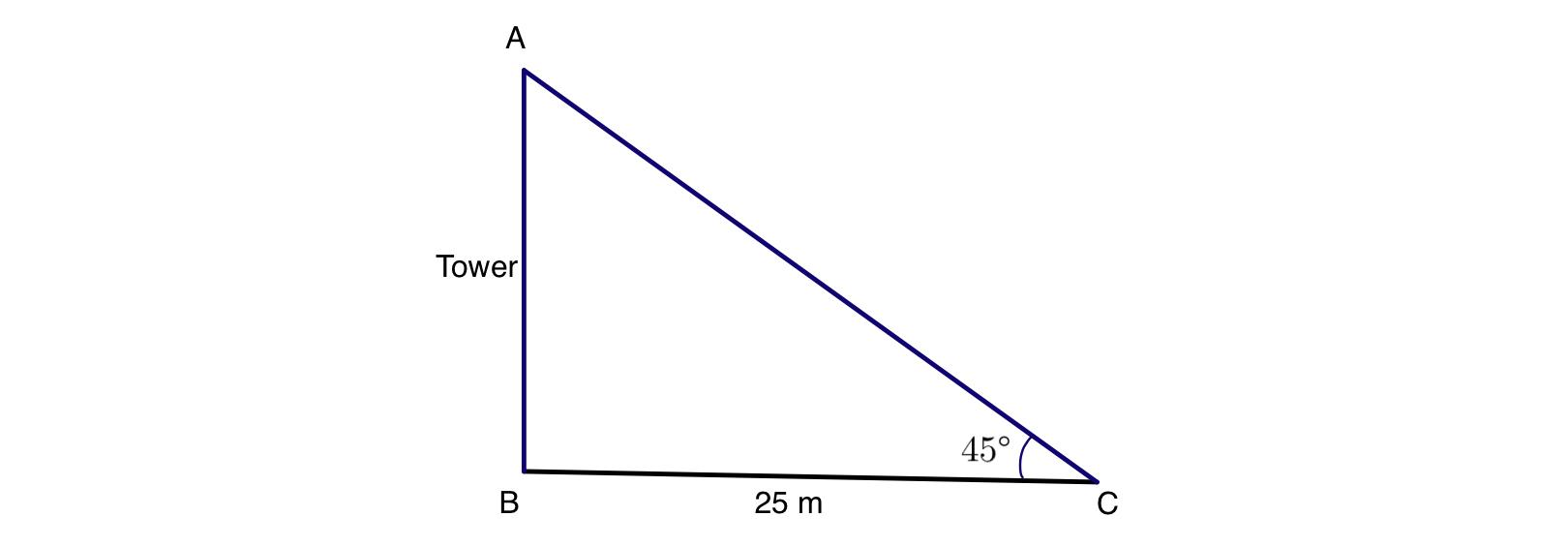
Complete step by step answer:
Let us consider the height of the tower AB to be x meter.
And it is given that the distance between any point C to the foot of the tower AB is 25 m, i.e, BC = 25 m.
The angle of elevation from the point C to the top of the tower is $$45^{\circ}$$.
$$\therefore \angle C=45^{\circ }$$
Now for the right angle triangle $$\triangle ABC$$,
$$\tan \angle C=\dfrac{AB}{BC}$$ [by formula (1)]
$$\Rightarrow \tan 45^{\circ }=\dfrac{x}{25}$$
$$\Rightarrow 25\times \tan 45^{\circ }=x$$
$$\Rightarrow x=25\times \tan 45^{\circ }$$
Now as we know that the value of $$\tan 45^{\circ }$$ is 1.
So from the above equation we get,
$$ x=25\times 1$$
$$\Rightarrow x=25$$
So, the correct answer is “Option C”.
Note: While solving you need to know that the adjacent side of the given angle is called base and another one is hypotenuse and the opposite side of that angle is always considered as the height of the right angle triangle. And among these three sides hypotenuse is the largest one.
then $$\tan \theta =\dfrac{\text{Perpendicular} }{\text{Base} } =\dfrac{AB}{BC}$$........(1)
So let us draw the diagram,
Complete step by step answer:
Let us consider the height of the tower AB to be x meter.
And it is given that the distance between any point C to the foot of the tower AB is 25 m, i.e, BC = 25 m.
The angle of elevation from the point C to the top of the tower is $$45^{\circ}$$.
$$\therefore \angle C=45^{\circ }$$
Now for the right angle triangle $$\triangle ABC$$,
$$\tan \angle C=\dfrac{AB}{BC}$$ [by formula (1)]
$$\Rightarrow \tan 45^{\circ }=\dfrac{x}{25}$$
$$\Rightarrow 25\times \tan 45^{\circ }=x$$
$$\Rightarrow x=25\times \tan 45^{\circ }$$
Now as we know that the value of $$\tan 45^{\circ }$$ is 1.
So from the above equation we get,
$$ x=25\times 1$$
$$\Rightarrow x=25$$
So, the correct answer is “Option C”.
Note: While solving you need to know that the adjacent side of the given angle is called base and another one is hypotenuse and the opposite side of that angle is always considered as the height of the right angle triangle. And among these three sides hypotenuse is the largest one.
Recently Updated Pages
Master Class 12 Economics: Engaging Questions & Answers for Success

Master Class 12 English: Engaging Questions & Answers for Success
Master Class 12 Social Science: Engaging Questions & Answers for Success
Master Class 12 Maths: Engaging Questions & Answers for Success
Master Class 12 Physics: Engaging Questions & Answers for Success
Master Class 10 English: Engaging Questions & Answers for Success
Trending doubts
Explain the Treaty of Vienna of 1815 class 10 social science CBSE
Why is it 530 pm in india when it is 1200 afternoon class 10 social science CBSE
What is the full form of POSCO class 10 social science CBSE
Define Potential, Developed, Stock and Reserved resources
Which Country Has the Largest Border with India?
Complete the sentence with the most appropriate word class 10 english CBSE