




A table-top measures $2m25cm$ by $1m50cm$. What is the perimeter of the table-top?
Answer
 Verified
602.7k+ views
Hint: You are given the length and breadth of a table and you are asked to find the perimeter of that table-top which is given by $2\left( {length + breadth} \right)$. Using this you will be able to get the answer.
Complete step-by-step answer:
Now it is given that the table-top measures $2m25cm$ by $1m50cm$. This means that the length of the table is $2m25cm$ and breadth is $1m50cm$.
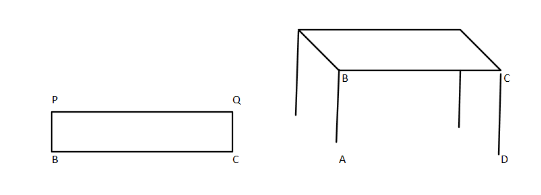
Here $ABCD$ is a table and $PCBQ$ is the table-top whose measurement is given by $2m25cm$ by $1m50cm$.
This means that the length of the table $PQ$$ = $ $2m25cm$ and breadth $BP$$ = $ $1m50cm$ and it is in the form of the rectangle.
Now the length is given in the form $x$ $m$$ and $ $y$$cm$ now we need to convert it into either $meter$ or $centimeter$. So if we try to convert $x$ $m$ $and$ $y$$cm$ into $centimeter$ then it will become:
$\left( {\left( {x \times 100} \right) + y} \right)cm$.
So here $PQ$ is given as $2m25cm$, we have to change it into $cm$.
$PQ = \left( {\left( {2 \times 100} \right) + 25} \right)cm$
$ = 225cm$
Similarly we have to change $BP$$ = $$1m50cm$
$ = \left( {\left( {1 \times 100} \right) + 50} \right)cm$
$ = 150cm$
Now it is asked to find out the perimeter of the table-top which is $BPQC$.
Hence we know that $BPQC$ is a rectangle and we know that the perimeter of the rectangle is equal to $2\left( {length + breadth} \right)$. Here adjacent sides are calculated as
$PQ$$ = 225cm$
$BP = 150cm$
Perimeter of the table top $ = $ $2\left( {PQ + BP} \right)$
$ = $$2\left( {225 + 150} \right)$$cm$
$ = $ $2\left( {375} \right)cm$
$ = 750cm$
Now we have perimeter $ = 750cm$
We can write it as $ = \left( {\left( {7 \times 100} \right) + 50} \right)cm$
Which means it is $7m50cm$.
Note: To convert $x$ $m$ $y$ $cm$ into $cm$, we have to use $\left( {100x + y} \right)cm$. We should know that the perimeter of the rectangle is equal to $2\left( {length + breadth} \right)$.
Complete step-by-step answer:
Now it is given that the table-top measures $2m25cm$ by $1m50cm$. This means that the length of the table is $2m25cm$ and breadth is $1m50cm$.
Here $ABCD$ is a table and $PCBQ$ is the table-top whose measurement is given by $2m25cm$ by $1m50cm$.
This means that the length of the table $PQ$$ = $ $2m25cm$ and breadth $BP$$ = $ $1m50cm$ and it is in the form of the rectangle.
Now the length is given in the form $x$ $m$$ and $ $y$$cm$ now we need to convert it into either $meter$ or $centimeter$. So if we try to convert $x$ $m$ $and$ $y$$cm$ into $centimeter$ then it will become:
$\left( {\left( {x \times 100} \right) + y} \right)cm$.
So here $PQ$ is given as $2m25cm$, we have to change it into $cm$.
$PQ = \left( {\left( {2 \times 100} \right) + 25} \right)cm$
$ = 225cm$
Similarly we have to change $BP$$ = $$1m50cm$
$ = \left( {\left( {1 \times 100} \right) + 50} \right)cm$
$ = 150cm$
Now it is asked to find out the perimeter of the table-top which is $BPQC$.
Hence we know that $BPQC$ is a rectangle and we know that the perimeter of the rectangle is equal to $2\left( {length + breadth} \right)$. Here adjacent sides are calculated as
$PQ$$ = 225cm$
$BP = 150cm$
Perimeter of the table top $ = $ $2\left( {PQ + BP} \right)$
$ = $$2\left( {225 + 150} \right)$$cm$
$ = $ $2\left( {375} \right)cm$
$ = 750cm$
Now we have perimeter $ = 750cm$
We can write it as $ = \left( {\left( {7 \times 100} \right) + 50} \right)cm$
Which means it is $7m50cm$.
Note: To convert $x$ $m$ $y$ $cm$ into $cm$, we have to use $\left( {100x + y} \right)cm$. We should know that the perimeter of the rectangle is equal to $2\left( {length + breadth} \right)$.
Recently Updated Pages
Basicity of sulphurous acid and sulphuric acid are

Master Class 10 English: Engaging Questions & Answers for Success
Master Class 10 Social Science: Engaging Questions & Answers for Success
Master Class 10 Computer Science: Engaging Questions & Answers for Success
Class 10 Question and Answer - Your Ultimate Solutions Guide
Master Class 10 General Knowledge: Engaging Questions & Answers for Success
Trending doubts
Who is known as the "Little Master" in Indian cricket history?
Explain the Treaty of Vienna of 1815 class 10 social science CBSE
A boat goes 24 km upstream and 28 km downstream in class 10 maths CBSE
Which are the three major ports of Tamil Nadu A Chennai class 10 social science CBSE
The highest dam in India is A Bhakra dam B Tehri dam class 10 social science CBSE
Describe the process of Unification of Italy class 10 social science CBSE