




A solid composed of a cylinder with hemispherical ends on both sides. The radius and height of the cylinder are 20 cm and 30 cm respectively. Find the total surface area of the solid. Take $\pi =3\cdot 14$.
Answer
 Verified
646.5k+ views
Hint: First assume radius of cylinder = radius of hemisphere = $r$. Let height of the cylinder $=h$. Then we should use the formulas, Lateral surface area (L.S.A.) of cylinder $=2\pi rh$, Lateral surface area (L.S.A.) of hemisphere $=2\pi {{r}^{2}}$, to calculate the area we need in the question.
Complete step-by-step answer:
Let the height of the cylinder is \[h\]. Since the radii of the hemisphere and cylinder are equal, we assume their radius as \[r\].
We have been given that \[r=20\text{ cm}\] and \[h=30\text{ cm}\].
Now, we have to imagine the figure when a solid cylinder has hemispherical ends on both its sides. We will come to the conclusion that only the lateral surface area of the cylinder and hemisphere are visible as both the circular bases of the cylinder overlap with the base of the hemisphere.
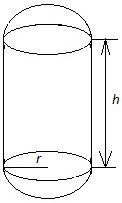
Therefore, the total surface area of the solid we need to calculate is the sum of lateral surface area of the cylinder and that of the hemisphere.
Required T.S.A. of solid \[=\] L.S.A. of cylinder \[+\] L.S.A. of hemisphere.
Required T.S.A. of solid $=2\pi rh+2\pi {{r}^{2}}...................................(1)$
Substituting the given values of \[r\] and \[h\] in equation $(1)$, we get;
\[\begin{align}
& \text{Required T}\text{.S}\text{.A}\text{. of solid}=2\times 3.14\times 20\times 30+4\times 3.14\times {{20}^{2}} \\
& \text{ }=3768+5024 \\
& \text{ }=8792\text{ c}{{\text{m}}^{2}} \\
\end{align}\]
Note: We have to imagine the diagram properly or it is better to draw it somewhere, otherwise one may get confused. Basic formulas of surface areas of different shapes must also be remembered. We have to make sure that all the lengths were taken in the same units to find the area.
Complete step-by-step answer:
Let the height of the cylinder is \[h\]. Since the radii of the hemisphere and cylinder are equal, we assume their radius as \[r\].
We have been given that \[r=20\text{ cm}\] and \[h=30\text{ cm}\].
Now, we have to imagine the figure when a solid cylinder has hemispherical ends on both its sides. We will come to the conclusion that only the lateral surface area of the cylinder and hemisphere are visible as both the circular bases of the cylinder overlap with the base of the hemisphere.
Therefore, the total surface area of the solid we need to calculate is the sum of lateral surface area of the cylinder and that of the hemisphere.
Required T.S.A. of solid \[=\] L.S.A. of cylinder \[+\] L.S.A. of hemisphere.
Required T.S.A. of solid $=2\pi rh+2\pi {{r}^{2}}...................................(1)$
Substituting the given values of \[r\] and \[h\] in equation $(1)$, we get;
\[\begin{align}
& \text{Required T}\text{.S}\text{.A}\text{. of solid}=2\times 3.14\times 20\times 30+4\times 3.14\times {{20}^{2}} \\
& \text{ }=3768+5024 \\
& \text{ }=8792\text{ c}{{\text{m}}^{2}} \\
\end{align}\]
Note: We have to imagine the diagram properly or it is better to draw it somewhere, otherwise one may get confused. Basic formulas of surface areas of different shapes must also be remembered. We have to make sure that all the lengths were taken in the same units to find the area.
Recently Updated Pages
Master Class 12 Business Studies: Engaging Questions & Answers for Success

Master Class 12 Biology: Engaging Questions & Answers for Success
Master Class 12 Chemistry: Engaging Questions & Answers for Success
Class 12 Question and Answer - Your Ultimate Solutions Guide
Master Class 11 Social Science: Engaging Questions & Answers for Success
Master Class 11 English: Engaging Questions & Answers for Success
Trending doubts
Explain the Treaty of Vienna of 1815 class 10 social science CBSE
Who Won 36 Oscar Awards? Record Holder Revealed
What is the median of the first 10 natural numbers class 10 maths CBSE
Why is it 530 pm in india when it is 1200 afternoon class 10 social science CBSE
The highest temperature in Karnataka is recorded in class 10 social science CBSE
Define Potential, Developed, Stock and Reserved resources