




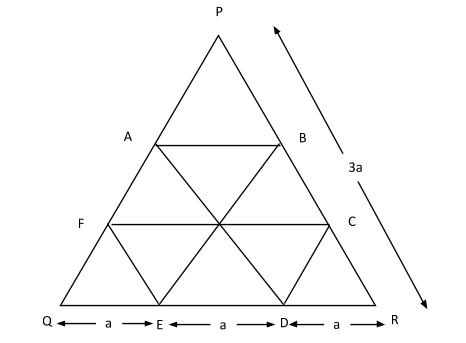
A regular hexagon of maximum possible area is cut off from an equilateral triangle. The ratio of area of triangle to the area of hexagon will be
A. $\sqrt {\dfrac{3}{2}} $
B. $\dfrac{{\sqrt 6 }}{2}$
C. $\dfrac{3}{{\sqrt 2 }}$
D. $\dfrac{3}{2}$
Answer
 Verified
616.5k+ views
Hint: Regular hexagons are six sided figures. In a regular hexagon, all sides are of the same length and all interior angles have the same measure. One of the easiest methods that can be used to find the area of a polygon is to split the figure into triangles. Each angle in the triangle is 60°, each triangle has three equal side lengths and three equal angles. If we find the area of one of the triangles, then we can multiply it by six in order to calculate the area of the hexagon.
Area of equilateral triangle =$\dfrac{{\sqrt 3 }}{4}{s^2}$, where‘s’ is the side of the triangle
Complete step by step solution: Let 3a be the sides of equilateral triangle PQR
The area of equilateral triangle =$arPQR = \dfrac{{\sqrt 3 }}{4}{a^2}$
$\begin{gathered}
arPQR = \dfrac{{\sqrt 3 }}{4} \times 3a \times 3a \\
arPQR = \dfrac{{9\sqrt 3 }}{4}{a^2} \\
\end{gathered} $
We know that a regular hexagon is formed by joining 6 equilateral triangles. Hence side of regular hexagon inscribed from an equilateral $\Delta PQR$ is $\dfrac{{3a}}{3} = a$
Therefore, Area of hexagon $ABCDEF = 6 \times \dfrac{{\sqrt 3 }}{4} \times {a^2} = \dfrac{{6\sqrt 3 }}{4}{a^2}$
The ratio of area of equilateral triangle to the area of hexagon $ = \dfrac{{ar\Delta PQR}}{{arABCDEF}}$
$\begin{gathered}
\dfrac{{ar\Delta PQR}}{{arABCDEF}} = \dfrac{{\dfrac{{9\sqrt 3 }}{4}{a^2}}}{{\dfrac{{6\sqrt 3 }}{4}{a^2}}} = \dfrac{9}{6} \\
\dfrac{{ar\Delta PQR}}{{arABCDEF}} = \dfrac{3}{2} \\
\end{gathered} $
Hence, the ratio of area of equilateral triangle to the area of hexagon is $\dfrac{3}{2}$
∴Option (D) is correct.
Note: If we know the side length, we can find the area of hexagon directly by the formula. Therefore, the formula for finding the area of a hexagon is derived by using the formula of equilateral triangle, hence the area of hexagon, where‘s’ is the length of a side of regular hexagon is:
Area of hexagon = $\dfrac{{3\sqrt 3 {s^2}}}{2}$
Area of equilateral triangle =$\dfrac{{\sqrt 3 }}{4}{s^2}$, where‘s’ is the side of the triangle
Complete step by step solution: Let 3a be the sides of equilateral triangle PQR
The area of equilateral triangle =$arPQR = \dfrac{{\sqrt 3 }}{4}{a^2}$
$\begin{gathered}
arPQR = \dfrac{{\sqrt 3 }}{4} \times 3a \times 3a \\
arPQR = \dfrac{{9\sqrt 3 }}{4}{a^2} \\
\end{gathered} $
We know that a regular hexagon is formed by joining 6 equilateral triangles. Hence side of regular hexagon inscribed from an equilateral $\Delta PQR$ is $\dfrac{{3a}}{3} = a$
Therefore, Area of hexagon $ABCDEF = 6 \times \dfrac{{\sqrt 3 }}{4} \times {a^2} = \dfrac{{6\sqrt 3 }}{4}{a^2}$
The ratio of area of equilateral triangle to the area of hexagon $ = \dfrac{{ar\Delta PQR}}{{arABCDEF}}$
$\begin{gathered}
\dfrac{{ar\Delta PQR}}{{arABCDEF}} = \dfrac{{\dfrac{{9\sqrt 3 }}{4}{a^2}}}{{\dfrac{{6\sqrt 3 }}{4}{a^2}}} = \dfrac{9}{6} \\
\dfrac{{ar\Delta PQR}}{{arABCDEF}} = \dfrac{3}{2} \\
\end{gathered} $
Hence, the ratio of area of equilateral triangle to the area of hexagon is $\dfrac{3}{2}$
∴Option (D) is correct.
Note: If we know the side length, we can find the area of hexagon directly by the formula. Therefore, the formula for finding the area of a hexagon is derived by using the formula of equilateral triangle, hence the area of hexagon, where‘s’ is the length of a side of regular hexagon is:
Area of hexagon = $\dfrac{{3\sqrt 3 {s^2}}}{2}$
Recently Updated Pages
Master Class 12 Business Studies: Engaging Questions & Answers for Success

Master Class 12 Biology: Engaging Questions & Answers for Success
Master Class 12 Chemistry: Engaging Questions & Answers for Success
Class 12 Question and Answer - Your Ultimate Solutions Guide
Master Class 11 Social Science: Engaging Questions & Answers for Success
Master Class 11 English: Engaging Questions & Answers for Success
Trending doubts
Find the sum of series 1 + 2 + 3 + 4 + 5 + + 100 class 9 maths CBSE
Fill the blanks with the suitable prepositions 1 The class 9 english CBSE
Difference Between Plant Cell and Animal Cell
How many hours before the closure of election must class 9 social science CBSE
What is pollution? How many types of pollution? Define it
Name 10 Living and Non living things class 9 biology CBSE