




A perpendicular drawn at the point of incidence of a light ray on the surface of a mirror is called –
A) Incident ray
B) Reflected ray
C) Normal
D) None of these
Answer
 Verified
587.6k+ views
Hint: When a light ray is reflected by a mirror, a law of reflection states that the angle made by the incident ray with the perpendicular drawn at the point of incidence on the surface is equal to the angle made by the reflected ray with the perpendicular drawn at the point of incidence on the surface.
Complete step by step answer:
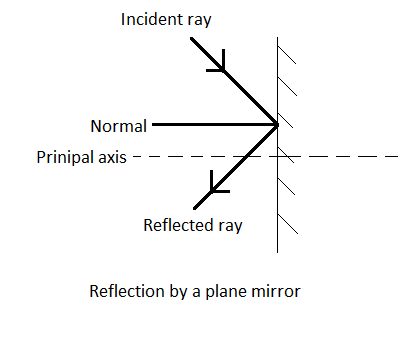
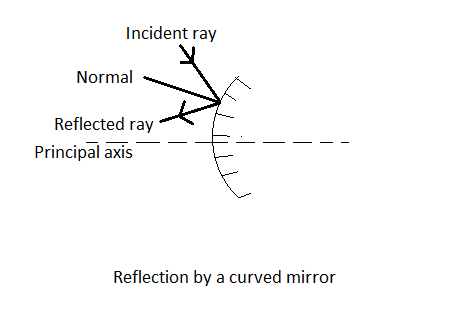
During reflection of a light ray by a mirror, the incident ray gets reflected and forms the reflected rays. At the point of incidence, it has been seen that the angle that the incident ray makes with the perpendicular on the surface at the point of incidence is equal to that made by the reflected ray with the same perpendicular.
This perpendicular is known as the normal at the point of incidence.
The incident ray, normal and reflected ray, all lie in the same plane.
For a plane mirror, the normal ray is parallel to the principal axis of the mirror, which is the extension of the line joining the centre of curvature of the mirror to the pole of the mirror. However, for curved mirrors, that is not the general case.
Hence, the correct answer is option C.
Note:
Students must note that they can easily find the normal at any point on the surface of the mirror by joining the point with the centre of curvature of the mirror with a line and extending the line. This is in fact, true for any circle and since curve mirrors are part of a circle, it is true for them also. This principle can also be extended to curved lenses and the normal to the surfaces at the points of incidence can be found out in the same way. For a plane mirror, the normal is parallel to the principal axis, since, their centre of curvature can be said to be at an infinite distance from the mirror and hence, the line from the point becomes parallel to the principal axis.
Complete step by step answer:
During reflection of a light ray by a mirror, the incident ray gets reflected and forms the reflected rays. At the point of incidence, it has been seen that the angle that the incident ray makes with the perpendicular on the surface at the point of incidence is equal to that made by the reflected ray with the same perpendicular.
This perpendicular is known as the normal at the point of incidence.
The incident ray, normal and reflected ray, all lie in the same plane.
For a plane mirror, the normal ray is parallel to the principal axis of the mirror, which is the extension of the line joining the centre of curvature of the mirror to the pole of the mirror. However, for curved mirrors, that is not the general case.
Hence, the correct answer is option C.
Note:
Students must note that they can easily find the normal at any point on the surface of the mirror by joining the point with the centre of curvature of the mirror with a line and extending the line. This is in fact, true for any circle and since curve mirrors are part of a circle, it is true for them also. This principle can also be extended to curved lenses and the normal to the surfaces at the points of incidence can be found out in the same way. For a plane mirror, the normal is parallel to the principal axis, since, their centre of curvature can be said to be at an infinite distance from the mirror and hence, the line from the point becomes parallel to the principal axis.
Recently Updated Pages
Which of the following graphs shows the variation of class 12 physics CBSE

Draw a labelled diagram of the human male reproductive class 12 biology CBSE
Describe the experiment to compare the emf of two cells class 12 physics CBSE
What is standard hydrogen electrode
What is conventional current and electric current class 12 physics CBSE
2Bromopentane is treated with an alcoholic KOH solution class 12 chemistry CBSE
Trending doubts
Draw a labelled sketch of the human eye class 12 physics CBSE
Which are the Top 10 Largest Countries of the World?
A member of Simon commission later became Prime Minister class 12 social science CBSE
Differentiate between homogeneous and heterogeneous class 12 chemistry CBSE
Draw ray diagrams each showing i myopic eye and ii class 12 physics CBSE
Which is the correct genotypic ratio of mendel dihybrid class 12 biology CBSE