




A peacock is sitting on the top of a pillar, which is 9 m high. From a point 27 m away from the bottom of the pillar a snake is coming to its hole at the base of the pillar. Seeing the snake the peacock pounces on it. If their speeds are equal, at what distance from the whole snake is it caught?
Answer
 Verified
609.5k+ views
Hint: Here, we will use the concepts of speed and distance as well as the Pythagorean Theorem i.e.., sum of squares of two adjacent sides of a triangle is equal to the square of the hypotenuse in a right angle triangle.
Given,
A peacock is sitting on the top of a pillar, which is 9 m high, so let us consider ‘A’ is the position of peacock and ‘AB’ be the pillar which is 9 m high. Now, it is also given that from a point 27 m away from the bottom of the pillar a snake is coming to its hole at the base of the pillar. Therefore, let ‘C’ be the position of the snake at the bottom of the pillar. Therefore, the representation is as follows:
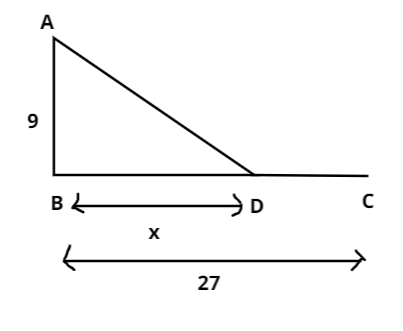
Let Peacock catch the snake at a distance of ‘x’ m from the bottom of the pillar. So, $AB = 9, BD = x, BC = 27$. Hence the value of ‘DC’ can be written as
$
\Rightarrow DC = BC - BD \\
\Rightarrow DC = 27 - x \\
$
Now, Using the Pythagorean Theorem, let us find the distance covered by peacock i.e.., AD
$
\Rightarrow A{D^2} = B{C^2} + A{B^2} \\
\Rightarrow A{D^2} = {x^2} + {9^2} \\
\Rightarrow A{D^2} = {x^2} + 81 \\
\Rightarrow AD = \sqrt {{x^2} + 81} \\
$
It is mentioned that the speed of peacock and snake are equal. Therefore, distance covered by the peacock and distance covered by the snake will be equal i.e..,
${\text{Distance covered by peacock(AD) = Distance covered by snake (DC)}}$
$
\Rightarrow AD = DC \\
\Rightarrow \sqrt {{x^2} + 81} = 27 - x \\
$
Squaring on the both sides, we get
$
\Rightarrow {(\sqrt {{x^2} + 81} )^2} = {(27 - x)^2} \\
\Rightarrow {x^2} + 81 = 729 + {x^2} - 54x \\
\Rightarrow 54x = 729 - 81 \\
\Rightarrow 54x = 648 \\
\Rightarrow x = \dfrac{{648}}{{54}} = 12 \\
$
Hence, the snake got caught at a distance of 12m.
Note: As, the speeds of peacock and snake are equal, we have considered distance covered by peacock and snake are equal.
Given,
A peacock is sitting on the top of a pillar, which is 9 m high, so let us consider ‘A’ is the position of peacock and ‘AB’ be the pillar which is 9 m high. Now, it is also given that from a point 27 m away from the bottom of the pillar a snake is coming to its hole at the base of the pillar. Therefore, let ‘C’ be the position of the snake at the bottom of the pillar. Therefore, the representation is as follows:
Let Peacock catch the snake at a distance of ‘x’ m from the bottom of the pillar. So, $AB = 9, BD = x, BC = 27$. Hence the value of ‘DC’ can be written as
$
\Rightarrow DC = BC - BD \\
\Rightarrow DC = 27 - x \\
$
Now, Using the Pythagorean Theorem, let us find the distance covered by peacock i.e.., AD
$
\Rightarrow A{D^2} = B{C^2} + A{B^2} \\
\Rightarrow A{D^2} = {x^2} + {9^2} \\
\Rightarrow A{D^2} = {x^2} + 81 \\
\Rightarrow AD = \sqrt {{x^2} + 81} \\
$
It is mentioned that the speed of peacock and snake are equal. Therefore, distance covered by the peacock and distance covered by the snake will be equal i.e..,
${\text{Distance covered by peacock(AD) = Distance covered by snake (DC)}}$
$
\Rightarrow AD = DC \\
\Rightarrow \sqrt {{x^2} + 81} = 27 - x \\
$
Squaring on the both sides, we get
$
\Rightarrow {(\sqrt {{x^2} + 81} )^2} = {(27 - x)^2} \\
\Rightarrow {x^2} + 81 = 729 + {x^2} - 54x \\
\Rightarrow 54x = 729 - 81 \\
\Rightarrow 54x = 648 \\
\Rightarrow x = \dfrac{{648}}{{54}} = 12 \\
$
Hence, the snake got caught at a distance of 12m.
Note: As, the speeds of peacock and snake are equal, we have considered distance covered by peacock and snake are equal.
Recently Updated Pages
Master Class 10 Computer Science: Engaging Questions & Answers for Success

State BPT theorem and prove it class 10 maths CBSE
A peacock is sitting on the top of a pillar which -class-10-maths-CBSE
Railways Women Helpline Number?
Explain the refraction of light through a glassslab class 10 physics CBSE
a Why did Mendel choose pea plants for his experiments class 10 biology CBSE
Trending doubts
In basketball, how many quarters are played in an NBA game?
10 examples of evaporation in daily life with explanations
What is the full form of POSCO class 10 social science CBSE
In which year voting age was reduced from 21 to 18?
Which metal is used to connect solar cells to solar class 10 chemistry CBSE
Make a sketch of the human nerve cell What function class 10 biology CBSE