




A ladder leaning against a vertical wall, makes an angle of $60^\circ $with the ground. The foot of the ladder is 3.5 m away from the wall. Find the length of the ladder.
Answer
 Verified
625.5k+ views
Hint: Express the given information in the form of a right angled triangle with the ladder as its hypotenuse. Use the formula\[\cos \theta = \dfrac{{length{\text{ }}of{\text{ }}the{\text{ }}adjacent{\text{ }}side}}{{length{\text{ }}of{\text{ }}the{\text{ }}hypotenuse}}\]to compute the length of the ladder.
Complete step by step answer:
Given that a ladder is leaning against a vertical wall making an angle of $60^\circ $with the ground.
The distance between the foot of the ladder and the wall is 3.5 m.
We need to find the length of this ladder.
We can view the ladder, the wall, and the ground as the sides of a triangle.
As the wall is vertical, it can be considered as one of the perpendicular sides of a right-angled triangle
Then we will have the following picture of the given information:
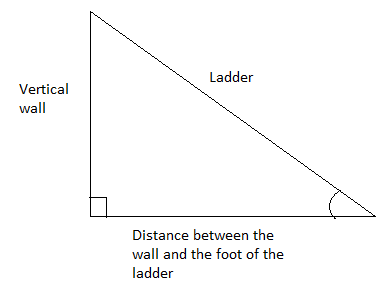
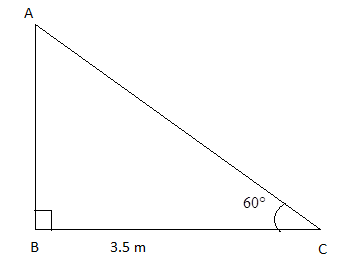
Let’s call this triangle as $\vartriangle ABC$ where side AB represents the vertical wall, side BC represents the distance between the foot of the ladder, and the wall and side AC represents the ladder.
This would imply that$\angle ACB = 60^\circ $and $BC = 3.5m$
Then according to the given information, we get the following figure:
We know that in a right angled triangle,\[\cos \theta = \dfrac{{length{\text{ }}of{\text{ }}the{\text{ }}adjacent{\text{ }}side}}{{length{\text{ }}of{\text{ }}the{\text{ }}hypotenuse}}\]
Here, in$\vartriangle ABC$,$\theta = 60^\circ $, length of the adjacent side = length of side BC = 3.5 m and length of the hypotenuse = length of the ladder = length of side AC = not known.
Thus, on substituting the above values, we get
\[
\cos \theta = \dfrac{{length{\text{ }}of{\text{ }}the{\text{ }}adjacent{\text{ }}side}}{{length{\text{ }}of{\text{ }}the{\text{ }}hypotenuse}} \\
\Rightarrow \cos 60^\circ = \dfrac{{3.5}}{{length{\text{ }}of{\text{ }}the{\text{ }}ladder}}.............(1) \\
\]
We know that$\cos 60^\circ = \dfrac{1}{2}$
On substituting$\cos 60^\circ = \dfrac{1}{2}$, we get
\[
\dfrac{1}{2} = \dfrac{{3.5}}{{length{\text{ }}of{\text{ }}the{\text{ }}ladder}} \\
\Rightarrow length{\text{ }}of{\text{ }}the{\text{ }}ladder = 3.5 \times 2 = 7m \\
\]
Hence the required length of the ladder is 7 m.
Note:
It is best to memorize the sine, cosine, and tangent values of$30^\circ $,$60^\circ $and$45^\circ $to be able to solve such questions and to avoid substitution of wrong values.
Complete step by step answer:
Given that a ladder is leaning against a vertical wall making an angle of $60^\circ $with the ground.
The distance between the foot of the ladder and the wall is 3.5 m.
We need to find the length of this ladder.
We can view the ladder, the wall, and the ground as the sides of a triangle.
As the wall is vertical, it can be considered as one of the perpendicular sides of a right-angled triangle
Then we will have the following picture of the given information:
Let’s call this triangle as $\vartriangle ABC$ where side AB represents the vertical wall, side BC represents the distance between the foot of the ladder, and the wall and side AC represents the ladder.
This would imply that$\angle ACB = 60^\circ $and $BC = 3.5m$
Then according to the given information, we get the following figure:
We know that in a right angled triangle,\[\cos \theta = \dfrac{{length{\text{ }}of{\text{ }}the{\text{ }}adjacent{\text{ }}side}}{{length{\text{ }}of{\text{ }}the{\text{ }}hypotenuse}}\]
Here, in$\vartriangle ABC$,$\theta = 60^\circ $, length of the adjacent side = length of side BC = 3.5 m and length of the hypotenuse = length of the ladder = length of side AC = not known.
Thus, on substituting the above values, we get
\[
\cos \theta = \dfrac{{length{\text{ }}of{\text{ }}the{\text{ }}adjacent{\text{ }}side}}{{length{\text{ }}of{\text{ }}the{\text{ }}hypotenuse}} \\
\Rightarrow \cos 60^\circ = \dfrac{{3.5}}{{length{\text{ }}of{\text{ }}the{\text{ }}ladder}}.............(1) \\
\]
We know that$\cos 60^\circ = \dfrac{1}{2}$
On substituting$\cos 60^\circ = \dfrac{1}{2}$, we get
\[
\dfrac{1}{2} = \dfrac{{3.5}}{{length{\text{ }}of{\text{ }}the{\text{ }}ladder}} \\
\Rightarrow length{\text{ }}of{\text{ }}the{\text{ }}ladder = 3.5 \times 2 = 7m \\
\]
Hence the required length of the ladder is 7 m.
Note:
It is best to memorize the sine, cosine, and tangent values of$30^\circ $,$60^\circ $and$45^\circ $to be able to solve such questions and to avoid substitution of wrong values.
Recently Updated Pages
Master Class 12 Economics: Engaging Questions & Answers for Success

Master Class 12 English: Engaging Questions & Answers for Success
Master Class 12 Social Science: Engaging Questions & Answers for Success
Master Class 12 Maths: Engaging Questions & Answers for Success
Master Class 12 Physics: Engaging Questions & Answers for Success
Master Class 9 General Knowledge: Engaging Questions & Answers for Success
Trending doubts
Explain the Treaty of Vienna of 1815 class 10 social science CBSE
Why is it 530 pm in india when it is 1200 afternoon class 10 social science CBSE
What is the full form of POSCO class 10 social science CBSE
Define Potential, Developed, Stock and Reserved resources
The speaker of the Lok Sabha is elected by the APresident class 10 social science CBSE
Complete the sentence with the most appropriate word class 10 english CBSE