




A girl wishes to prepare birthday caps in the form of right circular cones for her birthday party, using a sheet of paper whose area is 5720 \[c{m^2}\], how many caps can be made with radius 5 cm and height 12 cm.
Answer
 Verified
632.4k+ views
Hint: In this particular problem we have to find the curved surface area of one cone using formula \[\pi rl\], where r is the base radius and l is the slant height. And then divide this area with the total area given to find the required answer.
Complete step by step answer:
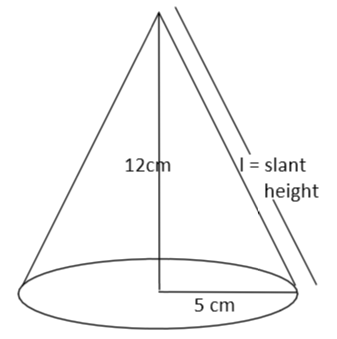
As we know, the base radius of the cone is 5 cm.
And the height of the cone is 12 cm.
Now to find the area of the cone we had to find the slant height of the cone.
Now as we know that the formula for slant height of the cone is \[l = \sqrt {{r^2} + {h^2}} \], where r and h are the base radius and height of the cone.
So, let us find the slant height of the cone (birthday cap).
Slant height = \[\sqrt {{5^2} + {{12}^2}} = \sqrt {25 + 144} = \sqrt {169} = 13\]cm.
So, now we can find the curved surface area of one birthday cap.
Curved surface area of one cap = \[\pi rl = \pi \times \left( 5 \right) \times \left( {13} \right) = 65\pi c{m^2}\].
Now as we know that if the area of one cap is \[65\pi c{m^2}\] then the number of caps that can be made in the given sheet of paper = \[\dfrac{{{\text{Area of sheet of paper}}}}{{{\text{Area of one cap}}}} = \dfrac{{5720}}{{65\pi }} = \dfrac{{5720}}{{65 \times \dfrac{{22}}{7}}} = \dfrac{{5720 \times 7}}{{65 \times 22}} = \dfrac{{40040}}{{1430}} = 28\]
Hence, 28 birthday caps can be made from the sheet of the paper.
Note:
Whenever we face such types of problems then we should remember that the birthday cap is open from the bottom. So, while making a birthday cap, no sheet of paper is required for covering the bottom so we have to find a curved surface area instead of a total surface area of one cone. And then we had to divide that with the area of the sheet of paper given to find the total number of caps that can be made. This will be the easiest and efficient way to find the solution of the problem.
Complete step by step answer:
As we know, the base radius of the cone is 5 cm.
And the height of the cone is 12 cm.
Now to find the area of the cone we had to find the slant height of the cone.
Now as we know that the formula for slant height of the cone is \[l = \sqrt {{r^2} + {h^2}} \], where r and h are the base radius and height of the cone.
So, let us find the slant height of the cone (birthday cap).
Slant height = \[\sqrt {{5^2} + {{12}^2}} = \sqrt {25 + 144} = \sqrt {169} = 13\]cm.
So, now we can find the curved surface area of one birthday cap.
Curved surface area of one cap = \[\pi rl = \pi \times \left( 5 \right) \times \left( {13} \right) = 65\pi c{m^2}\].
Now as we know that if the area of one cap is \[65\pi c{m^2}\] then the number of caps that can be made in the given sheet of paper = \[\dfrac{{{\text{Area of sheet of paper}}}}{{{\text{Area of one cap}}}} = \dfrac{{5720}}{{65\pi }} = \dfrac{{5720}}{{65 \times \dfrac{{22}}{7}}} = \dfrac{{5720 \times 7}}{{65 \times 22}} = \dfrac{{40040}}{{1430}} = 28\]
Hence, 28 birthday caps can be made from the sheet of the paper.
Note:
Whenever we face such types of problems then we should remember that the birthday cap is open from the bottom. So, while making a birthday cap, no sheet of paper is required for covering the bottom so we have to find a curved surface area instead of a total surface area of one cone. And then we had to divide that with the area of the sheet of paper given to find the total number of caps that can be made. This will be the easiest and efficient way to find the solution of the problem.
Recently Updated Pages
Master Class 11 English: Engaging Questions & Answers for Success

Master Class 11 Social Science: Engaging Questions & Answers for Success
Master Class 11 Maths: Engaging Questions & Answers for Success
Master Class 11 Biology: Engaging Questions & Answers for Success
Master Class 11 Physics: Engaging Questions & Answers for Success
Master Class 11 Chemistry: Engaging Questions & Answers for Success
Trending doubts
Explain the Treaty of Vienna of 1815 class 10 social science CBSE
What is the full form of POSCO class 10 social science CBSE
What planets have no moons Which one has only one moon class 10 physics CBSE
Define Potential, Developed, Stock and Reserved resources
In cricket, which Indian bowler is known as the "Yorker King"?
The diagonals of a rhombus are 10cm and 24cm Find the class 10 maths CBSE