




A girl brings a positively charged rod near a thin neutral stream of water flowing from a tap. She observes that the water stream bends towards her. Now if she is to bring a negatively charged rod near the stream, then it will:
A) Bend in the same direction.
B) Bend in the opposite direction.
C) Not bend at all.
D) Bend in the opposite direction above and below the rod.
Answer
 Verified
648.9k+ views
Hint: Water is made up of oxygen and hydrogen molecules. Oxygen is electronegative while hydrogen is electropositive and so a water molecule is just like an electric dipole which is made of equal and opposite charges separated by a distance. When a charged rod is placed near an electric dipole, it rearranges itself so the opposite charge of the dipole is near to the rod and the same charge of the dipole is away from the rod. This is referred to as induction.
Complete step by step answer:
Step 1: Sketch figures representing the induction by the positively charged rod and the negatively charged rod.
Case 1: Positively charged rod placed near the water stream
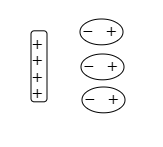
The stream of water contains several electric dipoles. When the positively charged rod is placed near the stream of water, the electric dipoles in the stream arrange themselves so that the negative part is facing towards the rod and the positive part of the dipoles are facing away from the rod. This is shown in the figure below.
The forces of attraction between the negative part of the dipoles and the positively charged rod cause the water stream to bend towards the rod.
Case 2: Negatively charged rod placed near the water stream
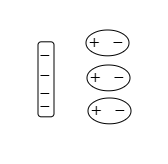
Now if the girl was to bring a negatively charged rod instead of the positively charged rod, the electric dipoles in the stream will arrange themselves so that the positive part is facing towards the rod and negative part of the dipoles are facing away from the rod. This is shown in the figure given below.
Here the electrostatic forces of attraction between the positive part of the dipoles and the negatively charged rod cause the water stream to bend towards the rod.
Thus the direction of bending does not change.
Hence the correct option is A.
Note:
In both cases, an attraction between the charged rod and the atoms of the water of opposite charge and repulsion between the charged rod and the atoms of water of the same charge exists. We know that the electrostatic force is inversely proportional to the distance between two charges. Here the distance between the rod and that part of the dipoles with the opposite charge is less. So the force of attraction will be greater than the force of repulsion and hence the stream will always bend towards the charged rod.
Complete step by step answer:
Step 1: Sketch figures representing the induction by the positively charged rod and the negatively charged rod.
Case 1: Positively charged rod placed near the water stream
The stream of water contains several electric dipoles. When the positively charged rod is placed near the stream of water, the electric dipoles in the stream arrange themselves so that the negative part is facing towards the rod and the positive part of the dipoles are facing away from the rod. This is shown in the figure below.
The forces of attraction between the negative part of the dipoles and the positively charged rod cause the water stream to bend towards the rod.
Case 2: Negatively charged rod placed near the water stream
Now if the girl was to bring a negatively charged rod instead of the positively charged rod, the electric dipoles in the stream will arrange themselves so that the positive part is facing towards the rod and negative part of the dipoles are facing away from the rod. This is shown in the figure given below.
Here the electrostatic forces of attraction between the positive part of the dipoles and the negatively charged rod cause the water stream to bend towards the rod.
Thus the direction of bending does not change.
Hence the correct option is A.
Note:
In both cases, an attraction between the charged rod and the atoms of the water of opposite charge and repulsion between the charged rod and the atoms of water of the same charge exists. We know that the electrostatic force is inversely proportional to the distance between two charges. Here the distance between the rod and that part of the dipoles with the opposite charge is less. So the force of attraction will be greater than the force of repulsion and hence the stream will always bend towards the charged rod.
Recently Updated Pages
Which of the following graphs shows the variation of class 12 physics CBSE

Draw a labelled diagram of the human male reproductive class 12 biology CBSE
Describe the experiment to compare the emf of two cells class 12 physics CBSE
What is standard hydrogen electrode
What is conventional current and electric current class 12 physics CBSE
2Bromopentane is treated with an alcoholic KOH solution class 12 chemistry CBSE
Trending doubts
Draw a labelled sketch of the human eye class 12 physics CBSE
Which are the Top 10 Largest Countries of the World?
A member of Simon commission later became Prime Minister class 12 social science CBSE
Differentiate between homogeneous and heterogeneous class 12 chemistry CBSE
Draw ray diagrams each showing i myopic eye and ii class 12 physics CBSE
Which is the correct genotypic ratio of mendel dihybrid class 12 biology CBSE