




A galvanometer of resistance $100\,\Omega $gives a full-scale deflection for a current of ${10^{ - 5}}\,A$ . To convert it into an ammeter capable of measuring up to 1 A, we should connect a resistance of
A. $1\,\Omega $ in parallel
B. ${10^{ - 3}}\,\Omega $ in parallel
C. ${10^5}\,\Omega $ in parallel
D. $100\,\Omega $ in parallel
Answer
 Verified
562.5k+ views
Hint: We will first calculate the current distributions in the circuit and then apply the basic fundamentals of a series and parallel combination. In a parallel combination, the total current flowing in the circuit is the sum of the individual currents flowing in each arm of the connection. We will then calculate the supply voltage and substitute the known values in the equation to get the answer.
Complete answer:
Let’s first draw the circuit diagram to help understand the concept better.
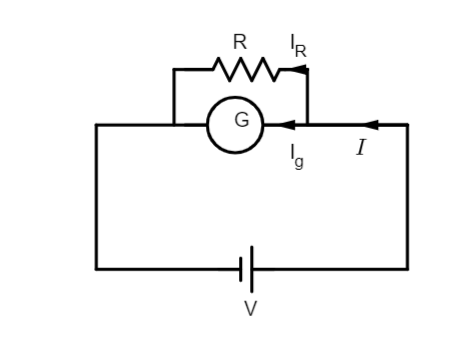
Here V is the source voltage, I is the total current flowing in the circuit, ${I_G}$ is the current flowing through the galvanometer and ${I_R}$ is the current flowing through the external resistance applied to extend the range of the ammeter.
We can see that $I = {I_G} + {I_R}$
Since the combination of the galvanometer and the external resistance is parallel, the voltage drop across each element is the same and equal to the source voltage.
So, the above equation can be rewritten as
$I = \dfrac{V}{R} + \dfrac{V}{G}\,\,\,\,\,\,\,\,\,\,\,.........(1)$ where R and G are the resistances of the external resistor and galvanometer respectively.
Now, when the external resistor was not applied, the galvanometer offered the resistance. The voltage from the source can be calculated.
$V = {I'}G$ where ${I'}$ is the current in the circuit when no external resistor is connected.
Substituting the values,
$V = 100 \times {10^{ - 5}}\,V$
$ \Rightarrow V = {10^{ - 3}}\,V$
Substituting all the known values in equation 1 we get,
$1 = {10^{ - 3}}(\dfrac{1}{R} + \dfrac{1}{{100}})\,$
$\dfrac{1}{R} + \dfrac{1}{{100}} = 1000$
Further solving this equation, we get,
$\dfrac{1}{R} = 1000 - 0.01$
$ \Rightarrow R = 0.001\,\Omega $
$ \therefore R = {10^{ - 3}}\,\Omega $
Hence, option B is the correct answer.
Note:
A galvanometer’s current sensitivity is determined by the amount of electric current required by the meter's coil to produce the required deflection. The smaller the amount of current required to produce the required deflection, the greater the sensitivity of the meter. It is designed to carry the majority of the circuit current so that only a small portion of it flows through it.
Complete answer:
Let’s first draw the circuit diagram to help understand the concept better.
Here V is the source voltage, I is the total current flowing in the circuit, ${I_G}$ is the current flowing through the galvanometer and ${I_R}$ is the current flowing through the external resistance applied to extend the range of the ammeter.
We can see that $I = {I_G} + {I_R}$
Since the combination of the galvanometer and the external resistance is parallel, the voltage drop across each element is the same and equal to the source voltage.
So, the above equation can be rewritten as
$I = \dfrac{V}{R} + \dfrac{V}{G}\,\,\,\,\,\,\,\,\,\,\,.........(1)$ where R and G are the resistances of the external resistor and galvanometer respectively.
Now, when the external resistor was not applied, the galvanometer offered the resistance. The voltage from the source can be calculated.
$V = {I'}G$ where ${I'}$ is the current in the circuit when no external resistor is connected.
Substituting the values,
$V = 100 \times {10^{ - 5}}\,V$
$ \Rightarrow V = {10^{ - 3}}\,V$
Substituting all the known values in equation 1 we get,
$1 = {10^{ - 3}}(\dfrac{1}{R} + \dfrac{1}{{100}})\,$
$\dfrac{1}{R} + \dfrac{1}{{100}} = 1000$
Further solving this equation, we get,
$\dfrac{1}{R} = 1000 - 0.01$
$ \Rightarrow R = 0.001\,\Omega $
$ \therefore R = {10^{ - 3}}\,\Omega $
Hence, option B is the correct answer.
Note:
A galvanometer’s current sensitivity is determined by the amount of electric current required by the meter's coil to produce the required deflection. The smaller the amount of current required to produce the required deflection, the greater the sensitivity of the meter. It is designed to carry the majority of the circuit current so that only a small portion of it flows through it.
Recently Updated Pages
Which of the following graphs shows the variation of class 12 physics CBSE

Draw a labelled diagram of the human male reproductive class 12 biology CBSE
Describe the experiment to compare the emf of two cells class 12 physics CBSE
What is standard hydrogen electrode
What is conventional current and electric current class 12 physics CBSE
2Bromopentane is treated with an alcoholic KOH solution class 12 chemistry CBSE
Trending doubts
Draw a labelled sketch of the human eye class 12 physics CBSE
Which are the Top 10 Largest Countries of the World?
A member of Simon commission later became Prime Minister class 12 social science CBSE
Differentiate between homogeneous and heterogeneous class 12 chemistry CBSE
Draw ray diagrams each showing i myopic eye and ii class 12 physics CBSE
Which is the correct genotypic ratio of mendel dihybrid class 12 biology CBSE