




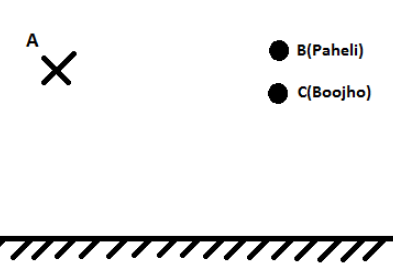
(a) Find out the position of the image of an object situated at A in the plane mirror
(b) Can paheli at B see this image?
(c) Can Boojho at C see this image?
(d) When paheli moves from B to C, where does the image of A move?
Answer
 Verified
632.4k+ views
Hint:The mirror given is a plane mirror. Recall the way of reflection of the object and its properties. Remember to see the image; the reflected rays of the object, reflected from the mirror must reach the eyes of the person.
Complete answer:
(a) For a plane mirror, the image distance is equal to the object distance and the image is virtual and the same size.The position of the image is exactly behind the mirror in the same vertical line and at the same distance from the mirror. It is shown as
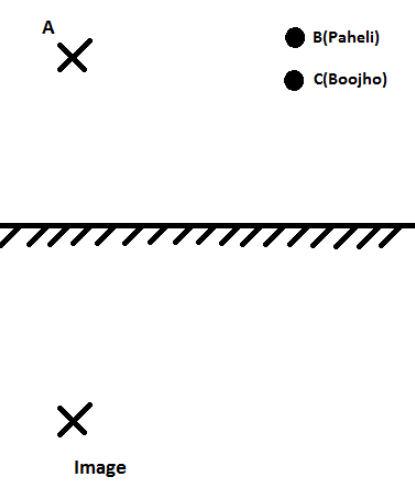
(b) Paheli can see the image since the rays of light can reach the eyes of Paheli.
(c) Boojho can see the image since the rays of light can reach the eyes of Boojho.
(d) When Paheli moves from B to C, the image of the A will remain at the same point. But when she moves from B to C it will look like that image is coming towards her.
Additional information:
When a ray of light falls on a surface, then it can undergo one of the following three phenomena: reflection, refraction, or absorption. When it falls on a normal surface then most of the light gets absorbed. So mirrors are polished surfaces coated with mercury such that they reflect most of the light falling on them. Now based on the type of reflecting surface we can classify mirrors as concave, convex, or plane mirror. Here we will be talking about the plane mirror only. So to form an image we require at least two rays from the object which meet or appear to meet at a point.
Note:Students should know the concepts behind the reflection from mirrors. It is easier to deduce for plane mirrors but tricky for spherical mirrors. For spherical mirrors, mathematical calculations have to be performed using the mirror formula.
Complete answer:
(a) For a plane mirror, the image distance is equal to the object distance and the image is virtual and the same size.The position of the image is exactly behind the mirror in the same vertical line and at the same distance from the mirror. It is shown as
(b) Paheli can see the image since the rays of light can reach the eyes of Paheli.
(c) Boojho can see the image since the rays of light can reach the eyes of Boojho.
(d) When Paheli moves from B to C, the image of the A will remain at the same point. But when she moves from B to C it will look like that image is coming towards her.
Additional information:
When a ray of light falls on a surface, then it can undergo one of the following three phenomena: reflection, refraction, or absorption. When it falls on a normal surface then most of the light gets absorbed. So mirrors are polished surfaces coated with mercury such that they reflect most of the light falling on them. Now based on the type of reflecting surface we can classify mirrors as concave, convex, or plane mirror. Here we will be talking about the plane mirror only. So to form an image we require at least two rays from the object which meet or appear to meet at a point.
Note:Students should know the concepts behind the reflection from mirrors. It is easier to deduce for plane mirrors but tricky for spherical mirrors. For spherical mirrors, mathematical calculations have to be performed using the mirror formula.
Recently Updated Pages
Write any three differences between metals and nonmetals class 10 social science CBSE

Amit standing on a horizontal plane finds a bird flying class 10 maths CBSE
Two circles of radii 5 cm and 3 cm intersect at two class 10 maths CBSE
Solve the following i John and Jivanti together have class 10 maths CBSE
What is the relation between orthocenter circumcentre class 10 maths CBSE
Two plane mirrors are inclined at 70circ A ray incident class 10 physics CBSE
Trending doubts
Explain the Treaty of Vienna of 1815 class 10 social science CBSE
Which country is known as "The land of Fire and Ice"?
1 GB equals how many MB?
10 examples of evaporation in daily life with explanations
What is the full form of POSCO class 10 social science CBSE
Make a sketch of the human nerve cell What function class 10 biology CBSE