




A chess board contains $64$ equal squares and the area of each square is $6.25c{m^2}$, the border around the square is $2cm$ wide. The length of the chess board is
$
A)\,8cm \\
B)\,24cm \\
C)\,12cm \\
D)\,16cm \\
$
Answer
 Verified
617.1k+ views
Hint:Since the chess board is a square and it actually consists of $64$ equals square boxes. The side length of each square box can be calculated since its area is given. Also there is a $2cm$ wide border on all the sides of the chess board. So, to calculate the complete length of the board, the length of borders will also be included.
Complete step-by-step answer:
The chess board contains $64$ equal squares. We know that the overall shape of the chess board is also a square.
Therefore, the chess board has $8 \times 8$ small squares.
It is mentioned in the question that the area of each small square is $6.25c{m^2}$.
We know that the area of a square is equal to the square of its side length
${\left( {side} \right)^2} = area$
$side\,length = \sqrt {area} $
$\therefore $ The side length of each of the small squares is equal to the square root of its area
$side = \sqrt {6.25} $
$side = 2.5cm$ $ \to \left( 1 \right)$
Now, it is also given that the chess board has a border in width $2cm$
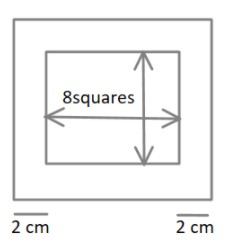
Therefore, the side length of the whole chess board will be equal to the sum of length of small squares on one side and the width of the border on the two sides.
$Total\,length = 8 \times length\,of\,one\,small\,square + 2 \times width\,of\,the\,\,border$
$Total\,length = 8 \times 2.5 + 2 \times 2$
$Total\,length = 20 + 4 = 24cm$
So, the correct answer is “Option B”.
Note:It should be noted that borders will exist on the both sides when the total length of the chess board is to be considered.Each statement given in the question needs to be understood carefully while converting them in mathematical form.
Complete step-by-step answer:
The chess board contains $64$ equal squares. We know that the overall shape of the chess board is also a square.
Therefore, the chess board has $8 \times 8$ small squares.
It is mentioned in the question that the area of each small square is $6.25c{m^2}$.
We know that the area of a square is equal to the square of its side length
${\left( {side} \right)^2} = area$
$side\,length = \sqrt {area} $
$\therefore $ The side length of each of the small squares is equal to the square root of its area
$side = \sqrt {6.25} $
$side = 2.5cm$ $ \to \left( 1 \right)$
Now, it is also given that the chess board has a border in width $2cm$
Therefore, the side length of the whole chess board will be equal to the sum of length of small squares on one side and the width of the border on the two sides.
$Total\,length = 8 \times length\,of\,one\,small\,square + 2 \times width\,of\,the\,\,border$
$Total\,length = 8 \times 2.5 + 2 \times 2$
$Total\,length = 20 + 4 = 24cm$
So, the correct answer is “Option B”.
Note:It should be noted that borders will exist on the both sides when the total length of the chess board is to be considered.Each statement given in the question needs to be understood carefully while converting them in mathematical form.
Recently Updated Pages
Master Class 12 Business Studies: Engaging Questions & Answers for Success

Master Class 12 Biology: Engaging Questions & Answers for Success
Master Class 12 Chemistry: Engaging Questions & Answers for Success
Class 12 Question and Answer - Your Ultimate Solutions Guide
Master Class 11 Social Science: Engaging Questions & Answers for Success
Master Class 11 English: Engaging Questions & Answers for Success
Trending doubts
Explain the Treaty of Vienna of 1815 class 10 social science CBSE
Who Won 36 Oscar Awards? Record Holder Revealed
What is the median of the first 10 natural numbers class 10 maths CBSE
Why is it 530 pm in india when it is 1200 afternoon class 10 social science CBSE
Why is there a time difference of about 5 hours between class 10 social science CBSE
What is the full form of POSCO class 10 social science CBSE