








How does sex determination work in humans? NEET Biology mechanisms explained
Sex determination is a fundamental concept in Biology, helping us understand how living organisms, including humans, inherit and express male or female characteristics. For NEET aspirants, grasping sex determination is essential because it connects genetics, inheritance patterns, and human biology, all of which are core to NEET questions. Mastering this topic forms a strong conceptual foundation and aids problem-solving in genetics-based NEET questions.
What is Sex Determination?
Sex determination refers to the biological system that governs whether an offspring will develop as male or female. It involves genetic mechanisms, especially the inheritance and expression of specific sex chromosomes, and sometimes hormonal or environmental factors in certain species. In humans and most animals, sex determination is mainly chromosomal, based on the presence of X and Y chromosomes. Understanding this concept helps in predicting inheritance patterns and genetic disorders linked to sex chromosomes.
Core Ideas and Fundamentals of Sex Determination
The Role of Chromosomes in Sex Determination
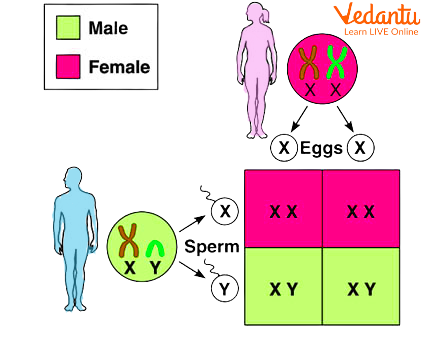
Humans have 23 pairs of chromosomes, of which 22 pairs are autosomes and 1 pair is sex chromosomes. The sex chromosomes determine the biological sex of an individual. Females have two X chromosomes (XX), while males have one X and one Y chromosome (XY). The combination of these chromosomes at fertilization decides the sex of the offspring.
How Sex Chromosomes are Inherited
During gamete formation, eggs from the mother always carry an X chromosome. Sperm from the father can carry either an X or a Y chromosome. The fusion of the egg with a sperm carrying X results in a female child (XX), while fusion with a sperm carrying Y results in a male child (XY).
Types of Sex Determination Systems
- Chromosomal Sex Determination - Found in humans, Drosophila, and most animals. The combination of X and Y (or Z and W in some species) chromosomes decides the sex.
- Genic Sex Determination - Seen in some plants where specific genes, not whole chromosomes, determine sex.
- Environmental Sex Determination - Occurs in some reptiles and fish, where environmental factors like temperature influence sex development.
Important Sub-Concepts Related to Sex Determination
XX-XY Type System (Human Sex Determination)
In humans, the XX-XY system is the primary mechanism. Females have XX chromosomes (homogametic), and males have XY chromosomes (heterogametic). The father determines the sex of the child, since he contributes either an X or Y chromosome during fertilization.
Other Systems: XO, ZW-ZZ, and Haplodiploidy
- XO Type: Found in some insects like grasshoppers. Females are XX, and males are XO (only one X chromosome).
- ZW-ZZ System: Seen in birds and some reptiles. Here, females are ZW and males are ZZ, and the female decides the sex of offspring.
- Haplodiploidy: In some insects like bees, males develop from unfertilized, haploid eggs while females develop from fertilized, diploid eggs.
Sex-Linked Inheritance
Genes located on sex chromosomes are called sex-linked genes. Disorders like hemophilia and color blindness are linked to genes on the X chromosome and are more common in males due to the presence of only one X.
Key Principles and Relationships in Sex Determination
Punnett Square Representation
A Punnett square visually predicts the possible combinations of sex chromosomes and the resulting sex of offspring when an X-carrying or Y-carrying sperm fertilizes an egg.
Comparison of Sex Determination Systems
| System | Organisms | Sex Chromosome Configuration |
|---|---|---|
| XX-XY | Humans, Drosophila | XX (female), XY (male) |
| ZW-ZZ | Birds, Some reptiles | ZW (female), ZZ (male) |
| XO | Grasshoppers | XX (female), XO (male) |
| Haplodiploidy | Bees, Ants | Diploid (female), Haploid (male) |
This table summarizes common sex determination mechanisms. Understanding which organisms use which system is important for NEET questions and for comparative reasoning in genetics problems.
Exam Relevance: Why Sex Determination is Important for NEET
Sex determination is a frequently tested topic in NEET because it integrates concepts from classical genetics, molecular biology, and human physiology. NEET questions may cover inheritance patterns, sex-linked disorders, Punnett squares, or ask to compare different mechanisms. Mastering this topic strengthens your understanding of genetic principles, chromosome behavior, and helps in solving complex genetics MCQs accurately. It also connects with other topics like inheritance of blood groups, pedigree analysis, and genetic disorders.
How to Study Sex Determination Effectively for NEET
- Start with a clear understanding of basic genetic terminology: chromosomes, alleles, autosomes, sex chromosomes.
- Study chromosomal mechanisms in detail, focusing on human sex determination (XX-XY system).
- Use diagrams, like Punnett squares and the provided sex chromosome inheritance chart, to visualize inheritance patterns.
- Compare different sex determination systems in animals for conceptual clarity and exam questions.
- Practice MCQs regularly on topics like sex-linked inheritance, genetic disorders, and pedigree problems.
- Review and summarize key points for quick revision before exams.
- Resolve doubts about exceptions and rare mechanisms by consulting standard NEET textbooks or teachers.
Common Mistakes Students Make in Sex Determination
- Confusing which parent determines the child's sex in humans (it is the father due to X or Y sperm contribution).
- Mixing up different chromosomal systems (example: XX-XY vs. ZW-ZZ).
- Misunderstanding the concept of sex-linked inheritance and its impact on expression of traits like hemophilia.
- Incorrectly interpreting Punnett squares and resulting probabilities.
- Overlooking exceptions or special cases in other organisms.
Quick Revision Points for Sex Determination (NEET)
- Human females: XX, males: XY; father determines sex of child.
- Egg always provides X chromosome; sperm provides X or Y.
- Differentiation between XX-XY, XO, and ZW-ZZ systems is exam-important.
- Sex-linked traits show unique inheritance patterns; more common in males if X-linked.
- Environmental sex determination exists but is rare in humans.
- Use Punnett squares for quick inheritance probability checks in problems.
- Revise diagrams for clarity – visual learning helps in genetics MCQs.
FAQs on Biology Sex Determination for NEET: Complete Guide
1. What is sex determination in biology?
Sex determination in biology refers to the process by which an organism develops as either male or female based on genetic, chromosomal, or environmental factors.
Key points include:
- In NEET syllabus, focus is on chromosomal and genetic sex determination.
- Humans use the XX-XY system for sex determination.
- Other systems include ZW-ZZ, XO, and environmental mechanisms.
2. How is sex determined in humans according to NEET syllabus?
In humans, sex determination follows the XX-XY chromosomal mechanism.
Steps to remember:
- Females have XX sex chromosomes, and males have XY.
- The sperm, carrying either X or Y chromosome, determines the offspring's sex.
- X + X = female child, X + Y = male child.
3. What are the different types of sex determination mechanisms in animals?
Sex determination mechanisms in animals can be genetic or environmental.
The main types are:
- XX-XY system (e.g., humans, most mammals)
- ZW-ZZ system (e.g., birds, some fishes)
- XO system (e.g., grasshoppers)
- Haplo-diploid system (e.g., honeybees)
- Environmental systems (e.g., temperature-dependent in some reptiles)
4. Explain the XX-XY type of sex determination with an example.
The XX-XY type of sex determination is where females have two X chromosomes (XX) and males have one X and one Y chromosome (XY).
Example:
- In humans (and most mammals), this system determines biological sex.
- The father's sperm carries either X or Y, deciding the child's gender.
- This mechanism is directly featured in NEET biology questions.
5. What do you mean by genetic sex determination?
Genetic sex determination is a system where chromosomes and genes control the development of male or female characteristics.
Key features:
- Sex is determined at fertilization by specific combinations of sex chromosomes (e.g., XX, XY, ZZ, ZW).
- Seen in humans, birds, and some insects.
- Understanding this system is crucial for NEET biology exams.
6. How does sex determination occur in honey bees?
In honey bees, haplo-diploid sex determination system is used.
Important points for NEET:
- Unfertilized eggs develop into haploid males (drones).
- Fertilized eggs develop into diploid females (workers or queens).
- This unique method is often tested in NEET questions.
7. What is the chromosomal theory of sex determination?
The chromosomal theory of sex determination explains how the presence or absence of certain chromosomes decides the sex of an individual.
Highlights:
- Introduced by scientists like McClung and Stevens.
- Involves sex chromosomes (Allosomes: X, Y) and autosomes.
- This concept is included in the NEET biology syllabus.
8. What is environmental sex determination? Give an example.
Environmental sex determination means an organism's sex is influenced by environmental factors.
Key example for NEET:
- Temperature affects the sex of many reptiles (e.g., in some turtles, warmer incubation produces females, cooler produces males).
- There are no sex chromosomes involved in these species.
9. How is sex determined in birds?
Birds use the ZW-ZZ sex determination system.
Details to remember:
- Females are ZW (heterogametic), males are ZZ (homogametic).
- The female egg determines the sex of the offspring.
- This system is an important NEET biology topic.
10. Can environmental factors influence sex determination?
Yes, environmental factors such as temperature can determine sex in certain organisms.
For NEET-based examples:
- Some reptiles exhibit temperature-dependent sex determination.
- Environmental sex determination occurs in some fish and invertebrates as well.
